 The Magazine of The Sierra Club
Here's Why It Feels Like Grizzlies Are Suddenly Everywhere
How social media creates a distorted sense of reality for grizzly bear recovery
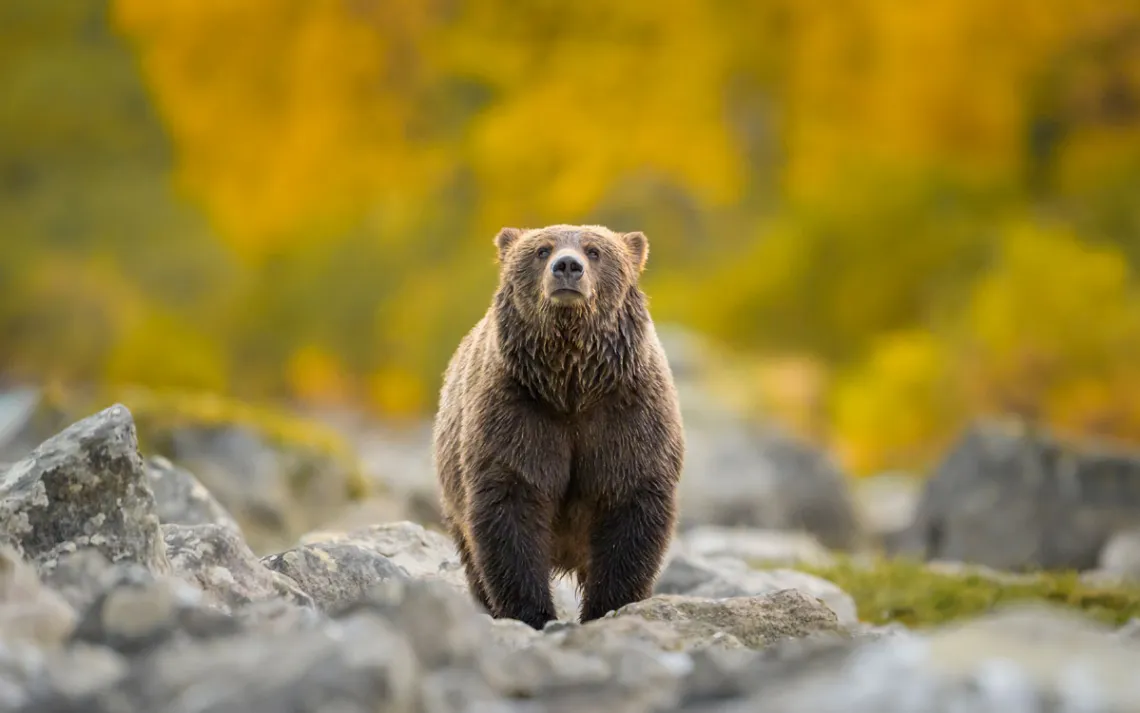
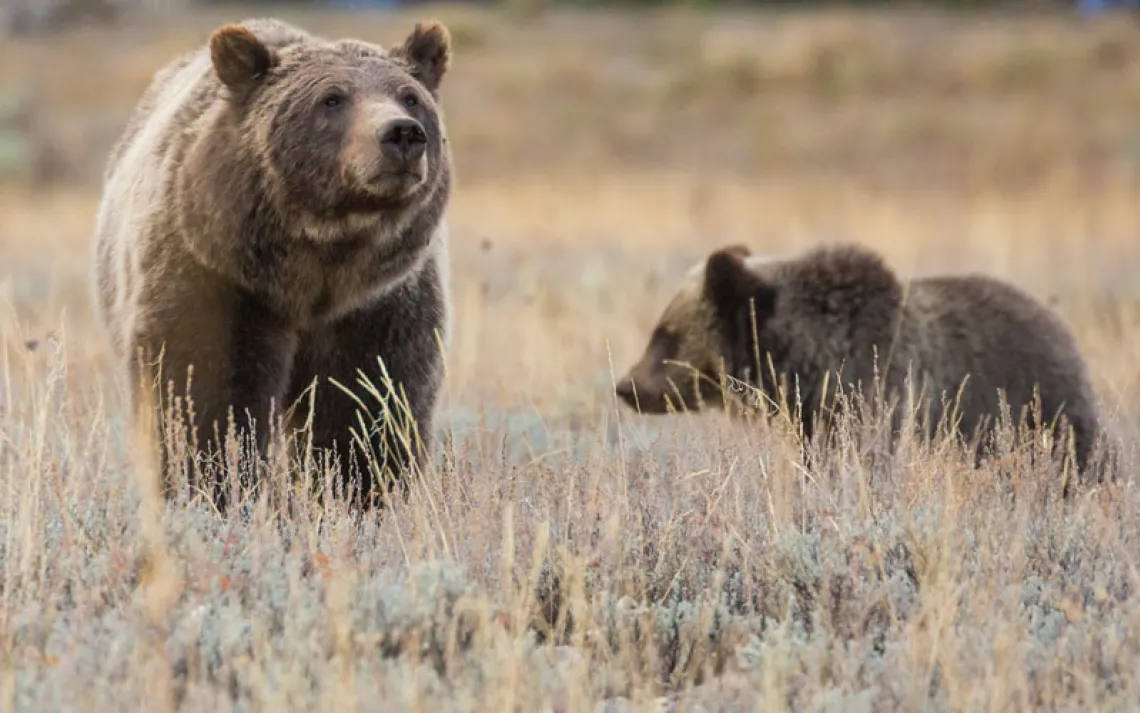
A majestic brown bear (Ursus arctos). | Photo courtesy of jared lloyd/Getty Images
Jessie Oakes was completing her usual morning routine when she noticed a juvenile grizzly bear approaching her. She was walking down the driveway of the main Mount Engadine Lodge with her dog and cup of coffee in hand. In a dizzying viral social media video from this June, Oakes is seen yelling at the bear, “Go away!”
The bear chases Oakes and her dog in circles. When the bear refused to let up, Oakes eventually threw her empty coffee cup to distract it. That gave her enough time to run into a tent with several other people, who screamed, scaring the bear away.
“I was in shock,” said Oakes, who works as a lodge hand in the remote Spray Valley Provincial Park in Alberta, Canada. “At the same time, I'm curious: Where is this behavior coming from? It just kept circling.”
Oakes is used to bears, but even she has noticed something different in recent months. Bear and human conflicts seem to be on the rise. More recently, a video of a man and his off-leash dog trying to keep a bear at bay also made the rounds on social media. These were just two of the several grizzly-human encounters across Canada this summer. And in the US, a man was killed by a grizzly back in May, the first fatal interaction in Glacier National Park since 1998.
The seemingly growing number of bears has incited fear among many in bear country and trepidation among conservationists, who worry this recovery success may be threatened. But some say that the rise in encounters is not necessarily because bears pose more of a threat than before. Rather, in recent years, bear encounters are increasingly being captured on phones and shared. This trend may be leading people to think encounters are happening far more often than they actually are.
“A key context variable for this comparison is reporting bias: Modern smartphone technology, door cameras, and social media have vastly increased public visibility and reporting of encounters in recent years compared to the 1900–2022 period," said independent scientist Lana Ciarniello in an email.
“I never thought it would end up on social media,” Oakes said. “The next morning, [one] guest was like, ‘You're famous.’ I'm like, ‘What do you mean famous?’ Nothing happened. There's no blood, no injury. I walked away fine.” The guest told Oakes to look at TikTok, where the video was posted. It had accumulated nearly 1.1 million likes.
Populations of bears across North America
Despite the potential over-reporting on social media, the reasons for the sightings are numerous, but researchers say the primary reason for the growing frequency likely stems from population growth. Hunters and trappers nearly wiped out grizzlies with extensive hunting and poisoning campaigns in the 19th and early 20th centuries, in some cases at the behest of the federal government. However, in the last 50 years, the grizzly (Ursus arctos) population has grown from around several hundred to over 2,000.
“Both bears and people are using more of the same landscape, said Jared Beaver, an assistant professor and the extension wildlife specialist at Montana State University in Bozeman. “There's simply more opportunity for those encounters.”
Over a century ago, grizzly bears roamed across large swaths of the US, Canada, and Mexico. But they were concentrated in the Rocky Mountains, along the Upper Missouri River, and in California. As European settlers arrived, they intentionally killed grizzlies under the assumption that they posed a threat to livestock.
“It was just our war against predators,” Bruce McLellan, a retired research ecologist with the British Columbia Forest Service, “Humans were hard on bears for a long time and wiped them out wherever they overlapped.”
The federal government banned grizzly hunting in the contiguous US in 1975, when it listed the bears as threatened under the Endangered Species Act. A recovery plan targeted six ecosystems within four states—Idaho, Montana, Wyoming, and Washington. The team tasked with executing that plan hoped to reduce harmful bear and human interactions and increase habitat. Every five years, researchers reassess available habitat to ensure it’s supporting bear recovery goals, which varies depending on the region. Eventually, with enough good quality habitat, researchers hope that bears would be able to naturally rebound. However, that recovery comes at a cost, as people encroach into former bear habitat. And as grizzly bear numbers slowly improve, it means humans are more likely to run into them.
“We know that the bear numbers are at numbers that they haven't been in a long time,” Beaver said. “So I think the overlap is causing a part of that.”
More bears, more people
Despite increasing population levels, grizzly bears are still missing from over 90 percent of their original home range in North America and never recovered in Mexico. Part of this is driven by human development, logging, mining, and road construction, which swallow up bear habitat. This then pushes them into smaller areas that may not offer sufficient space or food, forcing them to move into more populated areas. At the same time, people are also venturing deeper into wilderness, including national parks, which hosted 323 million visitors in 2025, more than ever.
Still, despite the increasing overlap, bear attacks are still very rare. More people have been struck by lightning in the last year than were fatally killed by a grizzly in the last quarter century. Between 2006 and 2025, there were 517 lightning-related deaths, while there have only been 82 fatal grizzly bear attacks since 1974 in the US.
When you're hiking in bear country, researchers recommend that you make noise, hike in a group of at least three or more people, avoid surprising a bear, and always carry bear spray.
“We're talking on the chest, on the hip, immediately accessible,” Beaver said. “Being familiar with how to use it. Walking through the steps of how can I pull it? How can I get the tab off? How quick can I do it?” Bear spray works 90 percent of the time to discourage all three bear species, according to researchers at Brigham Young University, who looked at the efficacy of bear spray in Alaska.
For people hiking with dogs, a recent study by the Journal of Wildlife Management found that having your canine companion off-leash can actually pose more of a risk. Researchers analyzed 326 human-bear conflicts and found that dogs initiated the incident more than 54 percent of the time, with 170 people being injured, including five fatalities. Encounters involving unleashed dogs outnumbered those involving leashed dogs nearly six to one. Having more people in your party and carrying a deterrent did lower the odds of conflict.
The presence of food can also increase the likelihood of a bear encounter, especially if it’s during a time when natural food is scarce, say experts. “Some years you'll have piles; next year, you won't have any. When natural foods are low, bears are way more prone to go into … human areas,” McLellan said. Researchers recommend storing trash or food in bear-resistant containers. Dumpster lids should be made of metal or reinforced with metal, not just plastic.
Even though there appears to be more overlap among bears and humans, Beaver said it’s important to remember that this is likely because social media is so prevalent, leading to more documentation. More encounters do not mean that bears are becoming more aggressive. He says that moving forward, it’s important that we learn to coexist with bears.
“Bear recovery is a success story,” Beaver said. “As bears occupy more landscapes, the challenge shifts from recovering populations to determine how can we sustain this effort and continue to keep bears and people safe.”