This Monument Is the Latest Casualty in Trump’s War on Public Lands
Northeast Canyons and Seamounts Marine National Monument could be opened up to commercial fishing
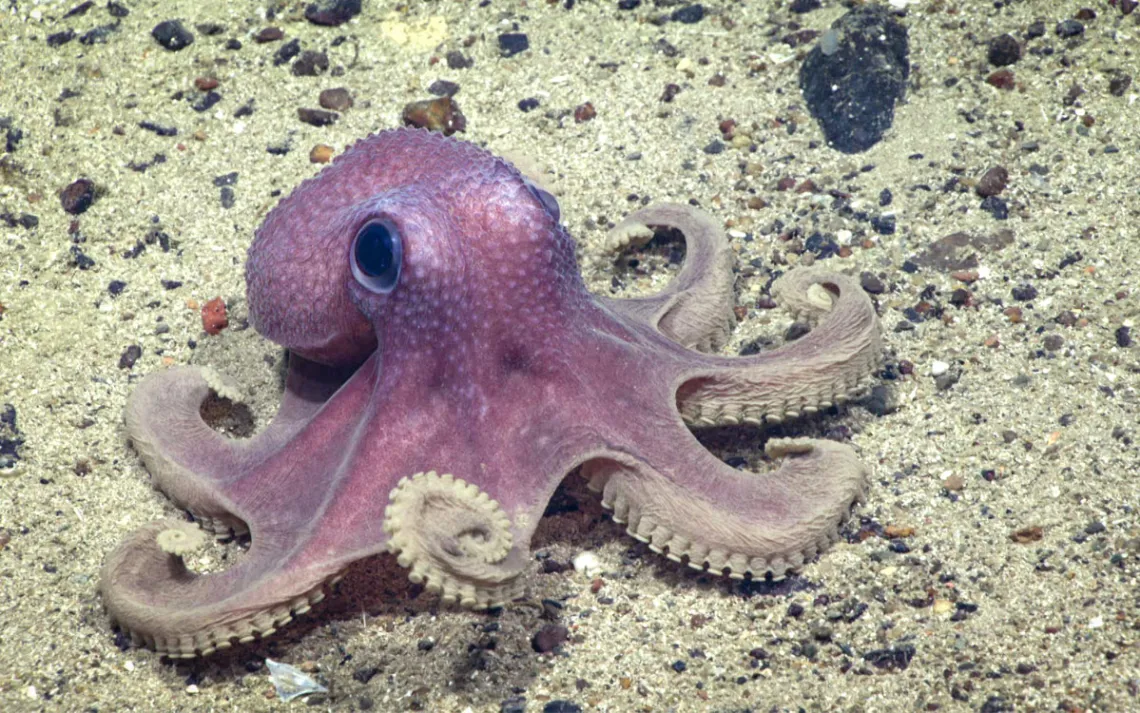
An octopus in the Northeast Canyons and Seamounts Marine National Monument. | Photo courtesy of NOAA Office of Ocean Exploration and Research
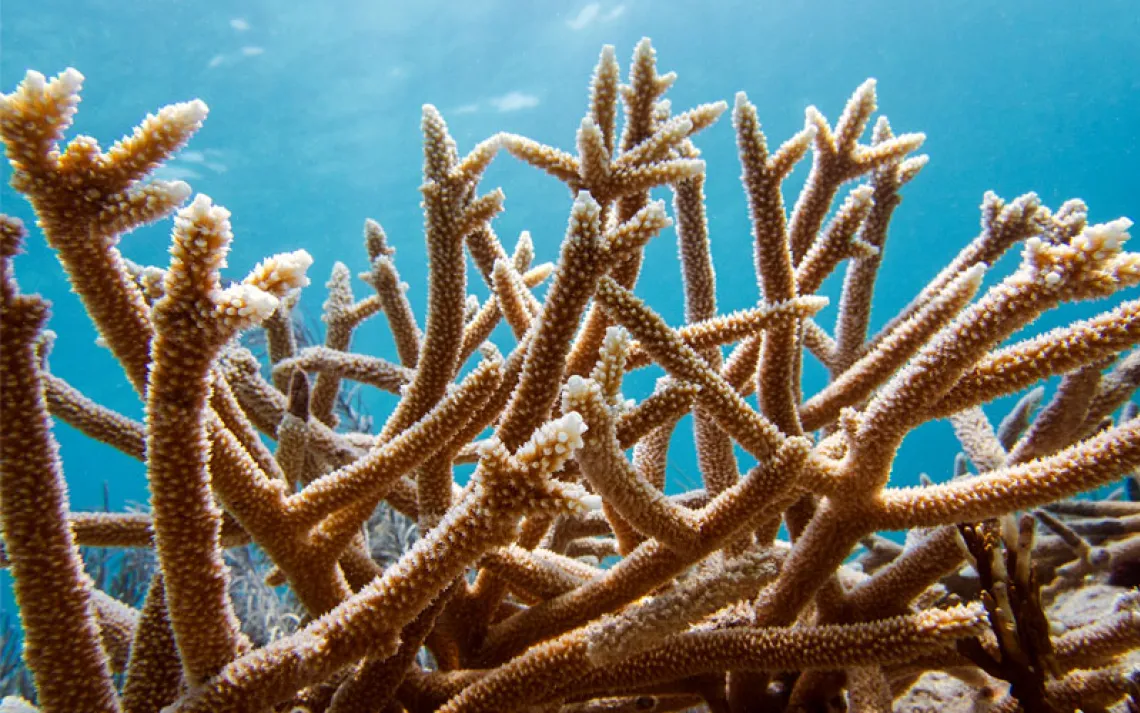
Corals have been growing 140 miles off the coast of Cape Cod since the Roman Empire. They emerge from 300-meter depths in fans and florets, in purples and pinks, and reach the height of small trees. It’s the underwater forests of Dr. Suess’s dreams.
These are the corals of the Northeast Canyons and Seamounts Marine National Monument, a highly protected area in the Atlantic Ocean, the size of Connecticut. The area consists of four underwater seamounts—ancient underwater volcanoes—and three submarine canyons, some of which rival the Grand Canyon in terms of depth. Here, sea life flourishes—an ecosystem intact and in service of many different species of dolphins, whales, turtles, and fish.
Peter Auster, a research professor emeritus at the University of Connecticut in the Department of Marine Sciences, has been visiting this spot since the 1970s and described reaching the monument by boat as if traveling through a portal. “The color of the water changes and the smell of the air changes,” Auster said. “You have this sense that you've entered this different environment—this different world.”
As exceptional as the area is ecologically, this site has served as an unlikely political football in recent years. Originally protected by President Obama in 2016, the expanse’s protections were rolled back during the first Trump administration toward the end of 2020, only to be restored shortly thereafter by the Biden administration in 2021. Last month, President Trump revoked a ban on commercial fishing in the monument once again.
According to many legal experts, including those at Earthjustice, undoing national monument protections is likely illegal. “The Antiquities Act of 1906 authorizes presidents to designate national monuments, but not the power to undo the protections granted by their predecessors,” stated an article by Earthjustice in March of last year. “The Antiquities Act is to be used to protect the nation’s archaeological, cultural, and scientific wonders. Not to destroy them.”
The most recent rollback comes close to a year after President Trump issued an executive order called “Restoring American Seafood Competitiveness,” aimed at removing regulations. In the executive order, the White House directed the Interior Secretary to review existing national marine monuments with the intent of opening them up to commercial fishing. So far, this administration has allowed commercial fishing in two marine national monuments: Canyons and Seamounts and the Pacific Islands Heritage National Marine Monument, approximately 1,500 miles southwest of the Hawaiian Islands.
But a big question mark hangs over whether or not opening marine monuments to commercial fishing maximizes profits for the industry. In a paper published in 2022, researchers found that less than 1 percent of fishing grounds were lost due to the Northeast Canyons and Seamounts Marine National Monument’s creation. They also concluded that catch in the fisheries studied did not decline: Pounds did not decrease, and boats were not forced to travel farther because of the monument.
What was notable, however, was the absence of positive impacts on the commercial fisheries studied after the reopening of the monument. After reopening, 99 percent of fishing activity was still taking place outside the protected area. In other words, the 2020 decision to remove the commercial fishing ban inside the monument does not seem to be substantiated by any actual economic data.
Though American commercial fisheries seem to suffer minimal harm when the monument is closed to activity, quite the opposite is true of the damage the monument could face if opened for fishing once again. The precipitous topography of the canyons, steep cuts into the edge of the continental shelf, and seamounts produce dynamic currents that generate an abundant oasis beneath the ocean’s surface for local species and those traveling through on their migratory journeys.
Swirling columns of plankton are the cornerstone of life, sustaining creatures we know well, including mako sharks and yellowfin tuna, and creatures we know not-so-well, such as the rare Cuvier’s and Sowerby’s beaked whales. This ecosystem is as diverse as it is fragile—pull one thread and the whole thing unravels. The monument is also a critical site for carbon storage, and it serves as a reference site for scientists like Auster, who can compare it to nonprotected areas when conducting studies.
“Playing ecological ping-pong with this place certainly does not do us any good in terms of the scientific community, in terms of environmental managers, in terms of our nation, in terms of understanding how these places work,” Auster reflected.
But experts agree that this doesn’t have to be a binary choice between the commercial fishing industry and the natural world (nor do any stakeholders, like fishers and conservationists, want it to be). “You can do both,” said Miriam Goldstein, executive director of the National Ocean Protection Coalition. “You can protect special areas that are not compatible with fixed-gear fisheries because there are 4,000-year-old corals that could break, and you can also sustainably manage fisheries, which we have done and do very well in this country.”
Goldstein draws a comparison to how our forest resources on land are managed. “We log some areas, and we protect old-growth forests in other areas,” Goldstein explained. “It doesn't have to be different.” Auster put it similarly. “It's not that we shouldn't fish anywhere. It's just that we shouldn't fish everywhere.”
How we treat our fisheries has not just local but also global implications. The UN Convention on Biological Diversity set a 2030 goal to protect 30 percent of the world’s oceans, which technically applies to all 196 countries that signed the treaty. This was, in part, symbolically created in acknowledgment of the idea that we are all threads in a delicate ecosystem, where none can be pulled without affecting the whole.
When it comes to migratory fish species, how one country handles its fisheries has a direct effect on the quality and costs of the fish that end up on another country’s plates. “All of these commercial species are subject to good, strong shared agreements and shared enforcement and shared monitoring across their ranges,” explained Lance Morgan, president of Marine Conservation Institute. “When we abdicate [that role], that gives everybody else the chance to play around with their rules and regulations, or at least lose their enthusiasm for wanting to cooperate and do things well.” Conservation can be, and is, an economic strategy in and of itself. “Nature is what our economies, our livelihoods, our well-being, depend on,” mused Morgan.
In August of 2025, a federal judge blocked the Trump administration from opening the door to the fishing council to change fishing regulations in the Pacific Islands Heritage Marine National Monument. And there is a chance that a similar lawsuit could slow down the rollbacks to the Atlantic’s only marine monument. In the meantime, new fishing regulations will have to be created under the Magnuson-Stevens Act, the primary law used to govern fisheries in federal waters, which could take months without any delay.
Of all the calculable casualties of the game of ping-pong, Auster described—the habitat loss, the crushing of corals one thousand years old, the beaked whales that humans hardly see anymore—perhaps the most important thing we stand to lose is the nonquantifiable resource of wonder. Just the knowledge that our oceans are exquisite holds value in and of itself.
“I think there is an enormous value to people in knowing how beautiful and strange our planet is, and that there are these places that are not destroyed,” reflected Goldstein. “We have the opportunity now, in this moment, to protect and save [these places] for future generations.... We are passing this gift down so that they will know that these things exist, that they're not a sad story of the past, but that they are there, thriving quietly in the dark.”