 The Magazine of The Sierra Club
When Tiger Sharks Show Up to Hunt Seabirds, Other Sharks Steer Clear
Smaller Galapágos and gray reef sharks change their behavior, likely to reduce competition or out of fear

A tiger shark surges out of the water to bite a fledgling black-footed albatross. | Photo by Joe Spring/NOAA
As the sun rises in the morning and the winds pick up, fledgling albatrosses line the sandy island’s edge, facing the Pacific Ocean, and flap their wings. Some will get just a couple feet of air. Others will fly far, disappearing into the distance and soaring over the open ocean for years before returning to this island to eventually nest. But others will fly only 15 to 20 feet, lose their lift, and plop into the nearby surf—where tiger sharks wait.
The tiger sharks come to East Island, in Papahānaumokuākea Marine National Monument, the largest protected area in the United States, every summer to hunt the birds. The predators arrive with the morning light and calmly cruise the shallows until a feathery youngster with a six-foot wingspan splashes into the drink. Then the subtly striped sharks, which can grow to 18 feet long, take off and breach the surf to snatch the birds.
I watched this spectacle most mornings while camping alone and working as a wildlife biologist studying Hawaiian green sea turtles on East Island. I only ever saw tiger sharks in the shallows—never any other shark species. That was weird, because over the rest of the atoll, plenty of other sharks swam around. Eight-to-10-foot Galápagos sharks regularly cruised the surf off nearby Trig Island, for example. And six-foot gray reef sharks glided by in other places.
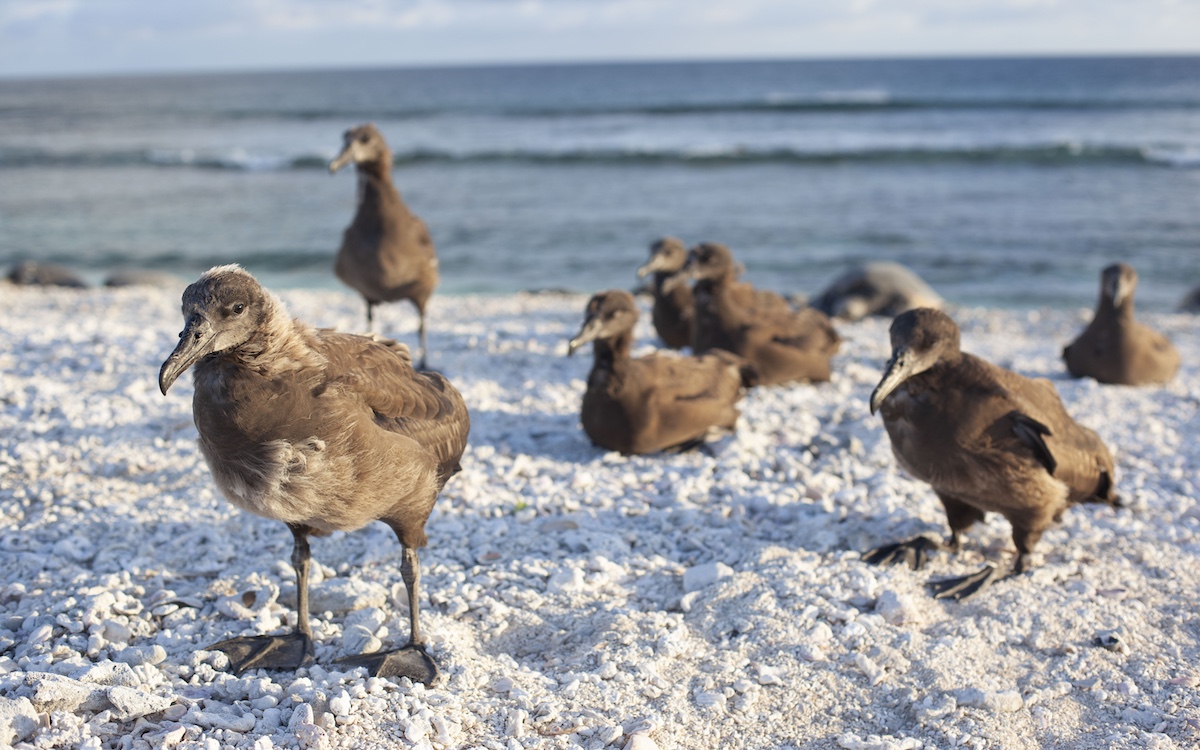
Young black-footed albatrosses face into the wind on East Island. | Photo by Joe Spring/NOAA
Now, an in-depth study analyzing the movements of dozens of tagged sharks shows a remarkable thing. When tiger sharks showed up off this island to hunt Laysan and black-footed albatrosses, the gray reef sharks stayed away and the Galápagos sharks focused on different prey in another area. But when the seabirds were gone and the tiger sharks dispersed to other habitats, the smaller sharks moved back to the shallows around East Island. The findings illustrate that tiger sharks, or niuhi in Hawaiian, are likely a keystone species that impacts the distribution of other sharks around them.
“Once the tiger sharks have selected birds as their prey, everything ripples out from that, right?” says study coauthor Carl Meyer, a researcher at the Hawaii Institute of Marine Biology. “So the tiger sharks are determining what everybody else does because they're the biggest. They are definitely stronger competitors and potential predators of the other two species that we looked at.”
Where those marine predators hunt may change as rising seas and powerful storms drown and wipe out islands where important prey, like seabirds, live. And that, in turn, could impact other species.
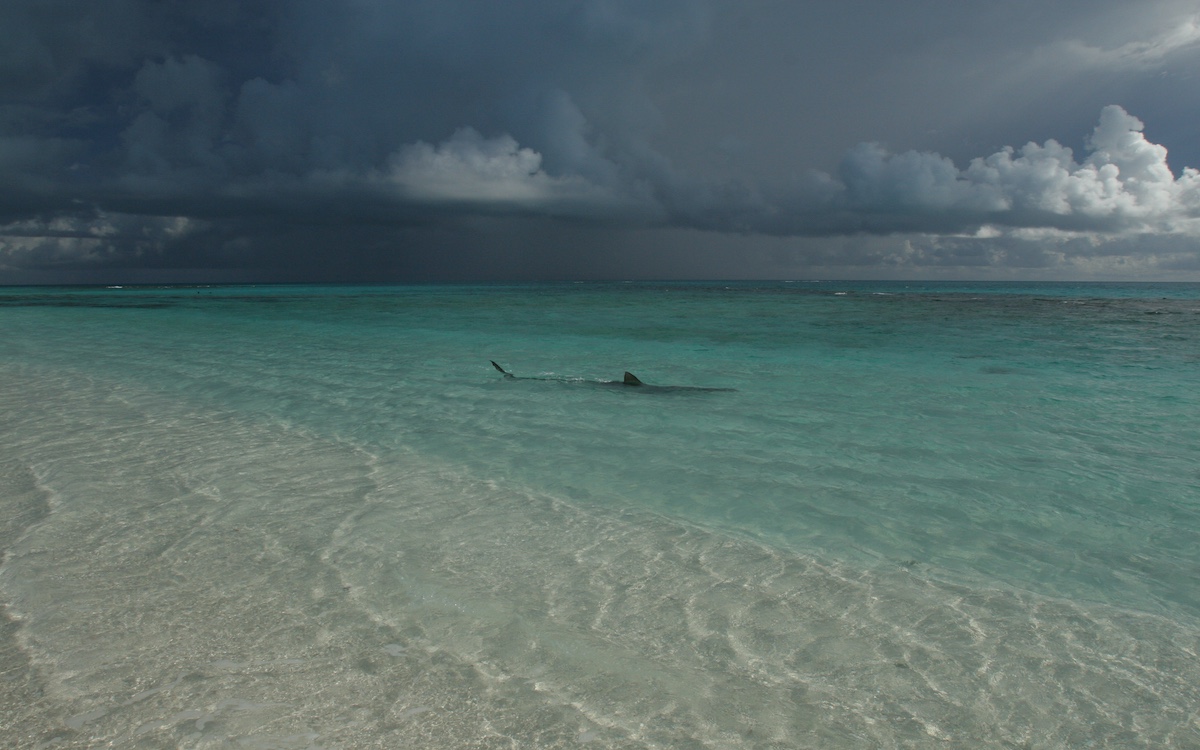
A tiger shark patrols the shallows off East Island. | Photo by Joe Spring/NOAA
Scientists tagged the sharks for this study more than a decade ago. A team of Meyer’s graduate students went to the coral atoll of French Frigate Shoals, or Lalo in Hawaiian, and caught and tagged 159 sharks of three species between 2008 and 2010. Acoustic transmitters with unique signals were surgically implanted under the skin and muscle layer of the sharks. Fourteen different stations set up around the atoll detected the tags when the sharks passed nearby. But analysis of those pings for this study didn’t happen for years.
During the pandemic, Hawaii Institute of Marine Biology graduate student Chloé Blandino's master’s project collapsed because she couldn’t go out in boats to research sharks. She was halfway through her course of study and needed something new. She started digging through archival data and found some interesting patterns visually from those tagged sharks at Lalo. Blandino saw a huge pulse of tiger sharks visiting East Island, and then started looking at prey distribution and identified the seabirds nesting there. After she found that out and told Meyer, he sent Blandino an email with photos of the tiger sharks attacking albatrosses. “I was like, ‘Holy shit,’” says Blandino, the study’s lead author. “They’re going after these birds. It's super cool.”
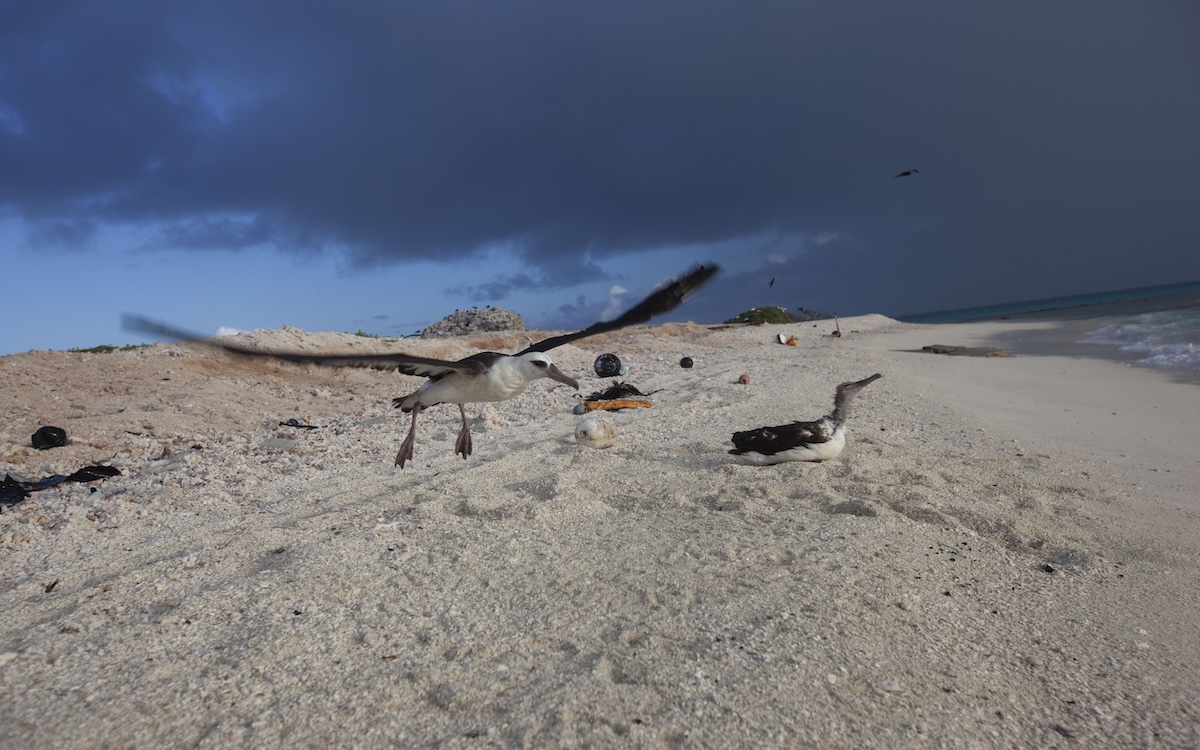
A young Laysan albatross gets a few feet of air. | Photo by Joe Spring/NOAA
One of the reasons for the massive shark-tagging effort more than a decade ago was that researchers thought Galápagos sharks, maybe even just a small subset of them, were preying on Hawaiian monk seal pups around nearby Trig Island. Only 1,600 of those endangered marine mammals live in the wild, and scientists wanted to know exactly who was eating the youngsters.
Blandino and Meyer were sitting on a treasure trove of data on those Galápagos, tiger, and gray reef sharks—the three most populous shark species on the atoll. They had questions about the relationships between the sharks. Where did they go? When did they go there? And what prey was available to them at those times? They knew that all three species ate fish. They knew that tiger and Galápagos sharks were more marked competitors—that both species ate marine mammals and birds, for example. And they knew that tiger sharks were predators of gray reef sharks.
Based on what they knew, they expected tiger sharks to use habitats near key prey like those fledgling birds and then disperse when that prey was gone. Since tiger sharks eat gray reef sharks, they expected the smaller species to avoid prime tiger shark habitats. And they expected tiger and Galápagos sharks to reduce competition between each other in different ways.
The team looked at 128 sharks monitored at 14 receiver stations from 2009 to 2011. They used an advanced statistical analysis to find out what areas sharks frequented at different times of day and year and looked at prey distribution in those places.
“All of my hypotheses aligned with my results,” says Blandino. “I just didn't anticipate them being so clean and so cool.”
When tiger sharks hunted for albatrosses in the summer at East Island, the gray reef sharks stayed away. During that time, Galápagos sharks were often found around Trig Island, where they cruised the shallows, likely waiting for unsuspecting young monk seals to enter the surf.
“So between gray reef sharks and tiger sharks, there's this fear dynamic,” says Blandino, “and then between larger Galápagos sharks and tiger sharks there is a competition dynamic.”
Gray reef sharks overlapped in areas with Galápagos sharks, likely because the two species often targeted different food sources, including different species of fish, and because small and medium Galápagos sharks probably wouldn’t eat the gray reefs. When tiger sharks dispersed from East Island after the summer, the other shark species returned to the area.
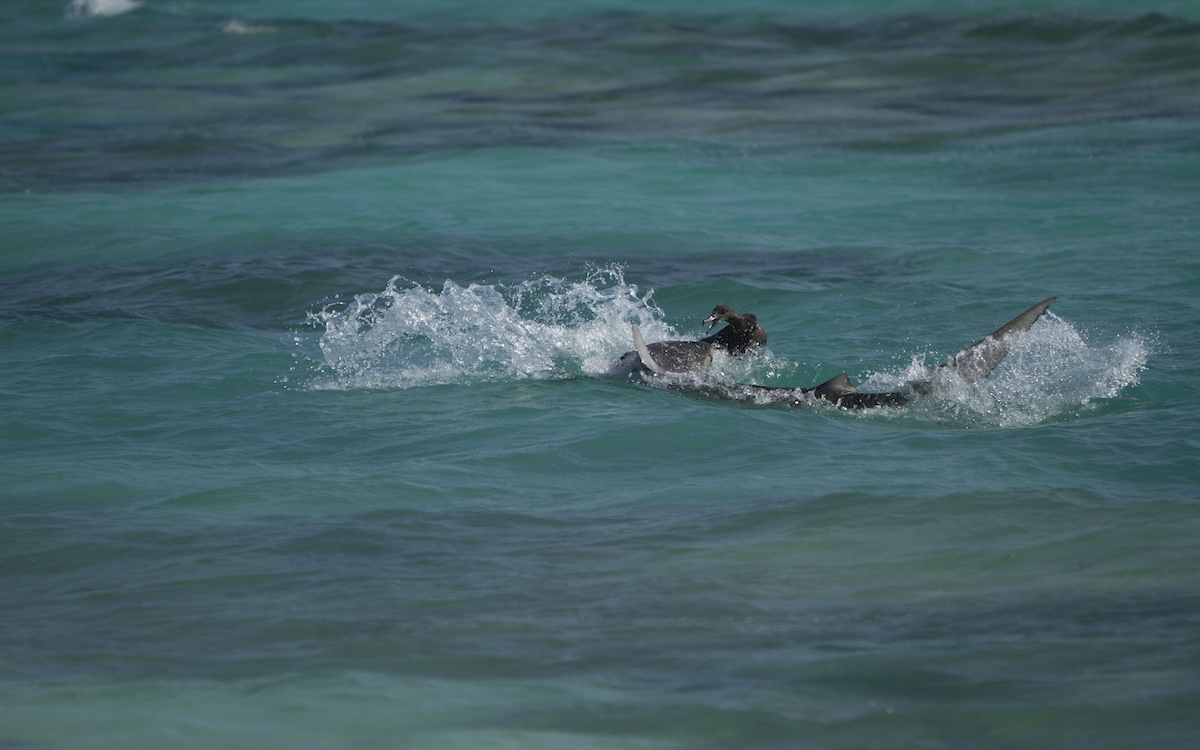
A black-footed albatross faces an attacking tiger shark. | Photo by Joe Spring/NOAA
Neil Hammerschlag, the executive director and chief scientist of the Shark Research Foundation, was a bit surprised that the other sharks scattered in the summer, because the smaller sharks are faster than the tiger sharks. “I mean the fledgling albatross—it seems like it’s such an easy target that the other species would be there to just sneak in and get some of the birds,” he says.
But he has studied great white sharks off South Africa, and notes that when they leave an area, sevengill sharks and bronze whaler sharks move in. “We’ve seen it because they are no longer constrained by the presence of larger great whites,” he says, “which were not only a competitor but also a predator of them.”
One of the notable results of the study for Blandino was that it showed how species that live partially on land, like Laysan and black-footed albatrosses, can dramatically impact what happens in the ocean. “This little, tiny atoll in the middle of nowhere Illustrates a really important example of how connected land and sea systems really are,” she says. “Because of the seasonal source on land having the ability to completely reshape this entire marine ecosystem.”
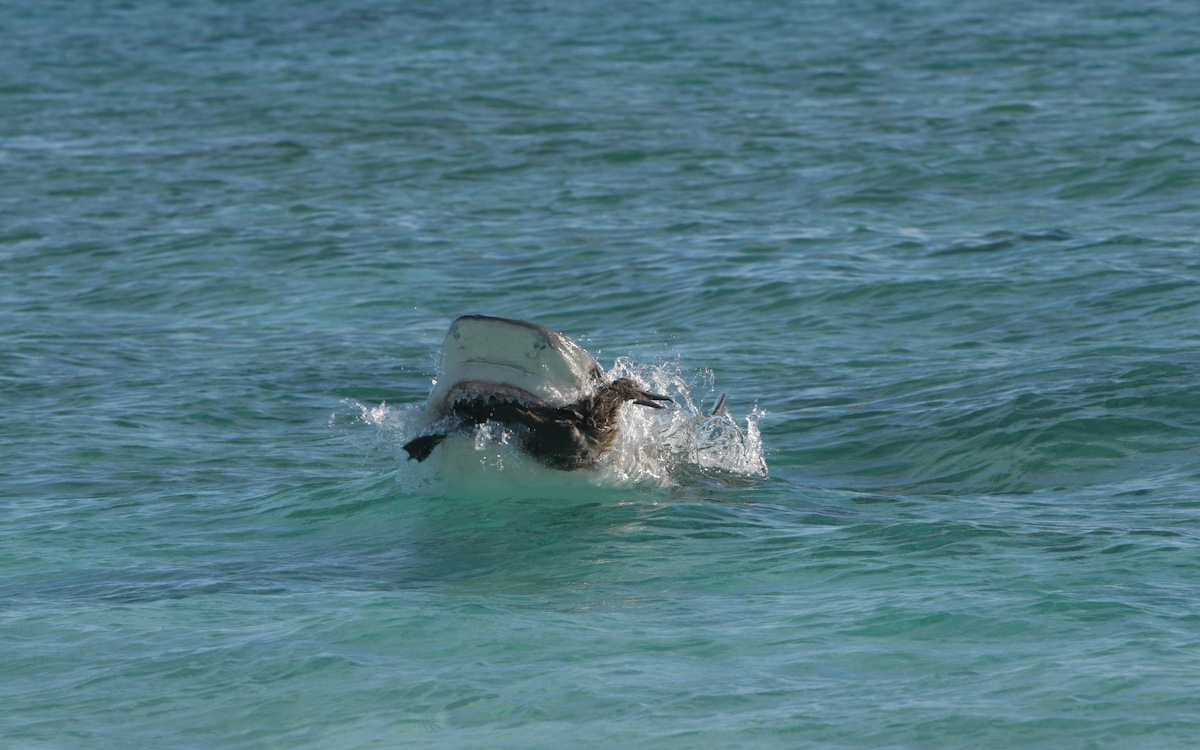
A tiger shark snatches its prey off the surface of the ocean. | Photo by Joe Spring/NOAA
While the results of Blandino’s study were clean, the habitat the animals live in is sometimes messy—so where and when sharks frequent areas likely shifts. In 2018, Trig Island, where the Galápagos sharks cruised the shallows for monk seal pups in the summer, went under water. Later that same year, East Island, where the tiger sharks hunted the albatrosses, was temporarily wiped out by a powerful hurricane. Both of those changes occurred after the data for this shark study was collected—leaving scientists guessing about how the sharks responded to such losses.
The drowning of Trig Island might mean the Hawaiian monk seals moved to other sandy islets around the atoll to give birth. And seabirds from East Island might have moved too. Blandino and Meyer think the changes would impact sharks. “It would be super interesting to basically recollect a lot of the shark data that we collected in 2009,” says Blandino, “to see if their habitat use patterns have shifted because of their prey sources having shifted theirs.”
Hammerschlag says that with such habitat changes, the sharks may have to find new prey. He thinks that large sharks are keystone species whose impacts were hard to show in the past, but that is changing. A key 2024 Science study noted that sharks affect ecosystems in diverse ways. Tiger sharks, for example, change the foraging of sea turtles and dugongs in seagrass beds, which allows for more dense underwater gardens, which can influence carbon sequestration.
“Now we’re seeing more and more evidence that is demonstrating the important roles they play,” Hammerschlag says of the large marine predators. “And what it points to is—what the implications are—is the loss of the sharks will have negative consequences.”