The Magazine of The Sierra Club
The Lithium Mine Next Door
One of the largest deposits of lithium is in an open-pit mine outside Charlotte, North Carolina
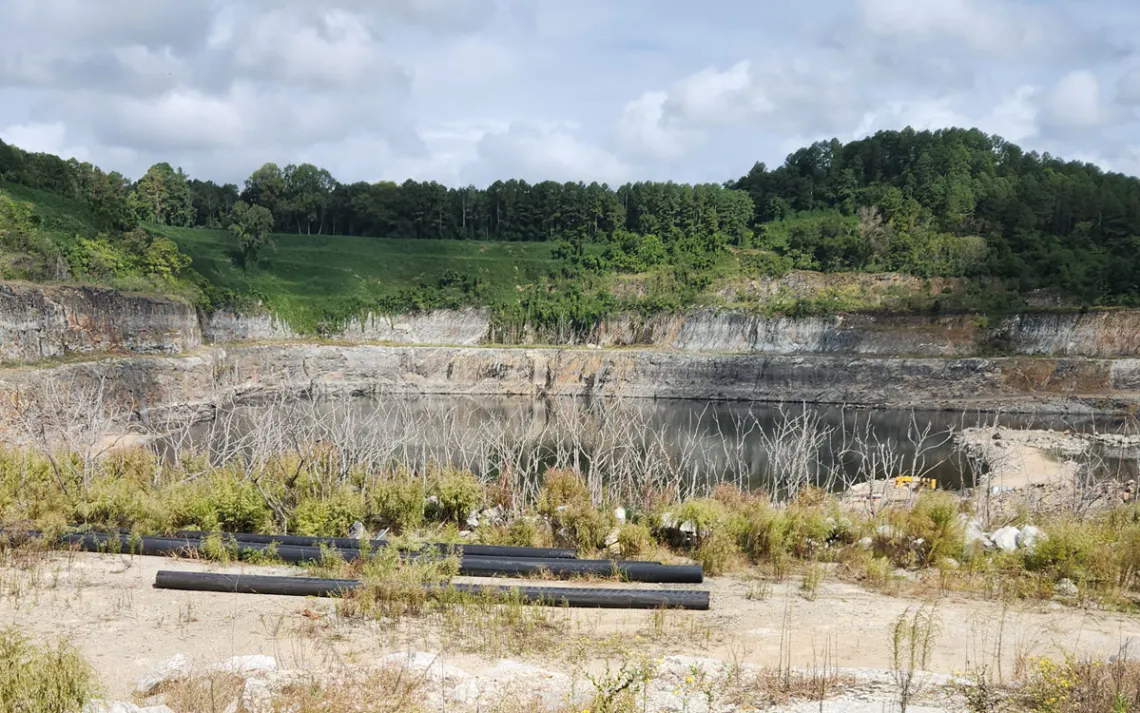
The Kings Mountain Lithium Mine. | Photo by Carrie Dow
The pavilion overlooking the small canyon before me made me think of a less imposing version of Black Canyon in Colorado’s Gunnison National Park. But I wasn’t in a national park, and I wasn’t in the West.
I was touring the Kings Mountain Lithium Mine located about 30 minutes from my home in Charlotte, North Carolina. The company that runs the mine, the Albemarle Corporation—the world’s largest lithium producer—offered tours as a part of a campaign to woo residents leery of having an open-pit mine in their backyard.
This site is crucial to America’s transition to renewable energy. A 2017 report issued by the US Geological Survey determined that lithium was an important element for the US to develop, and Kings Mountain holds most of North America’s supply. Not only is the amount of lithium significant (over 90 million metric tons)—it’s at the surface, making this area a vast source of low-hanging fruit for mining operations.
“It’s important that America rebuilds its domestic supply chain to support the clean energy economy,” said Stan Cross, electric transportation director of the Southern Alliance for Clean Energy. “That includes mining and mineral processing, because if we do it here, our environmental regulations and our workforce safety protocols will guide the efforts, and having a domestic supply will strengthen our ability to develop clean energy technologies and transition our country away from dirty fossil fuels.”
Mining began in this part of south-central North Carolina when gold was discovered in the mid-1800s, and then tin and aluminum at the turn of the 20th century. Lithium mining began in 1936 and spiked during World War II, when it was used in the Manhattan Project, and again in the decades immediately after during the Cold War.
However, mining hard rock was much more difficult and expensive than the liquid brine mining that occurred elsewhere in the world at the time. So, when demand for lithium dropped in the US in the early 1990s, mining ceased, and the pit went dormant for 30 years. During that time, a new battery type was developed that revolutionized electric technology—lithium-based rechargeable batteries.
Today, lithium-ion batteries are in everything from laptop computers to heart pacemakers. Lithium is also used to make ceramics and lubricants. And it’s even found in the safety glass of car windows and cellphone screens.
The mine is in an area called the Kings Mountain Shear Zone, created by a transform slip fault, like California’s San Andreas Fault. Millions of years ago, a violent slip caused one side to drastically drop, forming cracks down to the magma chamber deep inside the earth. As hot magma flowed up the cracks, a variety of elements, including lithium, were released, and as they rose and cooled, mineral groups formed. One was a lithium-rich mineral called spodumene (spa-joo-meen).
Back on the tour while riding from Albemarle’s offices to the site in an electric minibus, our guide and Albemarle’s community engagement manager, Cindy Estridge, stopped at the pit’s entrance. On our left, she pointed out that there was enough lithium in the mine to create 1.2 million electric car batteries annually. On the right, there is zero. Afterward, Estridge, a former high school chemistry teacher, showed us large black-and-white rocks that she had gathered from the ground around the pavilion. She told us to think of the rocks as a chunk of chocolate chip cookie dough.
“What’s the best part of chocolate chip cookie dough? The chocolate chips!” she sang out. The spodumene were the chips. “But what makes chocolate chips chocolate?” she asked. “The cocoa, right? The lithium is the cocoa.”
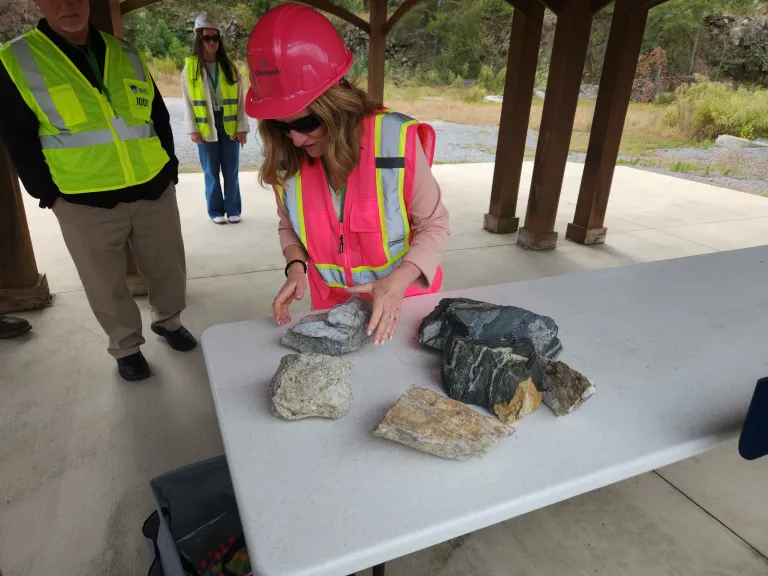
Cindy Estridge explains the process of mining to the tour group. | Photo by Carrie Dow
She explained that when Albemarle begins mining, likely in 2027, they will do traditional blast mining of the rock walls into giant chunks. The company will then separate the spodumene from the pit’s other minerals. Then, after a series of physical processes, the spodumene will be crushed into a fine powder. From here, the spodumene crystals will be sent to a conversion facility, but not the one on site. That facility handles lithium salts from Albemarle's Silver Peak Brine Mine in Nevada. Conversion is the chemical process that changes the mine's mineral output into lithium carbonate and lithium hydroxide, the compounds used in electric battery production.
Estridge made the whole process sound simple and safe, but public perception of lithium mining has been fraught. Globally, residents, tribes, and conservation groups have all raised concerns about mine waste, noise, and pollution wherever lithium mining is proposed, from Nevada to Chile. Over the last two years, residents near the Kings Mountain mine have complained of sulfuric smells as rainwater was drained from the site, mourned the loss of a popular drive-in movie theater, and worried about reduced home values.
Professors at Duke University’s Nicholas School for the Environment have been looking at the impact of lithium mining on North Carolina’s environment for decades. They specifically studied Kings Mountain’s previous mining activity and water quality. While the authors of the report found no impact on groundwater due to previous mining, they had concerns it could change when the mine reopens.
“Excavating and crushing ore is just one aspect of lithium mining,” Gordon Williams, one of the authors, said. “Processing—which requires a chemical treatment to separate lithium from spodumene—may include additional chemicals that could potentially affect water quality.” The report also detected higher levels of rubidium and cesium in the mine, metals not regulated by the federal government.
Another university report from 2025 highlighted the atmospheric tradeoffs posed by lithium mining. When looking at climate change and air pollution impacts between lithium extraction and driving electric vehicles versus oil extraction and driving gasoline vehicles, the authors declared a clear winner: Lithium and EVs.
“We found that electric vehicles still come out far ahead in terms of climate change in both total greenhouse gases and air pollution,” Professor Drew Shindell, a lead author of the study, told me. Albemarle provided funding for both studies; however, they were not involved in the scientists’ methods, processes, and outcomes.
While state and federal organizations, such as the NC Department of Environmental Quality, provide oversight, Albemarle is also following standards set by the Initiative for Responsible Mining Assurance. IRMA is an international program that develops environmental and social impact assessments for the mining industry and sets high standards of industrial practices that respect the environment and human rights. Michelle “Meech” Carter, clean energy campaigns director for the North Carolina League of Conservation Voters, monitors that assessment.
“NC LVC has historically worked closely with labor advocates to promote safe and healthy clean energy jobs,” she said. “We are optimistic that Albemarle will hold their commitments of 100 percent IRMA compliance, which will protect workers and expand economic opportunities to local residents.”
She likes what she has seen from Albemarle but agrees that oversight must continue. “My biggest concern with the mine’s reopening is around local benefits and protection,” she said. “I want to make sure residents see tangible benefits yet are protected from the boom-bust cycle that we see from mining operations.”
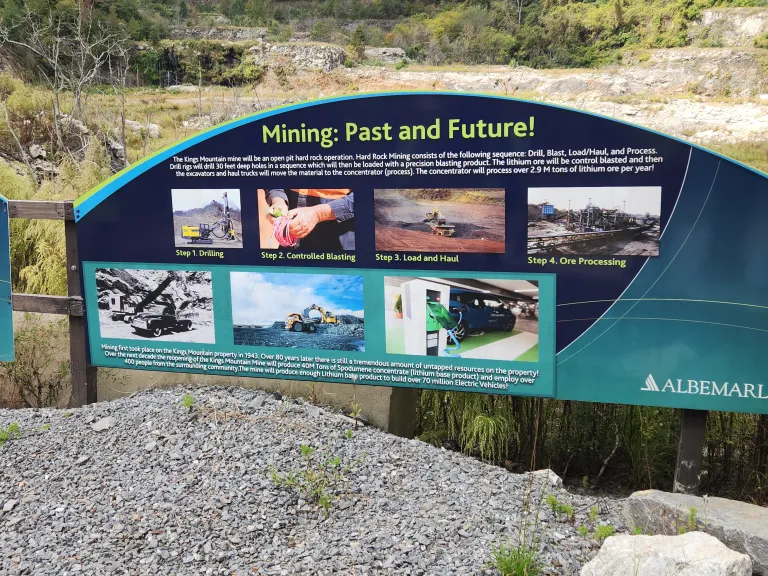
A sign outlines the mining process. | Photo by Carrie Dow
To benefit the community, Albemarle expects to add 440 new skilled jobs to the workforce, and help establish a new $5 million mining engineer certificate program at Cleveland Community College. The program will accept its first students this fall. Other ways the company supports the community are through initiatives like sponsoring a local hiking trail, providing grants to community health programs, and preserving area bat habitat.
A large portion of Albemarle’s funding for these initiatives came from federal grants. So far, Albemarle has received $150 million from the Department of Energy and $90 million from the Department of Defense to conduct feasibility studies and mitigate potential negative impacts to the region.
There’s a lot riding on this mine, say proponents. In the short term, economies from local to national will depend on the jobs, products, and taxes this mine creates. For the long term, Kings Mountain presents an opportunity for the US to lower carbon emissions, slow climate change, and enable a transition to renewable energy.
“I think it’s worth it for people who care about the environment to realize that there are going to be pros and cons,” said Shindell of the mine’s reopening. “Of course, it’s important to do it in a way that minimizes negative consequences … because you have to get the lithium from somewhere.”
Editor's note: A previous version of this article mistated the amount of lithium at Kings Mountain, and it also mistated the placement of the site's lithium conversion facility. Those two places have since been updated.