Low Prices for Sustainable Palm Oil Could Harm Efforts to Clean Up the Industry
The supply chain for the ubiquitous cooking oil is one of the most damaging in the world
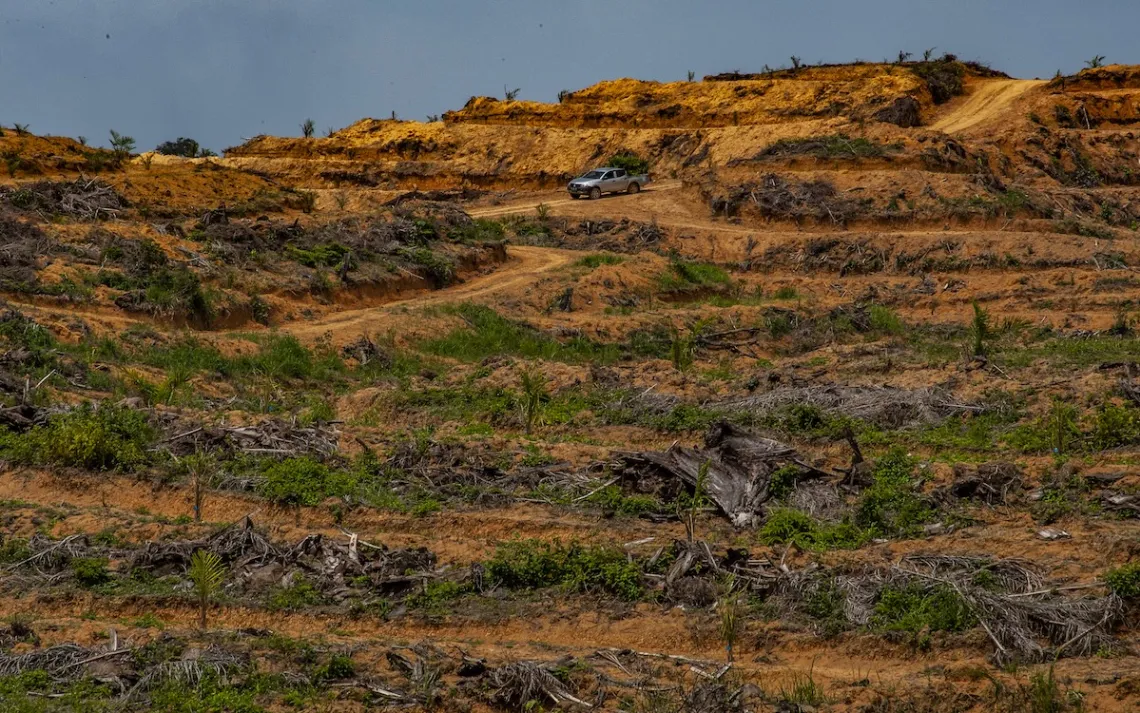
Forest degradation in the Leuser Ecosystem, Indonesia, which was converted into a palm oil plantation. | Photo by Susanna Aditya/AP
Palm oil is rarely mentioned on labels or packaging, yet it is the most consumed cooking oil in the United States. It can be found in many processed foods like instant noodles and potato chips, and also at the drugstore, a key ingredient in soaps, shampoos, and numerous cosmetic products.
The palm oil industry is also one of the world’s most notoriously harmful supply chains. Today, over 28 million hectares of former peatland or forests are now covered with oil palm trees, producing nearly 80 million tons of palm oil. Of exports, the vast majority—85 percent—comes from Malaysia and Indonesia.
Now the Roundtable on Sustainable Palm Oil (RSPO)—an initiative of stakeholders tasked with transforming the palm oil industry into one that is more environmentally friendly—has a crisis: low credit and premium prices for certified, sustainable palm oil. Big food companies purchase grower credits to take on the added cost of sustainable practices and certification. The price for those credits are at an all-time low.
At just 0.01–0.05 cents per metric ton of certified palm oil, RSPO’s goal to expand smallholder certifications—they account for 40 percent of palm oil grown globally but only about 8 percent of certified palm oil exports—may not work. The goal of making the entire industry ethical could be at risk.
“These credits hardly cover certification costs, turning what was meant to reward sustainable production into a financial burden for independent producers,” said Reza Azmi, executive director of Wild Asia, a Malaysia-based nonprofit focused on palm oil.
One factor could be corporate sustainability backtracking. Big brands like Procter & Gamble, driven partly by a wave of anti-climate/sustainability spreading across corporate boardrooms, have abandoned their environmental commitments, including on sustainable sourcing.
“The situation in the US has an important impact, because these are market-based solutions and basically if the market doesn't see the need of implementing sustainability policies and adopting sustainability commitments, definitely I believe there will be an impact,” Francisco Naranjo, RSPO’s technical director, told Sierra.
Smallholder farmers must decide whether sustainability is worth the cost. Are the benefits enough to prevent them from expanding into nearby forests, paying workers a fair wage, and reducing the use of chemical inputs?
“If there is no business case for them, of course the incentive to stay certified and to become certified is going to decrease,” added Naranjo.
Palm oil, deforestation, and the RSPO
In the early 2000s, environmentalists and journalists began raising the alarm as farmers in Malaysia and Indonesia drained, cut down, and burned huge swathes of tropical rainforests and peatlands—critically important tropical ecosystems—to plant endless rows of oil palm trees. In response, environmentalists, governments, businesses, and farmers came together in 2004 to create the RSPO—a multi-stakeholder initiative with the goal of incentivizing the shift to sustainable growing of palm oil.
The idea was that brands would commit to purchasing RSPO-certified palm oil at a premium, and that premium would incentivize sustainable farming, including using degraded land rather than virgin rainforests for expansion. The initiative has made substantial progress: Today, about 20 percent of palm oil is certified sustainable globally, including more than 50 percent consumed in the United States and an astounding 88 percent in Europe.
“Europe was the frontrunner in creating a market for sustainable commodities, and I think North America learned from that,” said Yen Hung Sung, RSPO’s director of standards and sustainability.
By many measures, the RSPO has been a success. Food and consumer goods brands like Nestlé, Unilever, PepsiCo, Mondeléz, and others caved to public pressure, adopting No Deforestation, No Peat, No Exploitation (NDPE) pledges, with third-party oversight from the RSPO. RSPO’s latest standards, which come into force this month, are notable for expanding environmental and labor rules.
“Our standards are very comprehensive, and we have been relying on the power of the markets to drive the change to drive a more sustainable palm oil industry,” said Naranjo.
Impacts and solutions
About 60 percent of palm oil is grown in large plantations by corporate owners, and it's these plantations that account for the vast majority of certified palm oil. Generally, large growers are easier to certify and monitor, and their integrated operations can provide the physical traceability that consumer goods brands increasingly are demanding.
The remaining 40 percent is grown by smallholders, usually with around one to five hectares of land. These mostly family- or community-owned plots provide livelihoods for more than 15 million farmers, mostly in Indonesia and Malaysia, but also in Thailand, Mexico, Ecuador, and part of West Africa.
There is evidence that smallholders are often responsible for much of the deforestation linked to palm oil, including in places like Tesso Nilo National Park in Sumatra, one of the last abodes of Sumatran rhinos and orangutans. RSPO has struggled to certify smallholders, and the creation of a specific smallholder standard in 2019 and grower credits were seen as ways to bridge that gap and address unsustainable practices.
Credits are used to support smallholders who are unable to sell directly to RSPO-certified mills due to location, size, or logistical costs. RSPO is looking at alternative ways to increase demand for credits. One way may be to better connect credit buyers to the real-world impacts happening at smallholder farms via better data and story gathering. Another is to look at the missing links between an RSPO-certified smallholder and an RSPO-certified mill.
“Sometimes, if there isn’t a certified mill nearby, the smallholders sell their palm fruit to an intermediary trader or a collection center, and they are not part of the RSPO ecosystem yet,” said Naranjo. These traders often mix palm from certified and noncertified growers before selling to a mill for further processing. “So what we are now trying to do is study how to bring intermediaries into the system,” added Naranjo.
Others, like Wild Asia, which works with smallholders through its Wild Asia Group Scheme (WAGS) program, are looking at other opportunities to generate revenue. This includes creating and selling nonchemical fertilizers made from palm oil or other agricultural wastes or by getting carbon credits through practices like using biochar to sequester carbon in soil. To Azmi, these solutions are necessary to address the key problem with palm oil: making sustainability a better economic choice than deforestation or heavy chemical and pesticide use.
“Sustainability should strengthen profitability rather than eroding it,” Azmi said.
In the past 20 years, RSPO’s success, though far from complete, has inspired the creation of other similar initiatives aiming to address environmental impacts of other commodities, like rubber, soy, and coconut. Those commodities are even more dependent on smallholders than palm oil, and the ability of the RSPO to include them in the future of sustainability will go a long way to determining if market-based efforts can, in fact, prevent environmental harms.