Meet the Kriller Queens
Next-gen polar scientists challenge the status quo in Antarctica
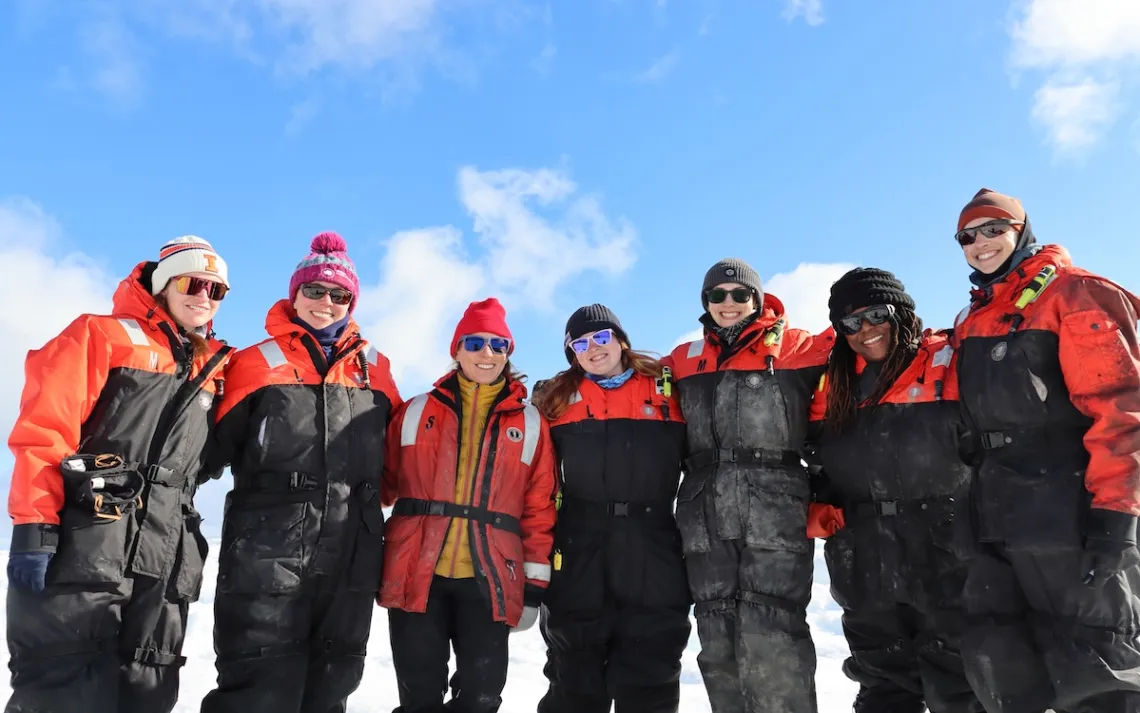
From left: Ellen Buckley, Tricia Thibodeau, Maggi Mars-Brisbin, Hailey Thomas, Rose Malanga, Kyra Sims (horn player), and Emily Fedders. | Photo courtesy of Tricia Thibodeau
A professional French horn player and six scientists boarded a ship headed to Antarctica for one month. What sounds like the start of an odd joke actually describes a group of women who set sail for the icy continent on the R/V Sikuliaq last winter. The researchers' main goal for the expedition was to study sea ice and the organisms that call it home, but their mission carried deeper significance: proving that women do belong in the polar sciences.
The National Science Foundation funded a grant for the scientists, from universities across the country, to research and understand different aspects of sea ice on the eastern side of the West Antarctica Peninsula. The six women were originally set to join the foundation's chief scientist training program, where early-career scientists spend weeks on a research vessel collecting data and conducting experiments for their studies. This training was slated for summer 2024 but was abruptly canceled just 36 hours before the team was supposed to depart due to mechanical problems with the ship.
After scrambling for a new ship and new funding, and cramming what would normally be a year’s worth of planning into three months, the team finally flew to Chile and boarded the R/V Sikuliaq on January 11. Sporting endearingly nerdy “Krill Power” and “Kriller Queen” T-shirts, they set sail on the month-long research trip, journeying through the Straits of Magellan and the notoriously temperamental Drake Passage then traveling toward Seymour Island, where they would begin their experiments. Horn player Kyra Sims joined the scientists to compose a piece of music based on sounds collected from the ice and ocean.
Antarctica is known for its thin ice, but the boat hit unusually thick ice at the beginning of its journey, stalling the scientists for about four days. While waiting for the ice to open up more, the team made the most out of the situation and began collecting water and ice data as well as deploying nets to collect zooplankton samples. Finally, the science began.
“The sea ice was thick enough that we put the gangway down, and we were all able to walk on to the ice floe,” Tricia Thibodeau, a zooplankton ecologist and assistant professor on the trip, said. “I've been to Antarctica five times before, but I'd never gotten to do anything like that. So that was really awesome for me.”
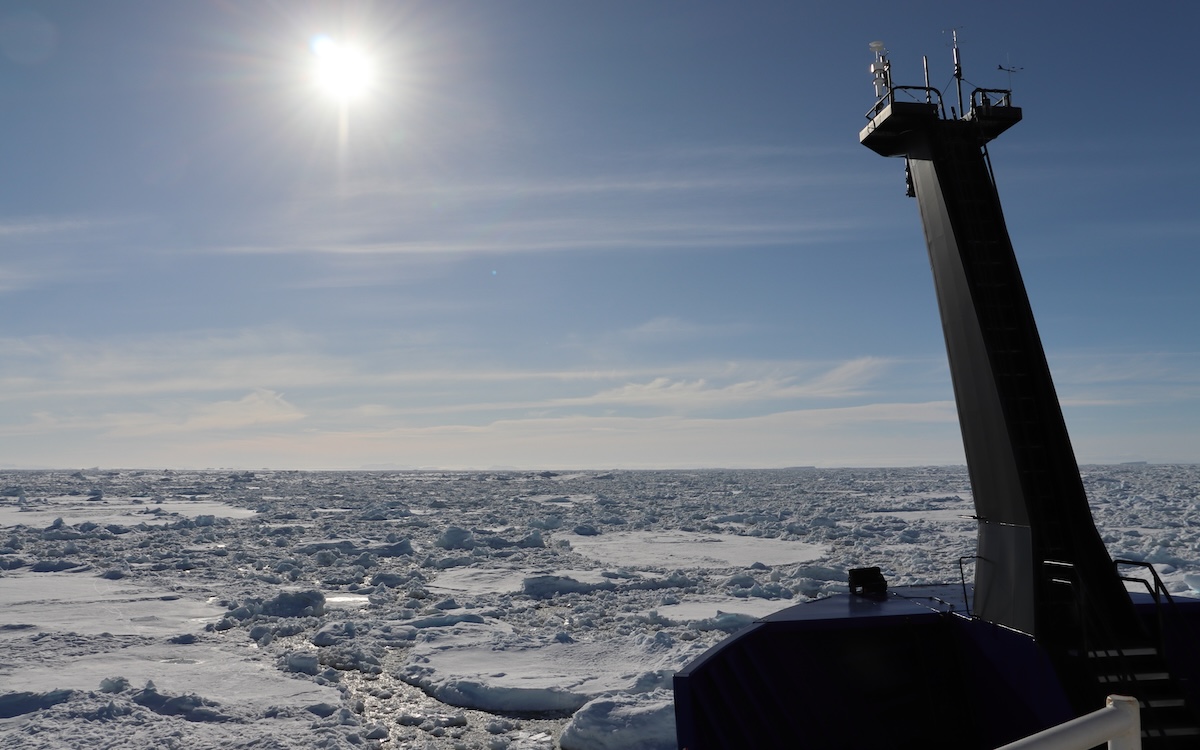
The R/V Sikuliaq encountered some of the thickest sea ice surrounding Antarctica, which stalled the group for four days. | Photo courtesy of Tricia Thibodeau
Ellen Buckley spent her PhD studying Arctic sea ice melt ponds through remote sensing observations. She pored over aircraft imagery and satellite data of the pools of melted water on top of ice and fell in love with the rare phenomenon, but it wasn’t until this trip that she finally saw a melt pond in person.
“You can see in so many different papers that people just assume that melt ponds on Antarctica don't exist and don't occur,” Buckley said. “So seeing the surface melt was really rare and exciting.”
This was also Buckley’s first fieldwork experience and first time staying overnight on a ship. She said the food was surprisingly good and she loved getting to talk science every day with like-minded women. While on the trip, her goal was to collect ice samples to see what organisms, nutrients, and isotopes were present so she could track sea ice melt in the water column. Buckley also collected physical and remote ice measurements to analyze how oceanic and atmospheric conditions affect Antarctic sea ice.
Although the researchers collected data for their independent projects, they still learned from one another and collaborated during the trip. For example, if Buckley saw algae in the ice samples she collected, she would give those samples to Maggi Mars Brisbin, whose research focus was on how the interactions between phytoplankton and ocean microbes influence primary production—the process of turning solar energy into biomass—and how environmental changes affect them.
“I was really hoping to look at the layer at the top of the mud that has recent phytoplankton export … and I wanted to collect some of that and see what phytoplankton were contributing to that export,” Mars Brisbin said. “And every time that we did it, there was just a crazy amount of weird worms and sea stars and all sorts of things that were in the sediment cores we collected.”
Thibodeau occasionally dabbles in phytoplankton, but her goal on the trip was to characterize the composition of zooplankton communities at different distances from the ice edges and link it to chemical data similar to what Mars Brisbin measured. Since zooplankton—which include organisms such as krill and mollusks—play a key role in carbon sequestration, they’re important when considering carbon export. They not only move approximately 65 million metric tons of carbon to the deep sea each year, but they’re also “really good poopers and pee-ers,” according to Thibodeau, meaning their excrement also sequesters significant amounts of carbon. Through her data collections, she noticed that the zooplankton community in the region was more gelatinous and contained fewer arthropods than she expected.
“Usually we see a lot of krill near the ice, and since this was a high ice year, I thought we would see a lot more krill than we did,” Thibodeau said. “I'm looking forward to leaning into the data more to kind of see maybe why that is.”
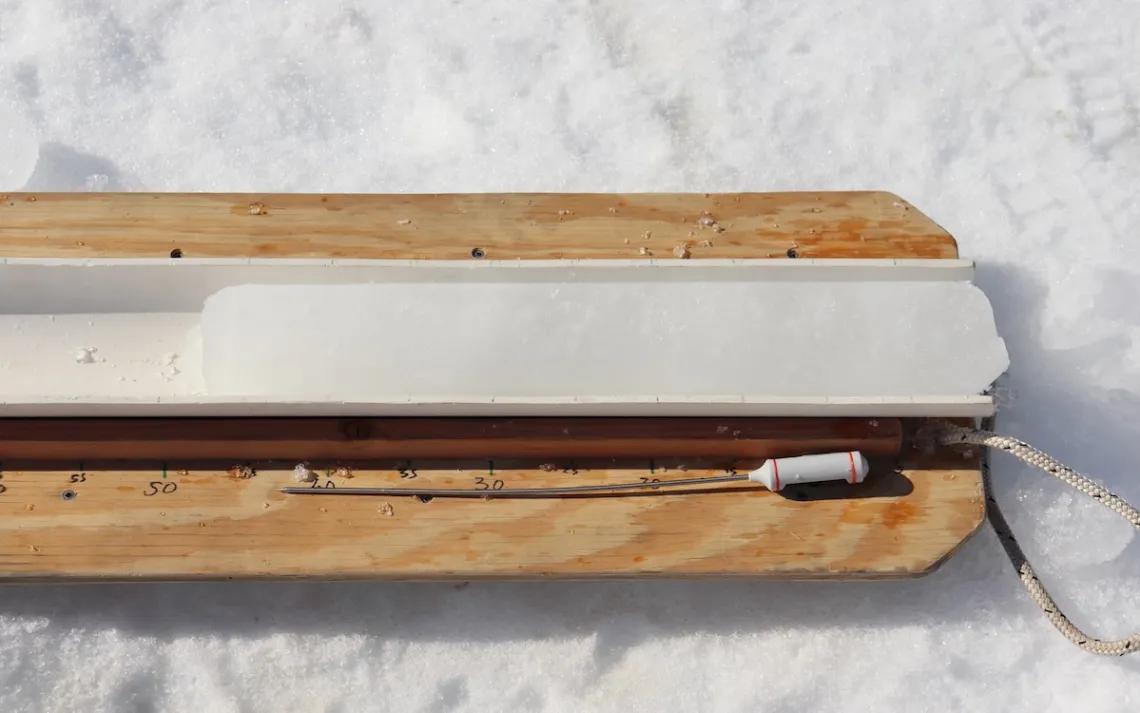
Examining an Antarctic ice core. | Photo courtesy of Tricia Thibodeau
No place on Earth is protected from the climate crisis, and Antarctica is no exception. The continent’s peninsula is warming five times faster than the rest of the world, and as its sea ice melts, species such as penguins lose viable habitats. Research like that being done by Mars Brisbin, Thibodeau, Buckley, and their peers will give scientists a better idea of the continent’s changing environment and its effects on Antarctic species. But their research would have been much harder to conduct in the 20th century. Not because climate change wasn’t as intense but simply because they are women.
Many countries had either formal or policy-related bans on women doing Western research in the poles until the mid-20th century. The United States’ largest Antarctic research facility, McMurdo Station, excluded women until 1962, and men in the polar sciences continued to discriminate against women even after the ban was lifted. US Navy admiral Frederick E. Bakutis said in 1965 that “Antarctica [will] remain the womanless white continent of peace,” and one British woman was allegedly denied a research position because, according to her rejection letter, “there were no facilities for women in the Antarctic, i.e., there was not a separate toilet, there were no shops, there were no hairdressers.”
Since then, the efforts of rightfully persistent female researchers have made the polar sciences more accessible to women, and now 55 percent of the Association of Polar Early Career Scientists members are women, according to the Scientific Committee on Antarctic Research. However, even as the field has opened up, the atmosphere at polar research stations can still be unwelcoming and even dangerous for women. A 2021 report from the National Science Foundation’s Office of Polar Programs found that 72 percent of women saw sexual harassment as a problem during Antarctic fieldwork and living arrangements. Mars Brisbin said that prior to their research trip, the team participated in trainings on how to be an active bystander and recognize signs of harassment and assault to promote a healthy and productive work environment.
The all-women team found that being surrounded by other women who were also early-career scientists was empowering and created a collaborative working environment. For example, there wasn’t as much hesitation when it came to asking for help since everyone on the trip was doing something new to them. And many of the research vessel’s crew members were also women, contributing even more to the welcoming environment.
“Previous [research] cruises that I've been on, we would have like twice the number of people doing the amount of work that we were doing on this cruise,” Thibodeau said. “And so the fact that we were an all-women team of six, working our asses off for a lot of the time—I'm very proud of us for that.”
The return home was bittersweet for the scientists. They missed their families and pets while on the ship (even creating a night dedicated to sharing slideshows of everyone’s pets), but now, back in the US, they miss being able to solely focus on their science and being in an environment that felt like an entirely different planet.
“I don't have anything to compare this [experience] to,” Buckley said. “But I am really realizing how unique this was, and how special it was that we had such a good group and a great crew, and we got science done.”