Nature Speaks to Us. We Just Need to Listen.
In the Ecuadorian Amazon, Nemonte Nenquimo found her voice as an activist in gatherings lit by fire and song
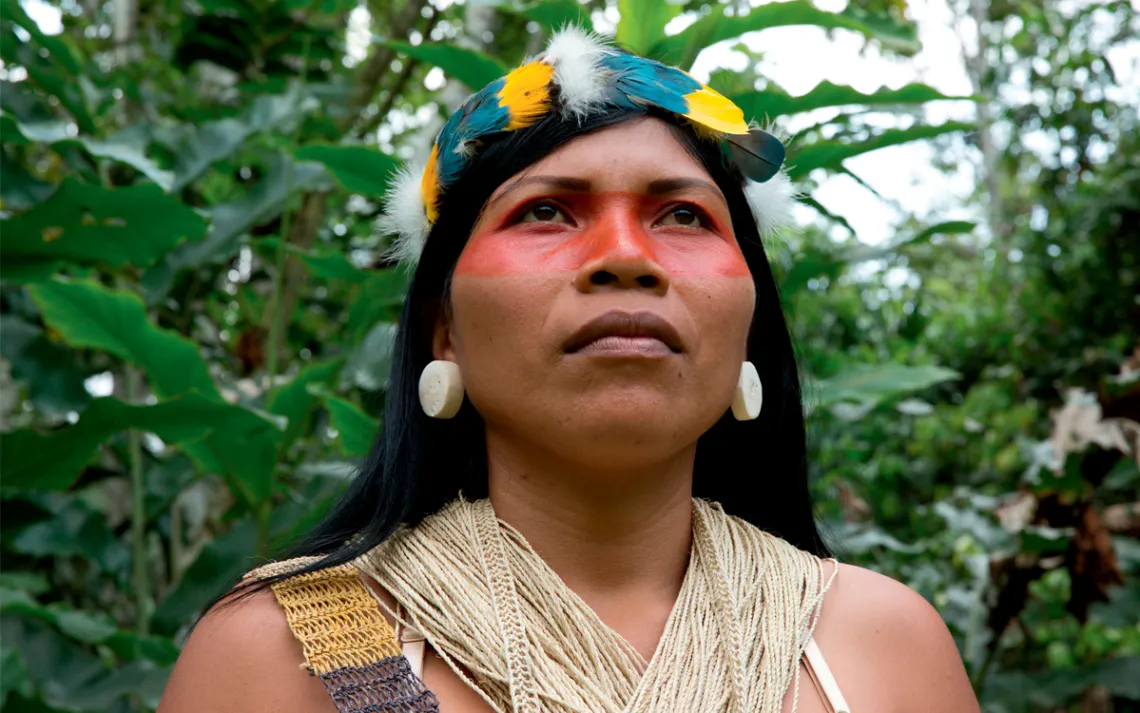
Photo courtesy of Amazon Frontlines
In Nemonte Nenquimo's world, a place she calls the “mother forest” deep in the Ecuadorian Amazon, the animals speak and the people listen. The land and the water have a voice. For the Waorani people, every sound matters and every movement is a message.
“We don’t need satellites to tell us the forest is in danger. The forest tells us herself,” Nenquimo says, her voice the rhythm of water. “The eagle’s call changes when danger comes. The monkeys scream differently when strangers are near. The water shifts when something is wrong.”
Nenquimo found her voice as an activist not in offices or courtrooms but in gatherings lit by fire and song.
Between 1964 and 1992, Texaco (now Chevron) drilled for oil in the Kofan territories in northern Ecuador. The operations devastated the environment, releasing an estimated 650,000 barrels of crude oil and 16 billion gallons of wastewater into the soil and waterways. Nenquimo grew up witnessing an oil company recklessly destroying pristine habitats while deceiving Indigenous communities with cheap gifts and empty promises in exchange for their compliance. But she would not comply.
After studying in the city of Quito, Nenquimo returned to the rainforest in 2013. A year later, when the Ecuadorian government announced new oil concessions for the Kofan territories, she walked for days through the bush to reach remote villages, carrying her child on her back and determination in her voice. She sat with elders under palm-thatched roofs, listening before speaking, letting stories of her ancestors guide the path forward. She gathered women, who wove chambira palms and courage in equal measure, and young warriors, who painted their faces in red achiote and black wituk, ready not for violence but for advocacy.
In 2015, Nenquimo cofounded the Ceibo Alliance and Amazon Frontlines, organizations dedicated to defending land, water, and Indigenous rights across the Amazon. Together, they built a campaign against the proposed oil concessions by relying on ancestral knowledge. Nenquimo worked with village elders to produce maps of their territory that could be used to build a legal challenge. She helped organize community protests, hold press conferences, and implement letter-writing campaigns.
Nenquimo insists on another truth: We are not visitors here. We are children of the earth. If the forest dies, so do we.
For the first time in living memory, the Waorani became one voice. Villages that had never before stood together marched, sang, and confronted oil company officials who came in suits and helicopters.
In 2018, Nenquimo was elected as the first female president of the Waorani Organization of Pastaza, which represents dozens of communities in the Amazon. A year later, she led her people to a historic legal victory that protected half a million acres of Waorani territory—jaguar trails, sacred trees, and rivers bursting with fish—from oil drilling.
In court, judges who had never listened to Indigenous voices before were challenged with an undeniable truth: These Native people were not relics of the past. They were the living present and the protectors of the land. Against the vast machinery of oil, they brought not only lawyers but also the weight of their ancestors and the forest itself. The Waorani legal win has inspired other Indigenous communities. Their victory was a reminder that when people stand as one, even the mightiest empires can falter.
Nenquimo was named one of Time magazine’s 100 most influential people in 2020. She also won the Goldman Environmental Prize and has been recognized globally as one of the leading voices for Indigenous rights and climate justice. A mother, a strategist, a truth-teller, Nenquimo has stared down presidents and corporations with the same steadiness she possesses when she listens to the river.
Nenquimo’s second name, Ayebe, comes from a small yellow bird that sings constantly, carrying stories from tree to tree. Her name is not a metaphor but a calling—one that she fulfills by carrying her people’s stories from rainforest clearings to courtrooms, from riverbanks to international stages.
To imagine her world, one she has dedicated her life to protecting, is to picture morning in the Amazon—a symphony. The howler monkeys roar, deep as drums through the canopy. Birds answer with bright trills. Macaws burst from the treetops in a riot of red and gold, their wings flashing like fire. Capuchin monkeys leap from branch to branch, chattering and scolding as if to wake the sun. Children splash in the river as mist curls between the trees. The air smells of fruit, soil, and something older than memory. Here, there is no “nature.” There is only home.
The importance of Nenquimo’s work extends far beyond her own people. The Amazon, the largest tropical rainforest and home to over 3 million species, is often called the lungs of the planet, storing over 120 billion tons of carbon. To destroy it is to attack the very foundation of what gives life to us all. And still, oil drilling and logging continue in parts of the Amazon. The Ecuadorian government is planning to expand oil operations across 8.7 million acres of land that is home to seven Indigenous nations. The machines of deforestation keep coming, louder than any animal cry, shredding bark and bone. Centuries-old trees are felled without witness or ceremony. And the silence that follows cuts deeper than grief. Nenquimo insists on another truth: We are not visitors here. We are children of the earth. If the forest dies, so do we.
So we must be like the jaguar.
The Waorani believe that when someone dies, their spirit may become a jaguar: guardian, protector, ancestor. Jaguars never flee. They strike with purpose. We, too, can be jaguars, she says—warriors who stand in front of bulldozers, unflinching, holding a barrier between the machines and the land.
When she is tired from battles, Nenquimo tells me, she goes to the water. She immerses herself, and the water carries her burdens away. Waorani women are called epe, water, because they give life as the rivers do.
“Without water, we are nothing,” she says. “So we must protect it like we protect our mothers.”
Watch Mother of the Forest, a short video featuring Nemonte Nenquimo.