Neglected but Necessary Fieldwork Conversations
Making field sciences inclusive means acknowledging women’s biological realities
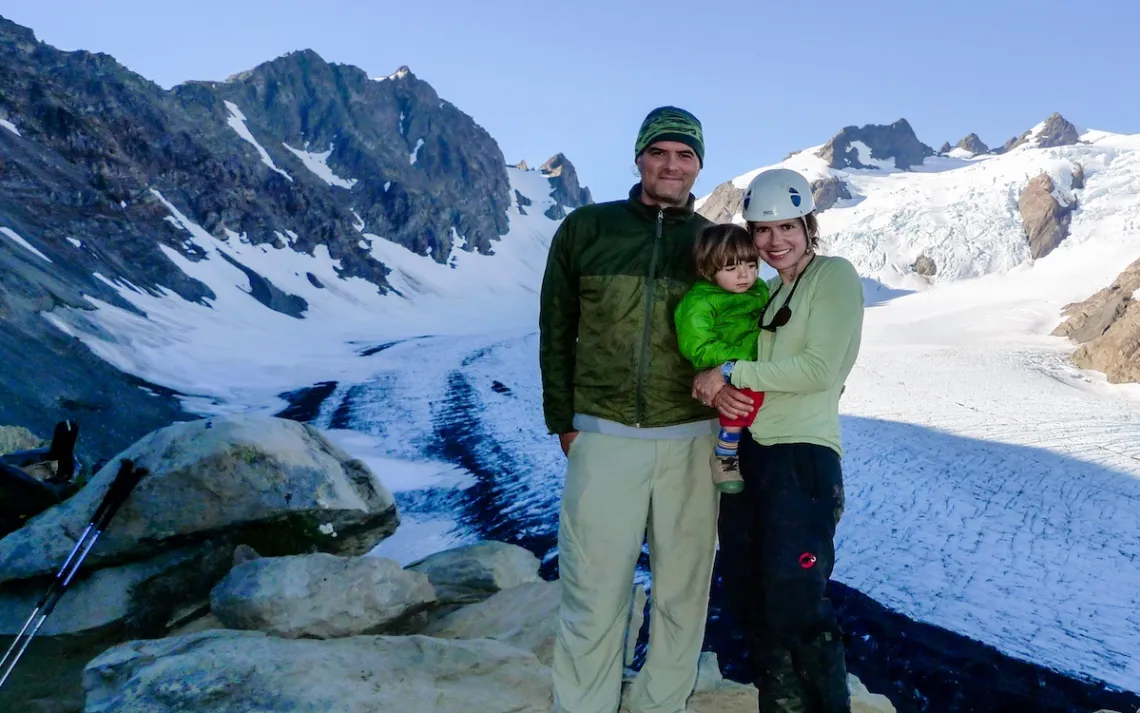
Susan Kaspari, a geological sciences professor at Central Washington University, was fortunate to be able to bring her family on a glacier research trip. | Photo courtesy of Susan Kaspari
Susan Kaspari remembers leaving her husband with their 21-month-old son at the edge of Washington’s Blue Glacier for 36 hours while she and her team hiked farther up to drill ice cores. She also remembers pumping and discarding her breast milk at the top of the glacier while she was away from her son. Kaspari had organized this research trip. If she hadn’t, she likely would not have been able to participate because of her body’s needs.
Kaspari is the Environmental Studies Program director and a geological sciences professor at Central Washington University, where she studies the roles of light-absorbing particles in climate change. She is also among the only 26 percent of STEM workers who are women, and the 57 percent who maintain a full-time career in science, technology, engineering, or mathematics after becoming a mother.
Kaspari has confronted a challenge many women in field sciences know well: carrying out fieldwork while navigating female biological realities that can make participation difficult, if not prohibitive. What’s helping clear the path is a shift toward open, honest discussion—normalizing women’s needs in spaces where such topics were once taboo, especially in male-dominated fields.
“I wasn't willing to stop breastfeeding [my son] just because my work required me to do so,” Kaspari recalled.
A 2022 report from the American Academy of Pediatrics reported that about 80 percent of infants are breastfed in the United States. However, mothers lactating while conducting fieldwork is rarely discussed among researchers, leaving those who produce milk responsible for managing pumping and breastfeeding logistics.
Kaspari recalled not having any role models for how to be a mother and a professor when she had her son. Marine science historian and sociologist Sam Muka described how a lack of positive representation for mothers in STEM makes it difficult for female researchers considering having children to know if it is possible to have a family and a successful career.
“There's kind of a social expectation of maternal desire,” Muka said. “And so if you don't show it, you're a bad woman; and if you do show it, you're a bad scientist.”
While progress has been made toward greater diversity in STEM fields, women often still have a difficult time visualizing themselves in positions dominated by masculine archetypes—such as the nerdy engineer and the rugged forestry technician—according to Muka.
Holly Jones, a research professor and applied ecologist at Northern Illinois University, recalled not having any tenured female professors in her department while pursuing her PhD. “This was part of the reason why I sought out a postdoc with a woman who was a mom,” Jones said. “Because before I actually actively sought that out in a postdoc adviser, I had never really seen anyone do it.”
Jones also described doing fieldwork in New Zealand while lactating, where stopping to pump every two to three hours sometimes made her feel like a burden to a predominantly male team. She also noted the added stress of traveling and conducting research with bags of gear just for pumping.
Another obstacle for women in fieldwork is menstruation, a monthly cycle experienced by an estimated 1.8 billion people worldwide and still surrounded by cultural stigma. In field settings, where access to bathrooms and clean water is often limited, it can pose an additional barrier to participation.
“There’s kind of a social expectation of maternal desire. And so if you don't show it, you’re a bad woman; and if you do show it, you’re a bad scientist.”
University of Michigan graduate student and National Geographic Explorer Betty Jahateh has managed menstruation and intense cramps while studying mangrove ecosystems in the mud and humid air during her fieldwork.
“It's such an excluding and isolating feeling to be going through menstruation,” Jahateh said. “It sort of feels like something I have to set aside and act like it's not happening.… But this has also revealed how much unspoken labor menstruating people carry in order to remain present in field science.”
Jahateh explained that just because people who menstruate work through or play down their menstrual discomfort doesn’t mean this should be the status quo.
“I think that endurance should not be confused with equity,” Jahateh said. “Pain doesn't make someone less capable. It just exposes how field systems have been designed without considering a diversity of bodies. And so when these support structures are absent, you sort of adapt silently.”
Fortunately, progress has been made in diminishing the stigma of female bodily processes in Western society, driven by folks and organizations advocating for menstruation and lactation support as human rights. Field disciplines are beginning to follow suit, as more scientists speak openly about their experiences and work to make fieldwork more accessible for younger researchers.
To support the next generation of field scientists, Jones uses her position as a primary investigator to make a more inclusive and informative experience for her lab members than she received during her education.
“I'm not only training women or people who are lactating or menstruating, I'm also giving those same skills, tips, and tricks to nonmenstruating people and men in my lab,” Jones said. “It's just rewarding and fulfilling that, hopefully, this group—or at least the ones who are coming through my lab—won't have some of the same stumbling blocks as I did.”
Meanwhile, people like Anne Egger and Bre MacInnes, also professors at Central Washington University, are actively challenging the taboo of menstruation.
Egger and MacInnes teach a sophomore-level course at a research station in eastern California for two weeks every year, giving geology students a taste of fieldwork. About seven years ago, a group of female students approached the two professors to inform them that their menstrual cycles had synced, catching some of them unprepared, and that they needed to go to the store for period products. Boxes of pads and tampons are now always available for anyone at the research station.
“We talked about a lot of other physical considerations,” Egger said. “Like going to the bathroom in the field, not to be afraid to talk to us about anything.… But it just took us a while to get to the realization that bleeding was something we needed to talk about as well.”
Ultimately, the field sciences will benefit from acknowledging that all bodies belong in fieldwork, resulting in stronger and more inclusive science.
“I want to highlight that I do not view menstruation itself as a barrier to fieldwork,” Jahateh said. “What I do view as a barrier is the lack of structural planning, the lack of open dialog, and the cultural sensitivity that comes with talking about menstruation.”