For the North Atlantic Right Whale, Scars Tell the Story
Fishing-gear entanglements and vessel strikes cause the whales unnecessary pain and suffering
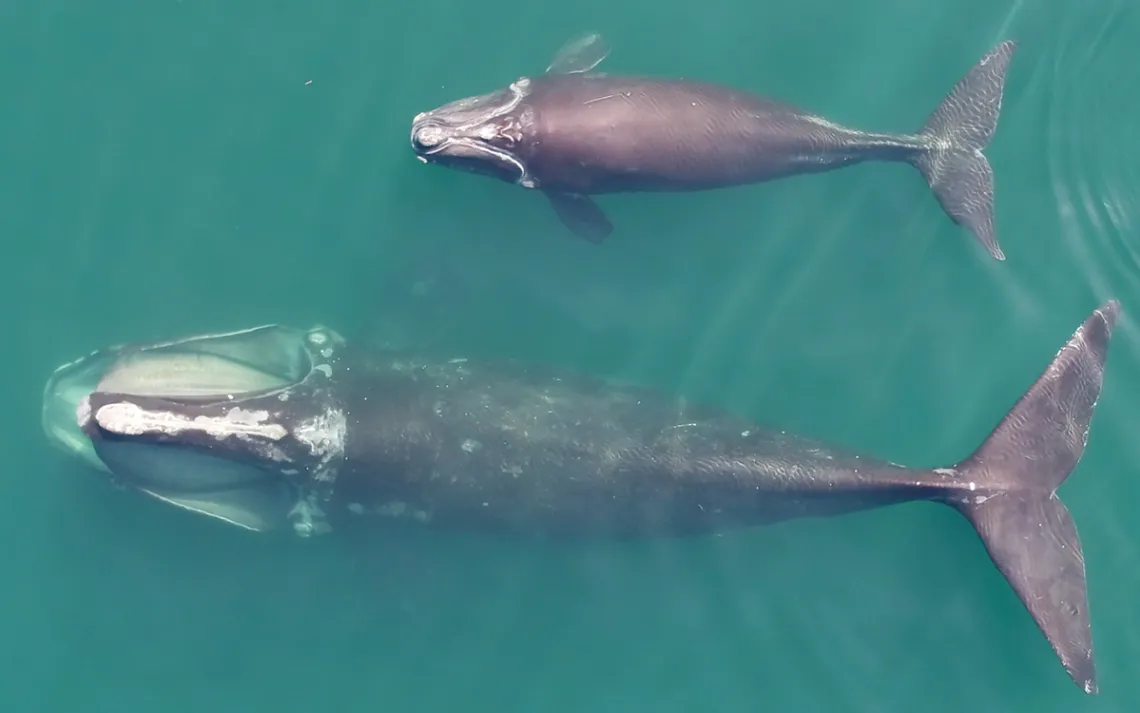
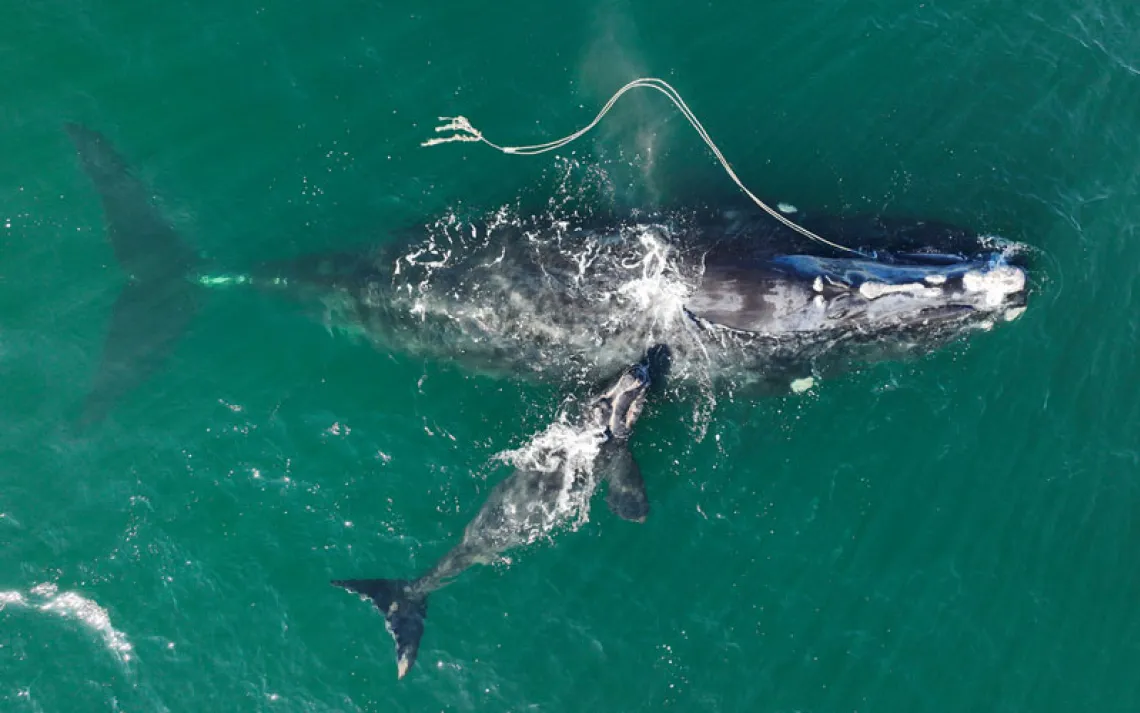
Spindle and her calf. | Photo courtesy of WHOI Michael Moore and Carolyn Miller NMFS Permit 21371.
Snow Cone, a 17-year-old North Atlantic right whale, was in trouble. It was September 2022, and scientists with the New England Aquarium (NEA) spotted her swimming south of Nantucket, Massachusetts, with fishing gear and rope streaming behind her body. Her skin appeared pale, she’d lost weight, and her callosities—rough skin patches normally colonized by harmless, commensal lice—had been overtaken by an orange louse found on ill individuals.
Named after a callosity on her head resembling a snow cone, this whale had been entangled by fishing gear the year before. Whale rescue teams helped but could not free her. A rope had encircled her mouth and head, cutting deeply into her flesh. And here she was in trouble again, dragging a trap with more ropes entangling her.
Stories in the scars
North Atlantic right whales are critically endangered. Only 384 remain, per the latest National Marine Fisheries Service (NMFS) estimate. They give birth during winter at coastal calving grounds from North Carolina to Florida. During spring, they migrate north to feed along the northeast coast of the United States and Canada throughout summer.
This species, three times the size of a humpback and dense with blubber, mainly inhabits the shallow waters of the continental shelf, making them exquisitely vulnerable to entanglement in “vertical lines,” 150-to-300-foot-long ropes from the ocean floor to the surface used by the northeastern lobster and Jonah crab fisheries.
“There's a broad base of work that we've done looking at the stories that the right whales are telling us from these [entanglement] events,” said Amy Knowlton, a senior scientist with the New England Aquarium. She’s part of a team curating the North Atlantic right whale photo ID catalog, supported by National Marine Fisheries Service. According to Knowlton, “Eighty-seven percent of the population had evidence of entanglement injuries. Sometimes these whales have entanglement interactions up to nine times in their lifetime.… It's sort of mind-boggling that so many have scars—and repeat scars.”
They earned their name by being the “right” whale to hunt. Blubber ran the Industrial Revolution. “Yankee whaling” drove the Leviathans to the brink. Today, the more immediate threat the remaining whales face is from accidental boat strikes or entanglements.
As filter-feeding baleen whales, they open their large mouths to ingest thousands of tiny zooplankton; this makes them vulnerable to encountering the vertical fishing ropes while feeding. Understandably, entangled whales “freak out,” thrashing about to free themselves. This can embed the rope deeper in their flesh, making them harder for rescue crews to remove. Such entanglements clearly cause direct pain and suffering to these highly intelligent animals that sing and communicate through low-frequency vocalizations.
“Chronic large whale entanglement, while unintentional, is cruel,” wrote Michael Moore, emeritus research scholar at Woods Hole Oceanographic Institution (WHOI), in a review article. If they don’t drown outright, an entangled whale can drag traps and rope for months before succumbing to death from starvation, dying in an average of six months unless freed. “If the equivalent of fixed fishery traps and nets was to be set on land,” Moore wrote, “with a comparably slow and painful death for wildlife, the responsible industry could be subject to consumer revolt.”
An unusual mortality event
So many North Atlantic right whales have died that, in 2017, NMFS declared an “unusual mortality event” for the species, which continues through today. Since then, there have been 43 deaths and 40 “serious injuries” likely to result in death—remarkable in such a small population. Another 87 whales have experienced serious illness or sub-lethal injuries in that time.
“We're worried about the extent and severity of the entanglement lesions,” said Moore, who also wrote We Are All Whalers, a memoir about his lifetime of work with the majestic animals. Trained as a veterinarian, his work on right whale pathology has shed light not only on how beached animals die, but also on how boat strike and rope entanglement injuries affect both individual and population-level health. “They either die from entanglement or they recover, but during their recovery the trauma can have a significant impact on their energetics and their ability to produce calves.”
This happened to Snow Cone. When first entangled in March 2021, everyone worried she would soon succumb to her injuries, but in December that year, scientists observed her suckling a newborn calf off the Georgia coast—ropes still dragging behind her. Her calf was seen again in April 2022, but by July, scientists observed Snow Cone alone. Far too soon for weaning, her young calf almost certainly died.
“Calves and juveniles are actually more frequently entangled than adults,” said Knowlton. “They don't have the strength of the adults and so they are more susceptible to not being able to escape from the entangling gear and acquiring more severe injuries.” While there’s no evidence that’s what happened to Snow Cone’s calf, it certainly could have. Adding to Snow Cone’s tragedy, a boat had also struck and killed her first calf.
Warming oceans also pose a threat. The Gulf of Maine, historically an important feeding and mating habitat for these whales, started warming faster than 90 percent of all oceanic water bodies on Earth around 2004. As a result, their zooplankton prey shifted their range northward, towards the Gulf of St. Lawrence in Canada. The whales followed, leading to a mismatch between where regulations exist to protect the whales—such as fishing closures and vessel speed limits—and where the whales were.
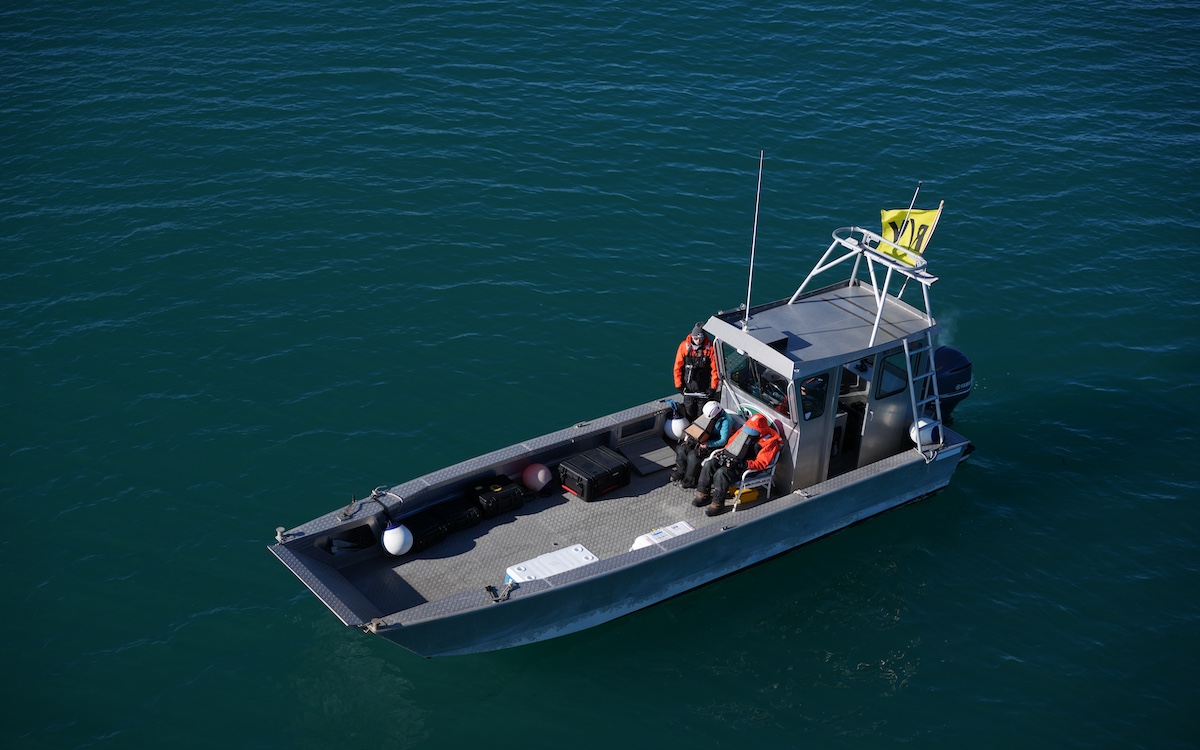
Michael Moore and team flying a drone to assess right whale health in Cape Cod Bay, March 4th, 2026. | Photo courtesy of WHOI Michael Moore and Carolyn Miller NMFS Permit 21371.
On the fast track to extinction
To better understand what was happening with these whales, Moore and his colleagues conducted a novel study photographing and measuring their body sizes using drones, comparing them to similar-aged whales from 20 years ago. To add insult to literal injury, Moore found adult right whales are getting smaller, with mature adults nearly three feet shorter than in times past. “That has significant impacts on their ability to reproduce and the frequency with which they can reproduce, because they don't have the body size necessary and nutrients and fat to make milk,” he said.
Not only do smaller females have fewer calves, but calves born to underweight, unhealthy females have lower survival rates. Normally a female right whale produces one calf every three years, but now, females are giving birth every seven to 10 years.
With so few North Atlantic right whales left, and only 70 reproductively active females, this species may not be long on the earth. According to the NMFS website, “given the estimated rate of human-caused mortality and serious injury,” 50 or more calves need to be born yearly to “stop the decline and allow for recovery.” And the only way to do that involves reducing human-caused mortality and stressors on their reproduction.
“The successful mitigation of this threat will rely on fishing industries, government agencies, scientists, conservationists, and the general public to advocate for range-wide protection measures, including the advancement of on-demand fishing technology and implementation," said NEA research scientist Heather Pettis. “The best way to protect right whales from these events is to prevent them from becoming entangled in the first place.”
The lobster industry strikes back
In 2018, the Center for Biological Diversity, Defenders of Wildlife, and the Conservation Law Foundation sued NMFS over violations of both the Endangered Species Act and the Marine Mammal Protection Act, arguing they were not doing enough to save the species. After some legal back and forth, in July 2022, a judge agreed: NMFS must do more.
Fearing new regulations, the lobster industry convinced Congress to add what environmental groups dubbed the “Extinction Rider” to the 2023 Consolidated Appropriations Act. This effectively blocked NMFS from implementing stronger regulations to protect the whales, locking the weaker 2021 rules in place until 2028 (this also rendered any appeal of the court ruling moot).
This year, US Representative from Maine Jared Golden introduced H.R. 2509 to extend this rider through 2035. “Between this and the recent Advanced Notice of Proposed Rulemaking from NOAA to consider deregulation of the vessel speed regulation that has been in place since 2008,” said Knowlton, “we are very concerned.”
The 2023 act did have one benefit: It authorized $15 million annually for 10 years to for fishers and other groups to test innovations to save the whales that don’t cause excessive economic burden on individual fishers. Appropriations of that money, however, depend on the will of the president and Congress. Since 2023, far less than the authorized $15 million has gone toward grants, mainly distributed under the Vessel Strike Avoidance Fund, and the New England Gear Innovation Fund. Possible solutions being tested thus far include fishing rope that breaks more readily when a whale gets entangled, smart cameras to spot whales farther away, and ropeless or "on-demand" fishing.
A slow transition to whale-safe fishing gear
In certain regions, both Canadian and US regulations do now require fishers to use rope with "weak links" every 60 feet that break at a certain pressure. This requirement is not applied consistently across the coastal habitat, said Knowlton. “In the Gulf of Maine and offshore waters, it's only being mandated in the top half or top third of the inline,” she added, “because there's a concern that in deeper waters, [fishers] can't effectively haul the weaker rope without parting their gear.”
The innovation getting the most buzz? On-demand fishing. The technique is not completely without ropes (hence the shift in terminology from ropeless to “on-demand fishing”), but greatly reduces the extent of it in the water column.
“The status quo is that when you are fishing for lobster or crab, you have a wire mesh trap on the bottom. To retrieve the trap, you have a line from the trap up to the surface to a marker buoy, and when you want to service the trap, you haul it up using a winch,” explained Moore.
Those ropes remain in the water column for months at a time. With on-demand fishing, fishers identify and retrieve traps from the ocean floor with the push of a button. “You have a device on the bottom which responds to an acoustic signal from the surface which enables release of the trap.” It floats to the surface within minutes.
In a WHOI pilot project funded by the Conservation Law Foundation and SeaWorld, a few dozen fishers in Canada and the US borrowed on-demand gear from a lending library managed by NMFS and WHOI. “The mechanistics and the technology work well,” said Moore, but kinks are being worked out to ensure all users have access to a “uniform, interoperable system that works for everybody,” such as how to identify gear without surface buoys.
According to the Ropeless Consortium, on-demand fishing may even reduce gear lost to storms, an incentive for fishers to implement the technique. Ropes tend to pull bottom gear during wind and storm events, whereas a lobster pot on the ocean floor without the drag caused by ropes stays put—not to mention fewer lost ropes and traps from entangled whales.
These innovations did not come in time to prevent the tragedy of the life and disappearance of Snow Cone and her calves. As she was last seen in September 2022, experts assume she succumbed to her injuries. Since then, at least 10 other North Atlantic right whales have died; the latest, a four-year-old named Division, who died after a months-long entanglement.
“For every whale we see [die], there's another two that we don't ever see,” added Moore.
The exhilarating feeling of liberation
In an episode of The Wild Ones, an Apple TV documentary series released last July, filmmakers joined Canadian researchers studying North Atlantic right whales. They tested smart cameras that use machine learning to spot whale “blow” from farther away than whales can typically be spotted. The cameras learn as scientists confirm if the camera correctly identified the species. Such cameras could help prevent boat strikes, if widely implemented, since these whales have no dorsal fin, making it hard for them to adroitly maneuver.
When the crew finally encountered a young whale with rope encircling its body and mouth, a whale rescue team—many of whom are expert fishers—spent hours before finally freeing the animal from the ropes slowly killing it.
Filmmaker and presenter Vianet Djenguet, who hails from the Republic of Congo, described the exhilarating experience. “[S]eeing that young whale untangled and set free.… It felt as though I’d known her before. I felt part of her life, and she became part of mine,” he said in an email. “That freedom—raw, sudden, hard-earned—was the most moving thing I’ve ever filmed.”
Herman Melville wrote in Moby Dick, “For there is no folly of the beast of the earth which is not infinitely outdone by the madness of men.” Time is short, but hope still remains to prove Melville wrong.