Planting Trees in Minnesota Is Harder Than It Sounds
As climate change threatens trees across the state, foresters have a plan. The missing piece? Seed collectors.
Photos by Katelyn Campbell/The Nature Conservancy
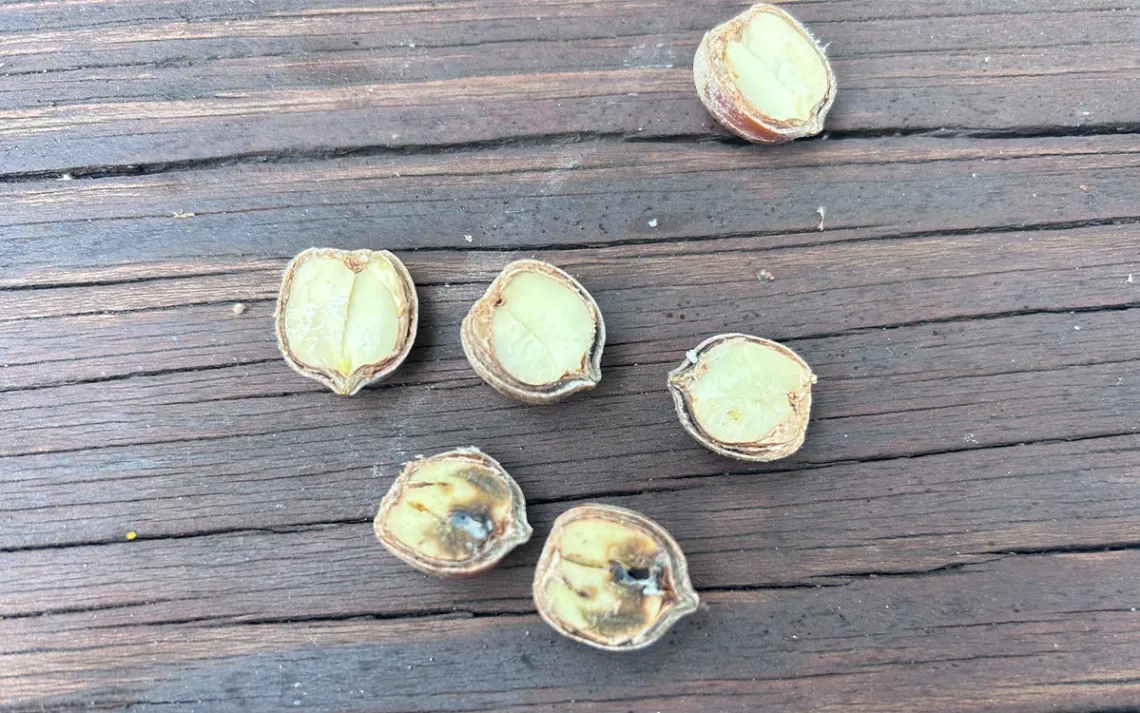
Natalie Kim has already begun blocking out weeks in their calendar for this season’s seed harvest. From May to November, they will spend over a month in Minnesota’s forests—and some people’s backyards—collecting bushels of acorns, samaras, cherries, and walnuts. But before the northern forests drop their bounties, Kim, a seed scout at the Nature Conservancy, must come up with a game plan. They’re locating tree species across the state, seeking out picking locations, and getting permission from landowners and land managers to collect. This year, their small team is hoping to gather almost 2 million tree seeds.
This number doesn’t even capture the full need for seed, Kim explained. As climate change makes Minnesota’s weather warmer and more volatile, the state’s forests are struggling to survive. Reforestation can help address the gaps left behind. Local scientists are planting new trees to enhance fish and wildlife habitat, prevent soil erosion, and keep communities and waterways healthy. The Minnesota Million project, a coalition supported by federal, state, and local agencies, is on a mission to reforest 1 million acres of the state, which will require about 780 million trees. A subset of this enterprise, the Climate Smart Seedling Production Network, is bolstering the reforestation effort with “climate smart” seedlings, trees adapted to better survive the warmer temperatures. But planting even just one tree requires a seed, and they are in short supply. Tree seed collection has plummeted in the US, creating instability at the very beginning of the reforestation supply chain.
So Kim’s team at the Nature Conservancy, along with scientists and foresters from local farms and the University of Minnesota, is building its own supply chain, from the ground up.
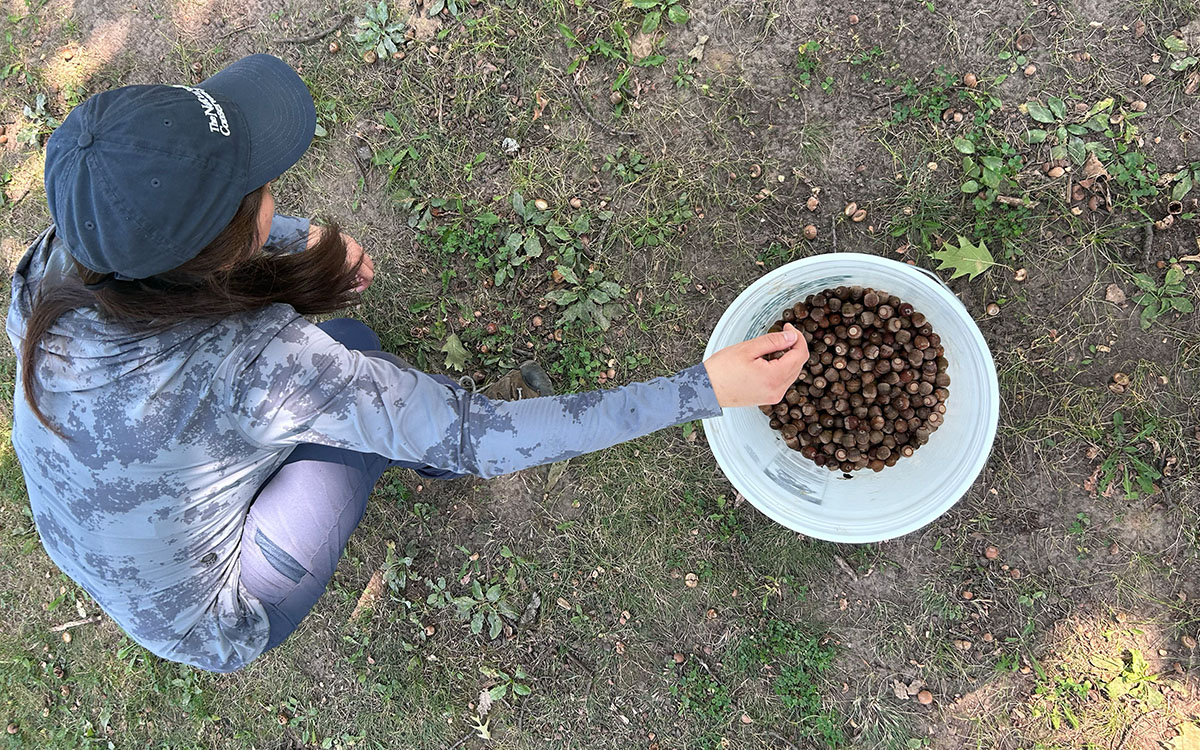
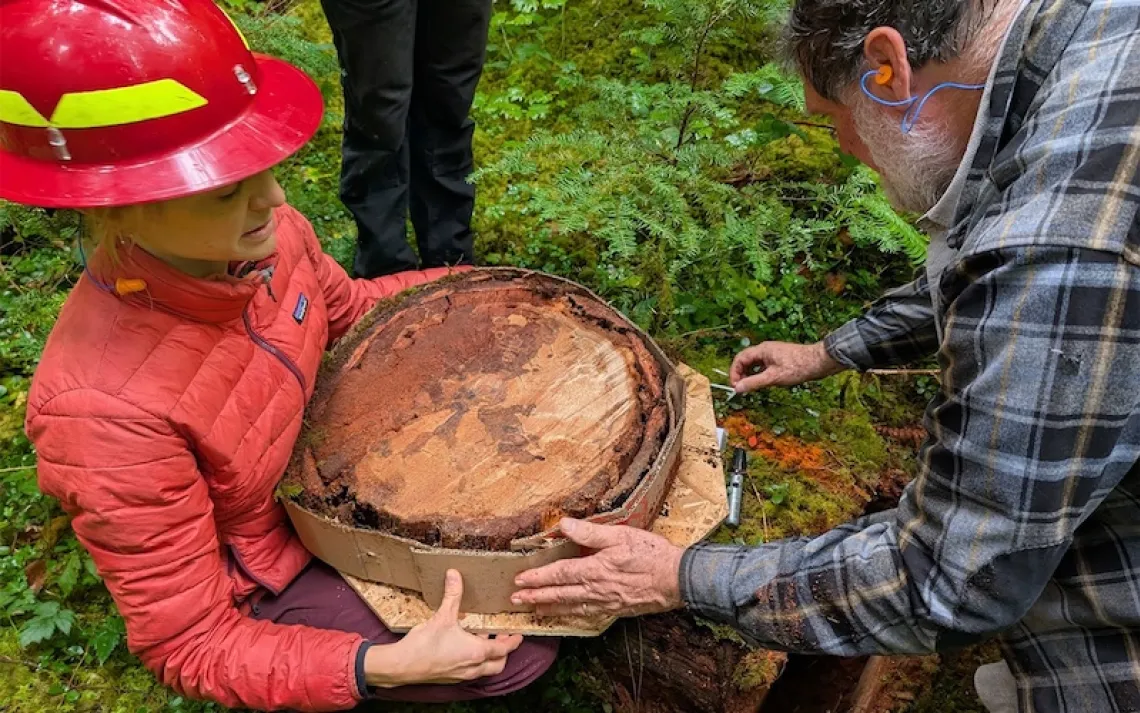
Natalie Kim searches for seeds.
Forests on the move
This isn’t the first time Minnesota’s climate has changed. Weather conditions have been shifting across the globe for millions of years, but historically, these changes were usually slow enough for forests to keep up. Historical evidence shows that during the ice ages, as the northern edge of North American forests got colder, some forests “migrated” south. While individual trees didn’t pack up and move, seedlings likely prospered in the warmer, southern end of their ranges, creeping their forests farther and farther down the continent.
Now that the climate is changing faster than ever recorded, modern forests are struggling to keep up.
“It's hard to imagine that trees are going to be able to migrate naturally fast enough, given how much more rapid climate change is now,” said Julie Etterson, an ecological geneticist at the University of Minnesota Duluth.
By some estimates, Minnesota has lost almost half of its forests since the 19th century. Agriculture, urban development, and logging have played a big part. But temperatures in Minnesota have climbed dramatically since then too, by about 3°F on average. Climate change’s impact on weather patterns is becoming a particularly potent threat. Recently, late season droughts have weakened trees’ immune systems and made it difficult for some species like birch to survive the onslaught of native insects (invasive pests add a new layer of horror). Aspen trees are declining, balsam firs are dying off, and on the edges of Minnesota’s swamplands, black ashes are struggling to survive.
“The long-term forecasts are not good for Minnesota,” said Etterson. “There's mortality on the ground, and we have overall forest loss.”
Some scientists think that because climate change has already rapidly changed the state’s climate, it’s possible local trees aren’t well suited to their current homes—which could be contributing to their decline. Etterson’s research helped elucidate this idea. Northern Minnesota’s current climate almost mimics what the central and southern part of the state felt like 50 years ago, she explained. By transplanting 110,000 seeds from southern Minnesota up north, her team was able to compare their growth side by side with local trees for six years.
For the most part, “the southern material did better than the local material,” she said. The process of moving forests, called assisted migration, has been controversial in the field of forestry. Getting data to show that trees adapt to localized climates was a game changer; Etterson was able to show that “assisted migration works.”
Because many seeds from southern Minnesota seem to grow better in northern Minnesota, some reforesters want to plant these “climate smart” seedlings by the millions. This could ensure a longer lifespan for the trees, while bolstering carbon sequestration, increasing biodiversity, and even supporting the timber trade.
“If we're reforesting anyway,” said Etterson, “why not use material that will do well in the future?”
Because many seeds from southern Minnesota seem to grow better in northern Minnesota, some reforesters want to plant these “climate smart” seedlings by the millions.
The need for seed
Building the Climate Smart Seedling Production Network, however, has proved difficult. For one, there are millions of seeds to gather and only three full-time seed scouts out collecting. Once acquired, the seeds need to be transported, processed, overwintered, distributed, sown, grown, and planted.
“It’s a ton of work,” said Mary Hammes, the reforestation strategy manager at the Nature Conservancy who coordinates the Minnesota Million project. “We aren’t and weren’t collecting enough seed or producing enough seedlings anywhere close to being able to meet these goals.”
One of the biggest challenges is a workforce shortage. The Minnesota Department of Natural Resources still pays individuals to collect seed, but the pool of collectors has shrunk, Hammes explained.
“It’s this invisible thing,” she said. Hammes has seen people who grew up collecting and selling seed retire from the practice. Plus, younger generations are more likely to face a “green wall” when they look at a forest. For people who haven’t spent a lifetime crawling around the woods, an army of trees might appear as a monotonous green mass. But once people learn about the individual species, the forest can come into sharper focus. Skills like species identification, which can help foragers know which tree will drop an acorn versus a walnut, are critical when it comes to seed collection.
There’s also been a massive movement away from seedling production in the US. A 2021 study found that the US now produces fewer than half the number of seedlings it did in 1980. Modern forestry funding is often funneled to other types of projects, and the capacity for tree nurseries to produce seedlings is shrinking. “The programs that created market signals for folks to collect seed have been disinvested in,” said Hammes.
The seeds that do get collected for the network are usually transported to the northern part of the state, where they are grown into seedlings by individuals and local farmers.
Once you’ve completed the tricky task of acquiring a seedling, it’s almost just as difficult to find a place to put it. A report from the Nature Conservancy identified about 2 million acres that could be reforested in Minnesota. Typically, these are areas that were forested at one point and could now be replanted. Often, Hammes learned, this sort of land is privately owned.
“There are so many goals like ‘Let's plant trees,’ and it always sounds like such a lovely thing to do, but one of the most difficult pieces is actually finding and negotiating appropriate land for that,” she said.
Now the Minnesota Million coalition is trying to reincentivize seed collection and seedling production and, finally, work with landowners to plant the new growth.
Greasing the chain
This summer, Kira Pollack, a University of Minnesota Extension forester and educator, will helm the first official training efforts for aspiring seed collectors. Through virtual sessions and in-person workshops, she’ll help outdoor enthusiasts, natural resource specialists, students, retirees, and curious families learn how to collect viable, climate-smart seeds from southern and central Minnesota.
Pollack said she plans to start by looking at silver maples. She’ll push would-be collectors to start thinking like a squirrel: “Does it look good, or is it decayed? Is there something munching on it? How do you know if this is a good tree to collect from?”
The project includes identifying popular, resilient trees—in addition to silver maples—and then convincing landowners to plant them. The list includes black cherries, a few species of oaks, yellow birches, and black walnuts.
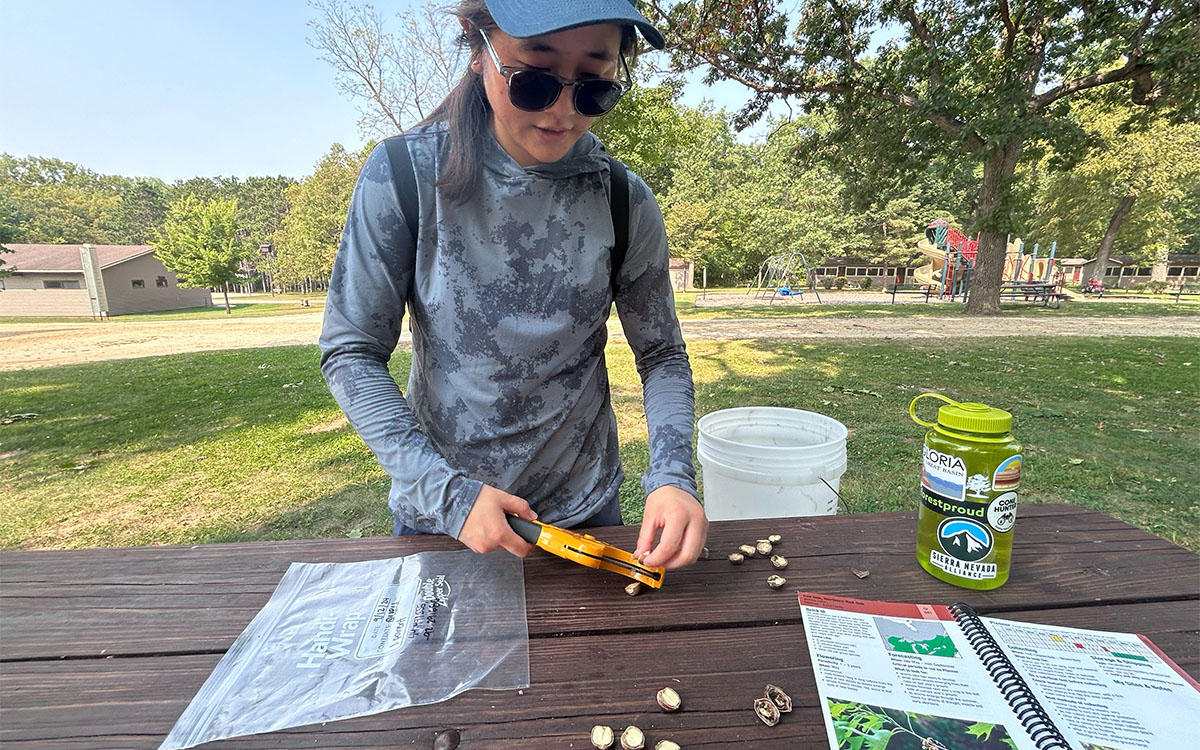
Supported by volunteers and a handful of other scouts, Natalie Kim from the Nature Conservancy is doing a great deal of seed collection. This season, they will take a car stuffed with paper maps, binoculars, ladders, buckets, and sometimes a tent to countless collection sites across the state.
“[It’s rewarding] knowing that we're helping build Minnesota's future and taking care of living things,” said Kim, who expects to spend three to seven hours a day gathering seeds. “But also, the experience itself is very enjoyable to me. The mosquitoes … a little bit less.”
Despite the insects, Hammes thinks the whimsy of tree seeds, whether they come in the form of a cherry, walnut, or catkin, might be enough to urge people to sign up for a training session.
“It's hokey a little bit, maybe, but seed inspires a lot of imagination and excitement for folks,” she said. “The National Park Service likes to talk about charismatic megafauna like the bald eagle, river otters, or things like that. I think that seed is a charismatic microflora. It gets people to think about the different pieces of the forest and what they mean.”