This Popular Law Is Driving a Wedge Between Public Lands Advocates
Here's why conservation and recreation groups are at odds over the EXPLORE Act
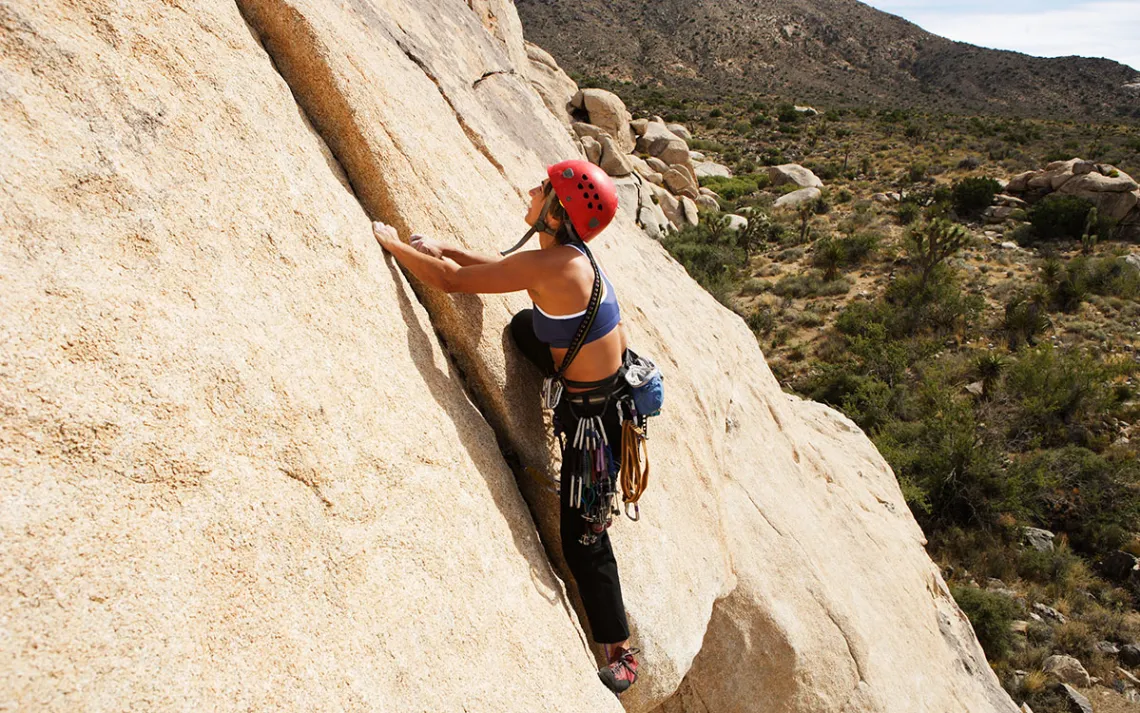
Rock climber in Joshua Tree National Park, California. | Photo by ericfoltz/Getty Images
When the EXPLORE Act passed in December 2024, many conservation groups heralded it as a success for outdoor recreation. However, some of the provisions failed to gain unanimous support, even among outdoor groups. One of them was the Protecting America's Rock Climbing (PARC) Act. In addition to reaffirming climbing as an appropriate activity within wilderness areas, PARC preserves climbers' right to place fixed anchors across the National Wilderness Preservation System.
Some conservation groups believe it opens the door to the overuse of these protected spaces, which include nearly 112 million acres. “Whether out of malice, indifference, or ignorance, the PARC Act is sending a loud message: that recreation interests are more important than wilderness preservation,” Dana Johnson, the policy director for Wilderness Watch, said in a blog post.
Yet, others contend that the law preserves a treasured outdoor activity that helps preserve access to iconic outdoor spaces and boosts recreation. “Sustainable wilderness climbing is good for our health, rural economies, and the environment,” said Heather Thorne, the executive director of a nonprofit rock climbing advocacy group called Access Fund, in a statement.
The PARC Act was a response to a 2023 National Park Service decision to reclassify fixed anchors, like bolts, as “installations” and conduct a detailed review of existing bolts in wilderness areas. The proposal would have impacted more than 50,000 climbing routes in wilderness areas on both National Park Service and US Forest Service land in 28 states. Climbing organizations like Access Fund feared the move would have halted climbing in some of the most treasured areas in the country, including El Capitan in Yosemite and Joshua Tree’s Wonderland of Rocks. The Access Fund argued the process would have also likely been time-intensive and expensive.
Access Fund deputy director Erik Murdock said it felt like the agency was reneging on an agreement made over a decade ago when the National Park Service issued Director’s Order 41. This order allowed climbers to install anchors in wilderness areas with the approval of land managers. “That's what was so disturbing about the 2023 proposals, is that they moved the goalposts, ignored this policy that was agreed on by the climbing community,” Murdock said.
The PARC Act also requires the secretaries of the interior and agriculture to issue national guidance on climbing management within wilderness areas, addressing the array of management policies, within 18 months. The Forest Service, which manages about 30 percent of climbing in America, has no national-level policy on climbing. Currently, regulations differ between land management agencies and from park to park. Some Forest Service wilderness areas prohibit bolts, and some allow limited use. Some parks have regulations on the number of bolts placed in a season, while others rely on a prior authorization system.
“I think the climbing community has a long history of managing ourselves and making sure that we're practicing Leave No Trace and respecting wilderness and land managers,” Murdock said.
The PARC Act weighs recreation and wilderness preservation, giving climbers access to wilderness areas and land managers the tools they need to protect wilderness areas from overuse. Murdock also pointed to the importance of access in creating a passion for protecting the wilderness.
“It's a huge asset and a huge benefit to the wilderness that people are getting out and exploring the wilderness in a compatible way, such as climbing,” Murdock said. “It would be a little bit tricky for the climbing community to endorse certain wilderness bills if fixed anchors and climbing were prohibited.”
Recreation on public land has a wealth of mental and physical benefits, which create environmental stewards dedicated to preserving natural spaces for future generations, according to Robert Scott, the deputy director of federal policy for the Sierra Club. “Once you experience the wonders of nature, it’s clear why it’s worth protecting,” Scott said. “That should be our focus, to make outdoor access attainable by everyone because that is where the next generation of stewards will come from.”
Climbing has been allowed under the Wilderness Act of 1964 despite regulations on other recreational activities. Sailing, paragliding, and cycling have been interpreted as inappropriate in wilderness areas and are banned. Though none of these are explicitly mentioned in the Wilderness Act, their bans are interpreted in section 4(c): “no use of motor vehicles … no other form of mechanical transport, and no structure or installation within any such area.”
Johnson from the Wilderness Watch, however, stands by the Park Service’s initial proposal, which has now been rescinded. Climbing’s popularity has exploded in recent years, amounting to a $12 billion industry. Access Fund said that some states reported a 50 percent increase in public land use levels year over year.
Johnson fears that the PARC Act could be a slippery slope and that other recreationists will push for their sports to be allowed in previously prohibited areas. Her fears may not be completely unfounded. Last June, Utah Senator Mike Lee reintroduced the Human Powered Travel in Wilderness Areas Act, which would allow cycling in wilderness areas. Johnson believes that conservation and recreation are too often conflated.
“Less than 3 percent of land is protected as wilderness in the Lower 48, and outdoor recreation is exploding,” Johnson said. “The outdoor recreation industry has money and political influence and is pushing for more recreational access to these spaces. It becomes challenging to preserve the integrity of environmental laws that protect these places. . . . I think one of the biggest threats to them is exploding recreation.”
She pointed to a statement from the Tulalip Tribes Natural and Cultural Resources Department, which published research on the impacts of recreation on wildlife and how such impacts threaten their treaties. “Recreation, both motorized and nonmotorized, can and does have a significant environmental impact,” the report read. “Cumulatively, recreational activities can influence the range and health of fish and wildlife species and habitat, degrade vegetative communities, and result in human presence and disturbance throughout even the most remote areas of public lands and treaty areas.”
The Sierra Club’s stance on fixed anchors, last amended in 2000, has taken a more middle-of-the-road approach. The organization feels that fixed anchors that cannot be placed or removed without altering the environment should be regulated as installations in wilderness areas. “Within designated wilderness areas, or areas otherwise protected for their wilderness values, climbing, including the use of fixed anchors,” according to official policy, "should be subject to the same standards as all other activities that are consistent with the preservation of the wilderness character of these lands.”