Researchers Are Trying to Save These Turtles From Disappearing in Illinois
Efforts to conserve Blanding’s turtles ramp up as habitat loss and a fungus hinder their recovery
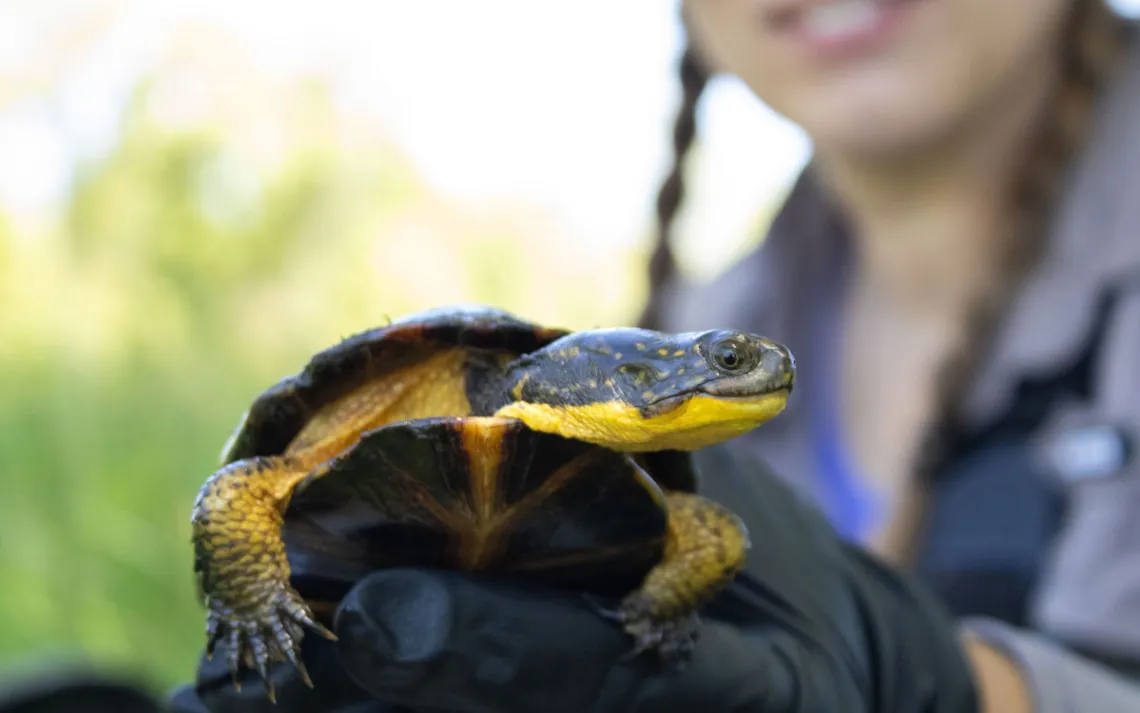
Callie Klatt Golba holds a Blanding's turtle in Illinois before taking its measurements in June 2026. | Photo by McKenna Sweet
When Callie Klatt Golba set out to check her recently laid traps, she was excited for what she would find. She and her team were looking for a very cute endangered species. Pulling the first sardine-baited trap from the water, they first documented two crayfish and some tadpoles—not what they were hoping for, but not a complete bust either. Two hours and multiple traps later, they finally found their target: a Blanding’s turtle.
These elusive turtles have spotted shells, a sunshine-yellow chin and throat, and a face that often makes them look like they’re smiling. Since they’re amphibious, Blanding’s turtles need a connected landscape of wetlands and uplands to thrive. However, human activities have wiped out over 60 percent of their habitat across the coastal Great Lakes since the 1800s. Now, the once common species is listed as endangered by the International Union for Conservation of Nature.
This is where people like Klatt Golba come in. As curator of turtle conservation for the Peggy Notebaert Nature Museum in Chicago, she has been working for over a decade to save Blanding’s turtles in Illinois, where about 90 percent of the state’s historic wetlands have been drained or otherwise lost to development. One of Klatt Golba’s current projects is the Blanding’s Turtle Recovery Program, where she works with Gary Glowacki, the manager of conservation ecology at Lake County Forest Preserves. Their goal is to create self-sustaining populations of Blanding’s turtles in northeastern Illinois.
Glowacki created the recovery program in 2010 after population analyses showed that there weren’t enough juvenile Blanding’s turtles to replace aging adults. To remedy this, the ecologists created a “headstarting” program, where they incubate around 100 eggs and raise the hatchlings for a little under a year. If the young make it past this milestone, the team releases the survivors into the wild. According to Glowacki, the program had been a huge success; almost 90 percent of the eggs they incubate hatch, compared with only 7 percent of nests in the wild. And since Blanding’s turtles can live for over 90 years, the recovery program has collected data that shows the team’s conservation strategy is working.
“We're not just putting cute baby turtles on the landscape and getting positive [public relations],” Glowacki said. “We actually have the science to support that it's working and it's being successful.”
That success, however, could be in danger from a fungus that once put the entire headstarting program in jeopardy. In 2022, ecologists with the recovery program were working with the Wildlife Epidemiology Lab at the University of Illinois to perform health assessments on different turtle species. They had extra funding, so they decided to test for shell rot fungus (Emydomyces testavorans), which was affecting western pond turtles in Washington. Two out of 500 samples collected from wild turtles came back positive. When Glowacki’s team tested the 284 headstart turtles at their facility, over half of them were positive.
“My heart sank,” Glowacki said. “We weren't [originally] testing them for Emydomyces, so we could have released hundreds and hundreds of turtles that were infected, and it could have had a catastrophic impact in the population.”
As the name suggests, shell rot fungus slowly eats away at a turtle’s shell. Their body’s response is to then grow a new shell, but this often results in nodules growing inward, putting pressure on the turtle’s organs and eventually killing the reptile. Glowacki and the wildlife epidemiologists immediately halted their headstarting program. They experimented with various treatments during those first 18 months and eventually discovered that bathing the turtles three times a week in terbinafine—which is used to treat athlete’s foot, ringworm, and other fungal infections—was an extremely effective treatment.
“It's been a good five years,” Glowacki said. “And we have not detected it in any wild turtles since then.”
Now the team is at a point where they’re monitoring Blanding’s turtles within their facility that have tested negative without treatment for six months to see if they are safe to release into the wild. Glowacki said he is hopeful for the remaining turtles and is glad to see they’re in good health. He acknowledged that the fungus set the headstarting program back a few years, but the program was never intended to be a long-term solution.
“It's a tool and a Band-Aid for some of these populations, where it helps boost them by adding more young individuals,” Klatt Golba said. “But at the end of the day, if we're not actually fixing the habitats … then we're just putting turtles back into a subpar habitat that they're not going to be able to survive in.”
Now that there are enough juveniles to support the populations they work with, Klatt Golba and Glowacki are brainstorming new strategies to continue supporting the turtles. Klatt Golba explained that Blanding’s turtles are considered an umbrella species, meaning that conserving them creates benefits for other species in the ecosystem.
“Because of their life history requiring these expansive landscapes with mosaic-like patches of all habitat types, robust Blanding's turtle populations only occur in these really functional ecosystems that also support so many other important flora and fauna of the Midwest,” Klatt Golba said. “So habitat conservation aimed at these turtles also supports countless other species as well.”
Although Blanding’s turtles are a state-endangered species in Illinois, populations in states such as Wisconsin and Michigan are faring slightly better. Both states list the turtle as a species of special concern, one category below being listed as threatened, which is just under endangered. Wisconsin listed the species as threatened in 1979, but delisted it in 2014 after citizen science programs boosted turtle sightings, said Andrew Badje, a conservation biologist with the Wisconsin Department of Natural Resources. He believes that since the state has only lost around 50 percent of its historic wetlands, it is home to a larger abundance of the species than Illinois. Badje and Thomas Goniea, who works at the Michigan Department of Natural Resources, said that shell rot fungus is not currently a problem in their states.
Klatt Golba and Glowacki said that as they continue to treat the remaining infected turtles, they’re looking forward to exploring new conservation strategies, such as habitat restoration and predation control. They’ve both been working with the turtles for over a decade and remain committed to protecting and saving what they call an extremely charismatic species.
“Sometimes I get the feeling I'm just kind of a weird turtle guy,” Glowacki said. “And that I'm the only one that really cares about the turtles. But when you see kids, adults, and grandparents all supporting turtle conservation … it really kind of reminds me that a lot of people care about the turtles and care about biodiversity and the important work we're doing.”