New Challenges Put Bald Eagle Recovery in Peril
Climate change and development could threaten this remarkable comeback
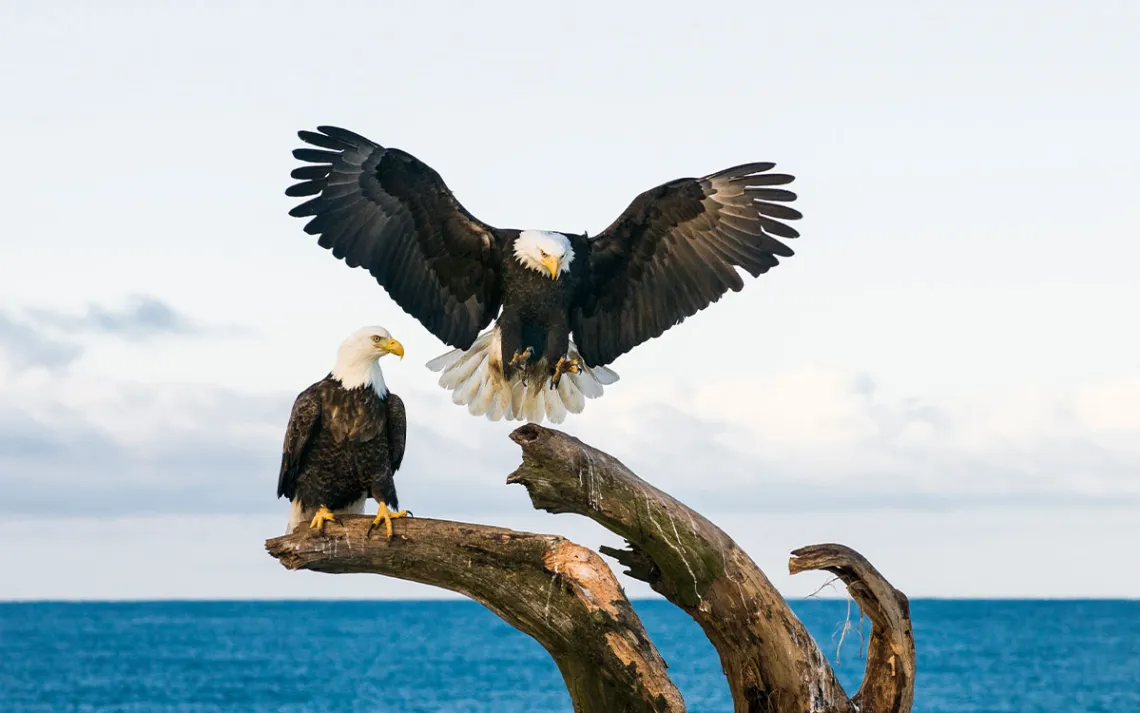
Bald eagles in Homer, Alaska. | Photo by Josh Miller/Getty Images
Each November, thousands of bald eagles descend on the Chilkat Bald Eagle Preserve, a 48,000-acre state park in Southeast Alaska’s Chilkat Valley. The convocation is one of the largest gatherings of bald eagles anywhere in the world. It is made possible by an abundant supply of late salmon runs; ideal nesting and roosting sites in old-growth forests along coast lines and river corridors; and limited human disturbance during critical nesting and feeding periods.
“Alaska, and particularly the Chilkat Valley, is becoming increasingly known for biodiversity and for some resilience to climate change,” Stacie Evans, the science director for the Takshanuk Watershed Council, told Sierra. “We definitely suspect that we'll become a refugia as habitat is degraded in other places.”
But as climate-change-related drought, fire, and other natural disasters accelerate, and human activity encroaches ever closer, this natural spectacle faces mounting threats.
“Eagles want to be where their food source is. They build nests overhanging the rivers or as close to them as they can,” said wildlife expert and author David Hancock, who has spent more than 50 years monitoring bald eagle populations in Alaska, British Columbia, and elsewhere. “They need to be able to catch their food and carry it to their nest. And they’re very territorial, so eagles spread out along the whole coast during the nesting season, very much in relationship of a distance that they can control.”
Among the nests he actively monitors in the Frasier Valley are those on golf courses and in a small pocket park in Vancouver.
“I have one little park with three nests, and the nests are all 20, 30 meters [approximately 65 to 98 feet] apart. And that’s not good,” Hancock told Sierra. “I have to tell you, when they start to nest that close together, they spend more time arguing. They should be spread out in linear fashion, closer to 500 meters [1,600 feet].”
During the annual congress in Haines, the town throws a Bald Eagle Festival, which attracts visitors from throughout Alaska, parts of Canada, and some of the Lower 48 for a series of workshops and exhibitions. Evans leads an annual bald eagle survey coinciding with the festival that focuses less on strict population numbers and more on where, and how far apart, the birds are gathering. The 2024 Bald Eagle Survey found the eagle population was about half that of the 2023 findings.
“The eagles seem to be congregating less here. We do still have a spectacular congregation, but it’s not like it was in the '80s, where you go out to the (preserve grounds) and it was just eagles as far as the eye can see,” Evans said.
Eagles didn’t always find refuge in the Last Frontier. From 1917 until 1953, salmon fishermen and fox hunters in Alaska (then a territory) claimed that the birds of prey were competing with their livelihoods. Although there was no credence to their claim, officials bowed to political pressure and put a bounty on their heads.
More than 120,000 eagles were killed during this period, with officials at the Alaska Department of Fish and Game estimating the unofficial tally to be much higher. The destruction was so widespread that as early as March 1930, an article in Popular Science warned, “In a few years, the American bald eagle will be seen only on coins and the coat of arms of the United States unless drastic action is taken to save these birds.”
When Alaska became a state in 1959, Alaska’s bald eagles were protected by the federal Bald Eagle Protection Act, which made it illegal to kill or own an eagle or possess any of their body parts. (There are exceptions for members of federally recognized tribes.)
The publication of Silent Spring in 1962 by Rachel Carson drew national attention to the harmful effects of the pesticide dichlorodiphenyltrichloroethane (DDT), including its role in thinning bald eagle eggshells and causing reproductive failure. This led to the pesticide’s US ban in 1972.
In 1978, the federal government went even further, listing bald eagles as endangered under the Endangered Species Act, which provided legal protection, habitat conservation measures, and recovery efforts. This included restricting human activities near nesting sites and rehabilitating damaged habitats, among other protections. By 2007, the population had recovered enough that officials removed bald eagles from the ESA. However, they’re still protected under the Bald and Golden Eagle Protection Act and the Migratory Bird Treaty Act. Meanwhile, individual states began downgrading protections as local populations rebounded. California delisted bald eagles from the state’s Endangered Species Act in 2011. Lawmakers in New Jersey removed the birds from its endangered species list in January 2025.
The US Fish and Wildlife Service, the federal agency that implements the ESA, reported that the total population in the Lower 48 had surpassed 316,000 by 2021. Canada’s Department of the Environment and Climate Change estimates there are 110,000 in the country. The Alaska Department of Fish and Game says there are 30,000 bald eagles in the state, more than anywhere else in the United States.
While experts say the overall population is stable in Alaska, Jones Hotch Jr., the tribal council president of the Chilkat Indian Village of Klukwan in Southeast Alaska, shares the concerns of Evans, Hancock, and others who have observed changing migration patterns. They say the pattern reflects a worrying trend—the health of the Chilkat River, which provides the eagles with a reliable source of salmon, is threatened by both human development and environmental changes. “They used to call Alaska the Last Frontier. I think there’s a lot of truth to that now,” Hotch said. “The reality of it is, we are eyeball to eyeball with losing our way of life forever.”
A proposed mine near the preserve, and a highway project running through it, are causing concern among local experts who worry about the impact on the salmon, the eagle population, and the health of the overall ecosystem. “The trees in the preserve are protected,” Evans said, “but the ones just outside the boundary on the highway aren’t, and those are nesting trees as well. What’s to keep them from being chopped down in the interests of a highway?”
The Chilkat Indian Village has vigorously opposed the mine, citing the lack of safeguards to protect the watershed.
“We must keep the watershed pristine. It's not just for our subsistence, our way of life,” Hotch said. “Salmon have been taking care of us for centuries, and now it's our turn to take care of them. Not only the eagles, but the entire ecosystem depends on it.”
Politics, too, could jeopardize the preserve. In early 2024, Alaska’s Republican governor, Mike Dunleavy, proposed disbanding the Chilkat Bald Eagle Preserve’s advisory council. The plan was canceled after community uproar, but critics fear the motivation to eliminate oversight at the preserve to pave the way for industrial mining still exists.
“Anything that happens in that preserve can impact the eagles returning,” Kathy Brenner, the avian curator and executive director of the American Bald Eagle Foundation in Haines, told Sierra. “Not necessarily their population, because these eagles are coming from all over Southeast [Alaska] and Canada. They’re not resident Haines eagles that are gathering out there. If the preserve is impacted, the eagles may just find somewhere else to go.”
That change in migration patterns was evident last spring when an eagle’s nest was spotted in Toronto for the first time in recorded history.
When the bald eagle first appeared on the United States national seal in 1782, it did so against the staunch wishes of founding father Benjamin Franklin, who considered the bird of prey “a bird of bad moral character,” who “does not get his living honestly.” Despite this, the eagle has been so intertwined with the American legend since then that when President Biden signed a bill officially naming it the national bird of the US in December 2024, many, if not all Americans, thought it long had been.
Brenner is thrilled. “I think this is amazing. And it’s going to help the bald eagle because it’s our national symbol,” she said. “It’s going to remind people that we need to protect it.”