 The Magazine of The Sierra Club
Roadside Pollinator Corridors and the Danger of Feel-Good Conservation
Researchers are starting to question the widely held belief that all pollinator corridors are good
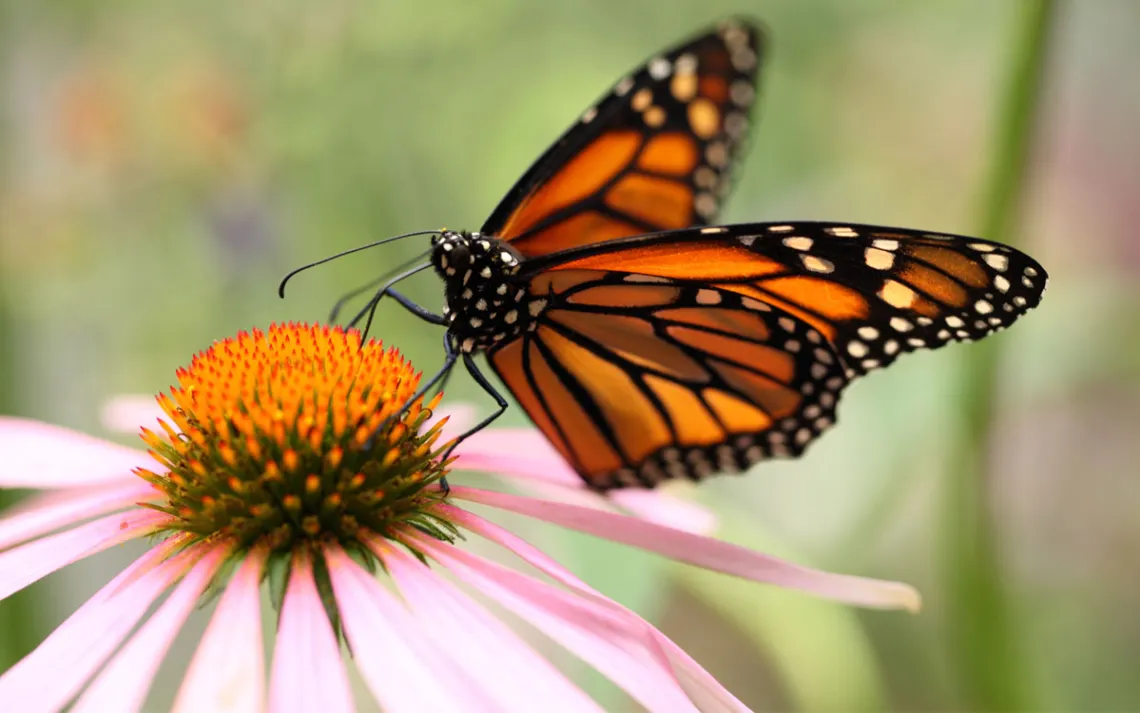
Monarch butterfly (Danaus plexippus) on a cone flower (Echinacea purpurea). | Photo courtesy of lewkmiller/iStockphoto
When Thomas Meinzen sees a monarch butterfly land on milkweed growing beside the road, the moment represents success. As an ecologist with Project 1100, an initiative to protect pollinators, Meinzen knows that such events are a culmination of his life’s work. Conservationists, like him, hope these strips of land can provide ecological refugia in a world where native grasslands have been converted to agriculture, suburbs, and urban development.
However, the same roadside habitat that offers butterflies a place of respite also places them within inches of one of the most dangerous environments humans have created for animals.
Every year, countless insects collide with vehicles. A widely cited 2015 study estimated that traffic may kill billions of pollinating insects annually in North America. Butterflies, moths, bees, beetles, hoverflies, and dragonflies can be struck directly by vehicles or disrupted by the powerful air turbulence generated by passing trucks. The road also introduces less obvious threats. Tires release microscopic particles containing synthetic compounds and heavy metals. Brake pads shed materials including copper and antimony. Rain carries oil residues, de-icing salts, microplastics, and PFAS compounds from pavement into adjacent soils.
For scientists, this raises the possibility of habitats appearing attractive to an organism, but it ultimately reduces its survival or reproductive success. One concerned ecologist is Emile Snell-Rood, a researcher and professor of ecology, evolution, and behavior at the University of Minnesota. She was recently funded by the Minnesota Department of Transportation to examine microplastics in monarch caterpillars collected in roadside habitats. She examined whether synthetic rubber from tires could impact their reproduction and survival. “Roadsides have a lot of potential as pollinator habitat,” Snell-Rood said in a university press release. “At the same time, though, we worry that they could be an ecological trap.”
Andy Davis, a monarch research scientist, and his team have discovered that the road itself may create stress even in the absence of collisions and pollution. Their studies placed monarch caterpillars in artificial environments and exposed them to simulated highway noise. They found elevated physiological stress responses, such as higher heart rates and aggressiveness, resulting from exposure to road noise, suggesting that the acoustic environment of roads may negatively affect insects living nearby.
“By putting in these roadside habitats that are meant as a conservation measure, we’re essentially conducting a long-term experiment,” Davis said in a press statement about his work. “I think our research demonstrates that we need to have more information before we continue to move forward.”
Such uncertainty has led Meinzen and other researchers to ask whether roadside habitats function as ecological sources or ecological sinks. In other words, do they produce healthy populations that repopulate insects back into the surrounding landscape, or do they merely concentrate pollinators in places where mortality exceeds reproduction? The answer may depend on the road.
Along quiet rural roads with diverse vegetation and limited traffic, roadside habitats can offer meaningful refuge. Along major highways carrying thousands of vehicles each day, the same flowers may become part of a far more dangerous ecological equation. A 2024 review in BioScience concluded that roadside habitats can simultaneously provide resources and expose pollinators to stressors depending on traffic intensity, pollution levels, and management practices.
Even the way humans maintain these landscapes creates another contradiction. For example, roadside planting may be established with the intention of supporting pollinators, but transportation agencies also prioritize driver visibility, drainage, fire prevention, and public safety. A field of wildflowers that appears untouched in June may be mowed flat later in the summer because a road crew has obligations that have nothing to do with the insects living there. For a native bee nesting in the soil or a caterpillar feeding on a host plant, the timing of that mowing can mean the difference between completing a life cycle and dying before adulthood. Organizations such as the Xerces Society have produced guidelines and best management practices for roadside pollinator habitat management, but Meinzen and other researchers caution that transportation departments are not often aware of or trained to work in these ways.
The very language used to describe these projects may also obscure their limitations. Ecologists use the word corridor to describe connections between large areas of suitable habitat that allow organisms to move safely through landscapes. But a narrow strip of flowers surrounded by pavement, industrial agriculture, parking lots, and development may not function as a true corridor at all. A 2021 study published in the Journal of Applied Ecology found that roads reduced bee movement and limited pollen transfer across landscapes, suggesting that the same infrastructure intended to connect habitats can also fragment them.
Paul Brewer, a retired private lands wildlife biologist, said that the same concern extends beyond roadsides. Pollinator buffers placed beside agricultural fields may offer flowers, but their benefits can be limited when they are embedded within landscapes dominated by pesticides and extensive habitat loss. Meaningful conservation, Brewer argues, requires thinking at larger scales—protecting and restoring extensive areas of prairie, grassland, and natural ecosystems.
None of this, however, means roadside pollinator projects are not viable. Many researchers have found that carefully designed and managed roadsides can provide valuable resources for insects. Wider buffers from traffic, reduced mowing schedules, lower chemical inputs, and diverse native plant communities can improve their effectiveness.
The larger question is not whether roadside conservation should exist. It is whether society will mistake a visible solution for a sufficient one. It is relatively inexpensive and politically easy to plant flowers on the side of a road compared with confronting the larger forces behind insect decline: industrial agriculture, pesticide dependence, urban expansion, and the destruction of native ecosystems.
The monarch butterflies that Meinzen watches beside the road illustrate the dilemma of modern pollinator conservation. Humans created a landscape where butterflies and bees can find exactly what they need: a host plant, a place to reproduce, a patch of green in a fragmented world. However, we’ve also created an environment that can kill them moments later.
“So, is roadside habitat a boon or a bane for pollinating insects?” Meinzen and fellow researchers asked in their 2024 study. “The answer, of course, likely lies in the details—the intensity of traffic, the distance of plants from the roadway, the frequency of mowing and spraying, and the local availability of alternative habitats.”