Slow Lanes Help Save a Dwindling Orca Population
Reducing speeds can help killer whales navigate an increasingly louder sea
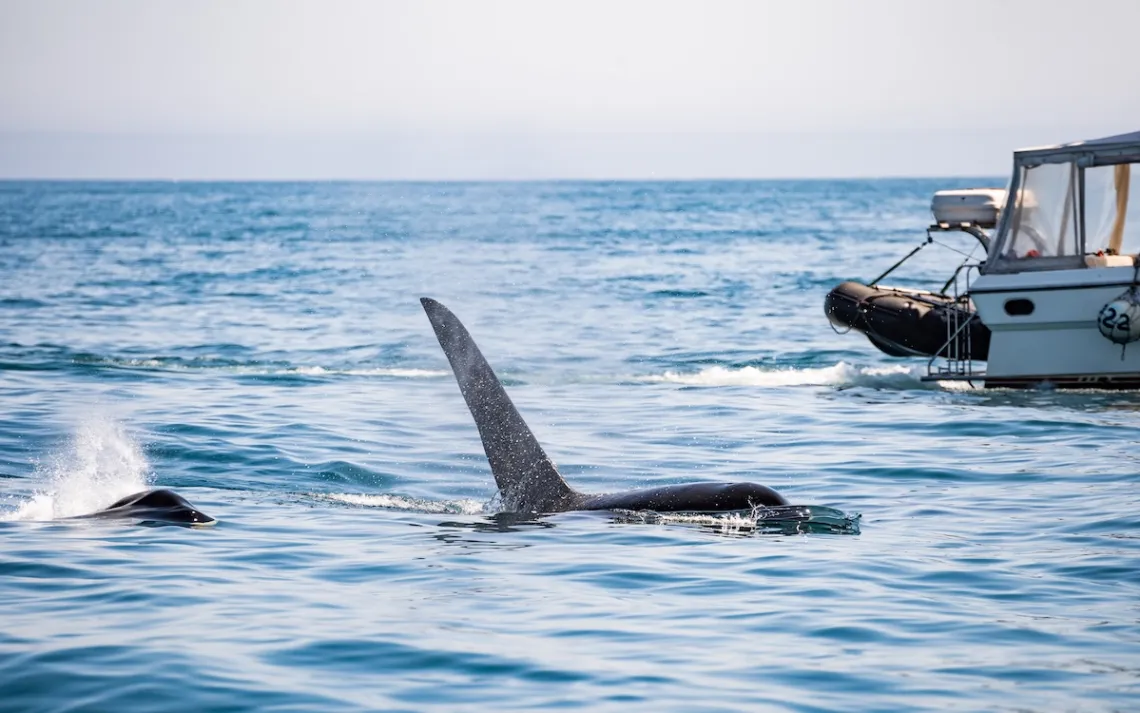
Orcas off Vancouver Island, British Columbia. | Photo by Evgenyi_Eg/iStock
Between Washington state and Vancouver Island, a group of southern resident killer whales glides effortlessly through the water. Each whale mirrors the others’ movements in what rivals a world-class synchronized swimming performance. The only sounds are the high-pitched clicking they make as they force air through their nasal passages to a fatty structure in their forehead called a melon. Here, sound is emitted as a directional beam (similar to how underwater sonar works). Bouncing off a school of Chinook salmon, the sound is returned to the whales as an echo. Following the sound, the whales find lunch.
“Light doesn’t travel very far underwater,” said Lance Barrett-Lennard, a senior scientist and Cetacean Conservation Research program director with the Raincoast Conservation Foundation. “By contrast, sound travels well. Whales can hear things miles away using echolocation. And so, sound is much more important than vision.”
For this particular group of orcas, which locals call J Pod, the waters of the Salish Sea are a noisy place with a lot of unnatural echoes that can confuse them as they search for prey and reach out to other pods. Every day, especially during summer, pleasure craft, cruise ships, cargo, and tanker ships traverse what is arguably one of North America’s busiest shipping routes. These large vessels are incredibly loud and, according to Barrett-Lennard, can be heard underwater up to a mile away. Sound typically travels four times faster in water than in air, which means J Pod and the other regional killer whales are being constantly bombarded with noise.
The population communicates using low-frequency sounds. Even a few miles from a shipping lane, J Pod’s echolocation returns can get masked by the drone of a ship’s engine. It’s not just an annoyance for the whales but a further impediment to their survival.
At the beginning of the 20th century, J Pod’s ancestors made up a mighty clan of over 200 southern resident killer whales. Now, just three pods (J, K, and L) remain, with a combined population of just 73. The whales have been listed as endangered by both the Canadian and American governments. And although they have on occasion been seen as far south as central California and as far north as Southeast Alaska, it’s the waters of northern Washington state and throughout the southern portions of Vancouver Island where you are most likely to spot them.
Contributing to the whales' stress, Chinook salmon, a mainstay of the orcas’ diet, are also facing hard times. The West Coast is getting drier, resulting in periodic droughts in which streams and rivers do not flow at capacity. This impedes both the spawning salmon as they make their way upstream and the young fry coming downstream back to the ocean. Many simply don’t make it in the shallower waters. Other variables often cited include overfishing and loss of habitat through land development.
It’s a cascading effect. The whales need the salmon. Fewer salmon are hard to find. And a noisy ocean impedes the whales' ability to find them.
In March 2025, with the plight of the whales top of mind, an ad hoc science panel of 31 international experts from universities, government agencies, and NGOs across Canada, the United States, and the European Union met in Vancouver to discuss how to help the region’s orcas. Barrett-Lennard was there. “Controlling and addressing underwater noise is a big priority,” he said.
Among the panel’s suggestions was the expansion of a voluntary slowdown of large vessels traveling through known southern resident killer whales' habitat. The Enhanced Cetacean and Habitat Observation Program (ECHO) has the support of the Vancouver Fraser Port Authority, the Canadian federal agency responsible for the stewardship of the lands and waters that make up Canada’s largest seaport.
“With ships traveling through the critical habitat of the southern resident whales, the port authority recognized that this shipping activity could result in more underwater noise and more disturbance to whales,” said Alanna Smith, a communications adviser for environmental programs at the port authority.
In 2025, the voluntary slowdown is currently advised throughout the southern tip of the inner and outer coastlines of Vancouver Island. While traveling through the slowdown zones, vessels are requested to reduce engine speed to approximately 16.5 miles per hour for vehicle carriers, cruise, and container ships and 12.5 miles per hour for larger bulkers and tankers.
Being a voluntary action allows the parties flexibility to adjust actions based on the best science available at any particular time. But it doesn’t mean that there isn’t a paper trail for those participating. The Vancouver Port Authority and other stakeholders have signed a Conservation Agreement with the Canadian government under the auspices of Canada’s Species at Risk Act, Canada’s federal law intended to protect threatened and endangered species.
“Collectively, the marine transportation organizations that signed the agreement represent all of the large commercial ship traffic that currently transits to and from the Port of Vancouver and passes through SRKW critical habitat,” Smith said. The agreement, according to her, outlines three priorities: to advance real-time whale presence notifications to commercial ship operators, to support the transition to quieter vessels, and to convene collaborators to maintain high levels of engagement and participation in ship slowdowns and route alterations.
“To wait for federal regulations would take time, ” Barrett-Lennard said. “A voluntary program can happen much more quickly.” According to both Barrett-Lennard and Smith, there has been an 85 percent participation rate of large vessels voluntarily slowing their engines. “It has resulted in a reduction in underwater sound intensity by up to half,” Smith said. Internationally, the ECHO program has been recognized by organizations including the United Nations and the European Commission for its conservation efforts.
And while these accolades offer great optimism that the slowdown is helping the whales, the population has yet to expand substantially in size.
“It takes a long time to try and understand how whales are reacting to any kind of change in their environment,” said Janie Wray, CEO and lead researcher for BC Whales, a not-for-profit group focused on protecting whales. “All we can do is listen and watch their behavior when they’re on the surface.”
Up and down the BC coast, BC Whales has placed a network of underwater hydrophones to listen to whales and learn more about how noise impacts them. Wray, along with Barrett-Lennard and Smith, said that the slowdown is an important strategy that's making a difference. But she hopes for more, and that the data being collected on how underwater noise affects whales will further convince the Canadian government to impose mandatory federal regulations.
She describes how, in the quieter waters farther north, humpback and fin whales are vocalizing and singing hauntingly beautiful songs that resonate for miles. She worries that projects, such as liquefied natural gas terminals now under construction along BC’s north coast, and the large tanker ships that will come to them, will affect not only BC’s orcas all up and down the coast but all whales.
“When you listen to what vessel noise sounds like, it’s like you're going to walk in the forest and it's suddenly filled with fog and you can't see anything,” Wray said. “You don't know where your friends are; you don't know where your food is; you're walking in the dark. It’s totally disorienting.”