The State of the Living Planet is "Without Precedent"
World Wildlife Fund releases its biennial report with grim news, and some cause for hope
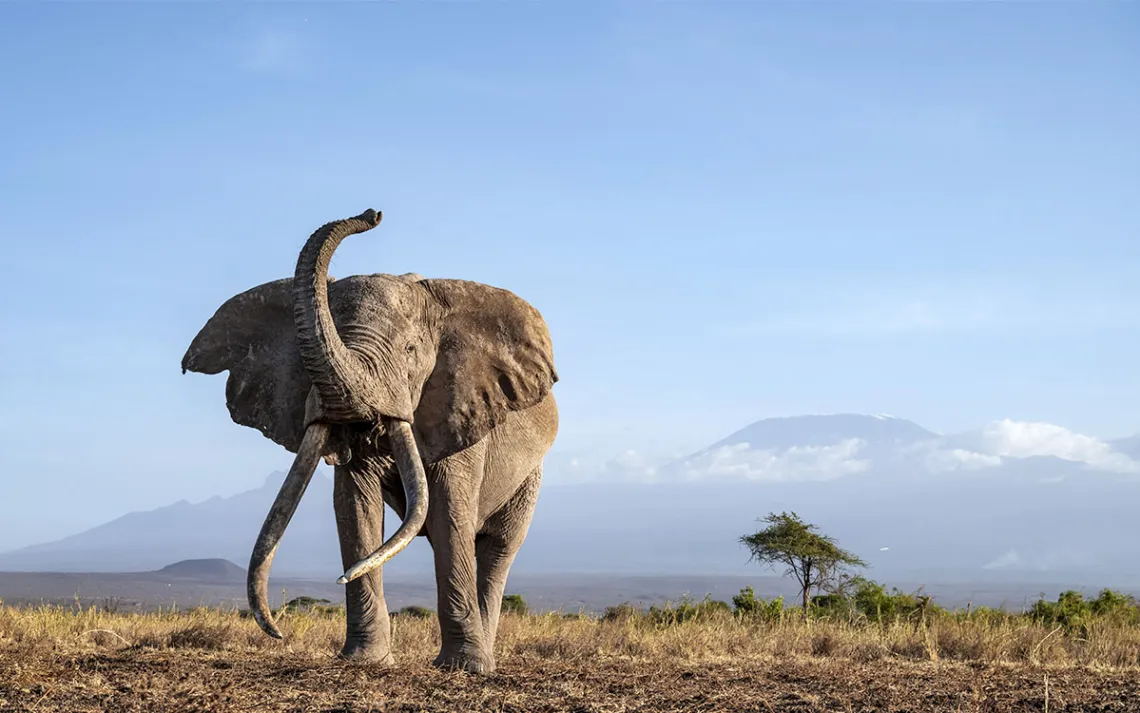
African elephant (Loxodonta africana) in Kenya. | Photo by imageBROKER/Moritz Wolf/Getty Images
The loss of life is happening at a pace "without precedent in human history," according to the Living Planet Report, released on Wednesday by the World Wildlife Fund (WWF) and the Zoological Society of London. In the biennial assessment, called the Living Planet Index, scientists conclude that biodiversity has experienced a whopping 73 percent decline in the past 52 years.
This year's report measured changes in 5,790 vertebrate species, including mammals, birds, reptiles, amphibians, and even fish. Habitat loss—driven by the need for energy, food, and finance—is the primary driver of this precipitous decline. But climate change, pollution, invasive species, and disease are all major contributing factors. According to the report, $7.3 trillion was spent in activities that harmed nature in 2023—industrial-level farming, agriculture, and emissions-heavy industries, such as shipping and mining—compared with $220 billion spent to protect it.
"How do we get the world to wake up and move into action?" asked Kirsten Schuijt, director general of WWF International. "We know the goal; we know the changes; we know the solution."
The steepest decline occurred in freshwater ecosystems, followed by terrestrial and marine environments. Meanwhile, the steepest regional declines were found in Latin America and the Caribbean, which showed a 95 percent drop in overall species biodiversity. In Africa, there's been an 80 percent decline, but that doesn't mean all wildlife dropped by that much.
This year's findings were consistent with the 2024 results, which also showed a similar rate of reduction. In another study, led by Queen's University Belfast in 2023, researchers found that about half of all animal species are declining. The authors warned that the impact of human industrialization on biodiversity loss is "significantly more alarming" than previously thought.
While the new findings from the WWF and ZSL are not a measure of cumulative global changes, Schuijt clarified, the findings do help point to overall trends. The goal is to serve as a road map of where to best aim conservation efforts, she cautioned. "It's not a headcount of individual animals lost," she said.
In other words, the report is not an overall measure of biodiversity loss; it’s based on averaging wide shifts. For example, North America and Europe saw less of a negative trend, but that's because major changes were felt on these continents before 1970, when the index began, meaning wildlife loss has been relatively lower since then.
The findings were based on 35,803 population trends. While overall numbers are going down, about half are stable or increasing. Green sea turtles, bluefin tuna, tigers, and southern African elephants have all shown upward population trends in recent years. These findings, say the report’s authors, show that nature does have the capacity to recover.
However, how and what data is measured remains debated. In one 2024 paper, researchers concluded that the index overestimated decline rates. David Storch, one of the paper’s coauthors, said the WWF report "exaggerates the biodiversity crisis" and calls it more hard "warning" than "hard science."
While not every species is measured—plants and invertebrates weren't included—there is agreement that nature is in decline. "People ask me if the glass is half-empty or half-full," said Mark Plotkin, an ethnobotanist and the president of Amazon Conservation Team. "Any glass that is half-full is half-empty, and vice versa. We clearly need to redouble efforts in forest and marine protection, Indigenous empowerment, endangered species monitoring and breeding."
But the report also revealed some bright spots. In the case of the tiger, hunting and loss of habitat due to overdevelopment drove the big cat to near extinction by the 1970s. By 2010, about 3,200 remained. However, thanks to partnerships, protections, and global awareness, the population has increased to at least 5,700 wild tigers, an over 70 percent increase.
“Half the populations we track are stable or increasing, and species that were in freefall a generation ago are fighting their way back," said Rebecca Shaw, WWF's chief scientist and the report's lead author. "The science now shows that the same self-reinforcing dynamics driving collapse can drive recovery, if we build the conditions for it.”
Islands are a case in point. With marine environments among the most declining systems, these isolated ecosystems are among the most responsive to intervention, said Rakan Zahawi, executive director of the Charles Darwin Foundation in Ecuador's Galápagos Islands. Penny Becker, the chief executive of Island Conservation, whose restoration work on hundreds of islands have a near 90 percent success rate, agrees, saying that being remote and small can help improve recovery.
But conservationists warn that wide change can take decades, if not longer. It also requires investments, policy support from governments, shifts in supply chains and industries, even buy-in from impacted communities. Incentivizing change is key, said Kristine Tompkins, who has spent over 30 years protecting 16 million acres and reintroducing 15 extirpated species, including jaguars and rare deer, across parts of South America.
Long-term conservation means thinking beyond "protected areas and national parks," said the former Patagonia CEO, who along with her late husband Doug Tompkins, spent $350 million creating or expanding 16 national parks in Argentina and Chile. Echoing the report's message, she said that nations need to reframe economies and offer jobs to those living with nature. "If you don't work with local communities, you're going to end up right where you started,” Tompkins said. “People have to have a reason to care. That's why this work is so hard."