States Step In After the Supreme Court Puts Wetlands at Risk
A patchwork of protections emerges as only some states pursue them

The Dixon Waterfowl Refuge has been restored over the past few decades by the Wetlands Initiative. | Photo by Ethan Freedman
On a warm day in late May, Paul Botts stood on a tall observation tower at the Dixon Waterfowl Refuge in Hennepin, Illinois.
“That’s the levee, where that tree line is,” he said, gesturing out past a large expanse of fresh water and a sea of grassy plants, toward a row of trees along the nearby Illinois River. “This was a natural backwater wetland for, probably since the last ice age,” Botts, the executive director of the Wetlands Initiative, noted.
Once, much of Illinois was covered with prairie, oak savanna, and forests. Here, water had free rein, pooling wherever it saw fit and forming wetlands large and small among the grasslands and trees. But as settlers expanded westward and agriculture began to take over the Midwest, this ebb and flow of water was tamed. At the Dixon site, local farmers built the levee to separate the flat riverbank from the Illinois River, and they drained the land to farm. This process played out across the state, as drainage, development, and conversion to agriculture razed the prairies and eliminated wetlands. Now, around 10 percent of Illinois’s original wetlands remain.
About 25 years ago, the Wetlands Initiative purchased the Dixon property to restore 3,000 acres of the former wetlands. Today, birds such as ducks, American white pelicans, and eastern kingbirds live among tall grass and freshwater lakes in the protected refuge. But some of Illinois’s other remaining wetlands sit on private lands, unprotected by nonprofits or the government. Those wetlands now face an uncertain future.
In 2023, in a case titled Sackett v. Environmental Protection Agency, the Supreme Court curtailed which wetlands are covered by the Clean Water Act, eliminating federal protections for millions of acres of wetlands across the country. In some states, those wetlands are still protected under state-level protection laws. In states without significant protection laws, including Illinois, those wetlands may be at risk of being filled in or paved over without mitigation.
A coalition of Illinois environmental groups is pushing for a bill that would essentially return the state’s wetlands to a pre-Sackett level of protection. Advocates hope the proposed law will protect the few wetlands still left in the Prairie State.
“We can’t afford to lose any more of them,” said Emily Kowalski from Environment Illinois, one of the groups advocating for the bill. “And the immense value that they bring to us and the health and future of our water, our wildlife, our environment, and the state of Illinois.”
There are many different kinds of wetlands in Illinois, from cypress swamps to wet meadows to marshes, home to a vast array of wildlife, including threatened species such as Blanding’s turtles. These areas can capture water as it runs off on the landscape, helping to prevent floods, and filter out nutrient pollution from agricultural areas, helping to prevent harmful algal blooms in rivers and lakes. Wetlands can also store a lot of carbon, slowing the pace of climate change.
Over the past few decades, the Clean Water Act has helped protect wetlands across the country. Under the law, anyone who wants to fill in a body of water—for example, to build a new home on that land—needs to apply for a permit before doing so (with some exceptions). That person also has to mitigate any unavoidable impacts to that body of water, such as by restoring or creating new habitat on their property or elsewhere.
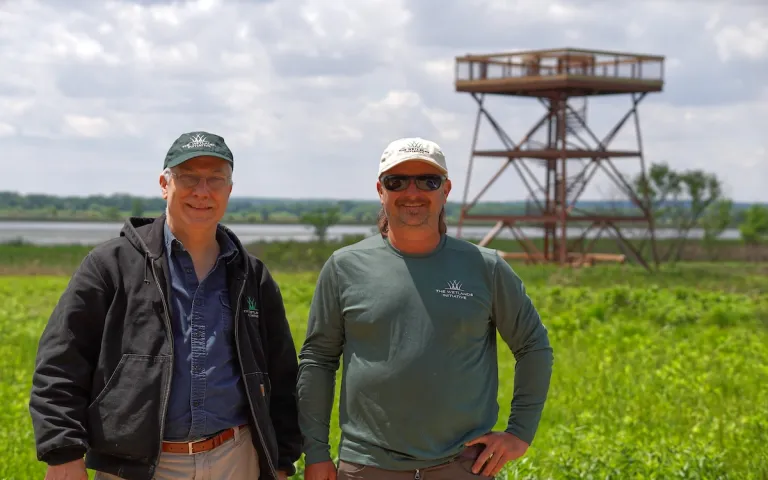
Paul Botts, executive director of the Wetlands Initiative, and Justin Seibert, the Dixon Refuge site manager, stand in front of the refuge’s observation tower. | Photo by Ethan Freedman
But in the Sackett decision, the court said the Clean Water Act only applies to “relatively permanent, standing or continuously flowing bodies of water” commonly referred to as “streams, oceans, rivers, and lakes.” For wetlands to be covered under the law, they need a “continuous surface connection” to other, covered bodies of water, "so that there is no clear demarcation between ‘waters’ and wetlands.’” Or, as Botts put it, you now need water “sloshing back and forth all the time” between the wetland and another body of water for the wetland to be protected under the Clean Water Act.
This means that more isolated wetlands—such as a seasonal pool in the middle of a forest, or a swamp separated from a lake by a housing development—may no longer be protected. To some, this new dividing line can seem arbitrary. For one, even wetlands without a surface-level connection to another body of water are often connected to the larger groundwater system. Botts also pointed out that the idea of an “isolated wetland” doesn’t really depict how wetlands work as ecosystems, with wildlife moving seamlessly between wetlands and the surrounding landscape.
“We don't use that term ‘isolated,’” Botts said. “It's not really accurate.”
An analysis from the Natural Resources Defense Council estimated that the Sackett decision may eliminate Clean Water Act protections from around 130,000 to 970,000 acres of wetlands in Illinois, depending on how the court’s ruling is interpreted. Some of these wetlands may have already been impacted by the Supreme Court’s ruling. Becky Hammer, an attorney with the NRDC, has estimated that between March 2022 and March 2023, about 30 percent of the time someone requested to know if a wetland in Illinois was protected by the Clean Water Act, the government would find that the wetland was protected by the law. But between September 2023 and September 2024, after Sackett, that number dropped to just under 21 percent, nearly a third less.
The bill circulating through the Illinois legislature would, in essence, restore the whole state to a pre-Sackett level of wetland protection. When landowners wanted to fill in a wetland protected by the law, they would need to apply for a permit with the Illinois Department of Natural Resources. They’d also need to pay for wetland restoration or protection somewhere else.
State Senator Laura Ellman, who initially introduced the bill in the state senate last year, said wetlands deserve protection. “It's good for communities, it's good for the environment, it's good for flora and fauna,” Ellman said. “And then with the Sackett decision carving out protections, we need to do something at the state [level]—so I'm thrilled to be part of trying to do this.”
Yet so far, the wetlands legislation hasn’t quite made it over the finish line in the Democrat-controlled Illinois state legislature. Concerns about the state budget made it difficult to get the legislation off the ground this year. And the bill has faced some opposition, including from the Illinois Farm Bureau, despite the fact that “normal farming, silviculture, and ranching activities” are exempted from the proposed regulations. (The Illinois Farm Bureau could not be reached for comment.)
Ashley Maybanks, from the Nature Conservancy in Illinois, also said that advocates didn’t have enough time to have conversations with relevant stakeholders, including county officials and agricultural groups. “We want to make sure that we're not unintentionally creating a burdensome program for people,” Maybanks said. “We also don't want it to be a hugely burdensome program for the Department of Natural Resources to administer.”
In other states, wetlands have been subject to a variety of state-level protections, or lack thereof, in the wake of the Sackett decision. In Michigan and Wisconsin, for example, existing state-level wetlands laws meant that very little changed after the Supreme Court’s ruling. In Colorado, the state legislature actually succeeded in passing a new wetlands protection bill in 2024, helping to fill “a regulatory gap created by” the Sackett decision, per the state. On the other hand, some state lawmakers, including in neighboring Indiana, have worked to loosen wetlands protections in recent years.
In Illinois, wetland conservation may be politically popular. In a poll of likely Illinois voters commissioned by the Nature Conservancy, 72 percent of respondents expressed support for the idea of a state wetlands protection program, including 92 percent of Democrats, 51 percent of Independents, and 59 percent of Republicans. The idea had high levels of support in Chicago, suburban areas, and rural parts of the state. Now, to drum up even more support for the bill, Environment Illinois has started sending people out to knock on doors and talk with Illinoisans about wetlands.
“When you actually share the science, share the information about what the value these wetlands bring to our water and us,” Kowalski said, “people understand and can see that these places are important and should be protected.”
On that warm day at the Dixon Waterfowl Refuge, red-winged blackbirds belted out their boisterous conkareeee! calls in all directions. A pair of towering sandhill cranes touched down at the water’s edge. At the edge of the wetland, wood ducks flew out of the row of trees that lined the Illinois River, swung across the levee, and fluttered into the tall grass.
Today, this landscape is maintained by people who are trying to protect this habitat after years of restoration. But once, this place was governed only by water, which pulsed across the land, trickled through rivulets, and percolated in the warm mud. Water nurtured the reeds and grasses and shaped depressions into pools, where ducks gathered and swallows dipped and dived in the breeze—all of it creating the vast, unified ecosystem that was the Midwest.