 The Magazine of The Sierra Club
Trump and Republicans Peddle False Claims About Wildfires
It’s part of an ongoing pattern of disinformation spreading in response to climate-fueled extreme weather
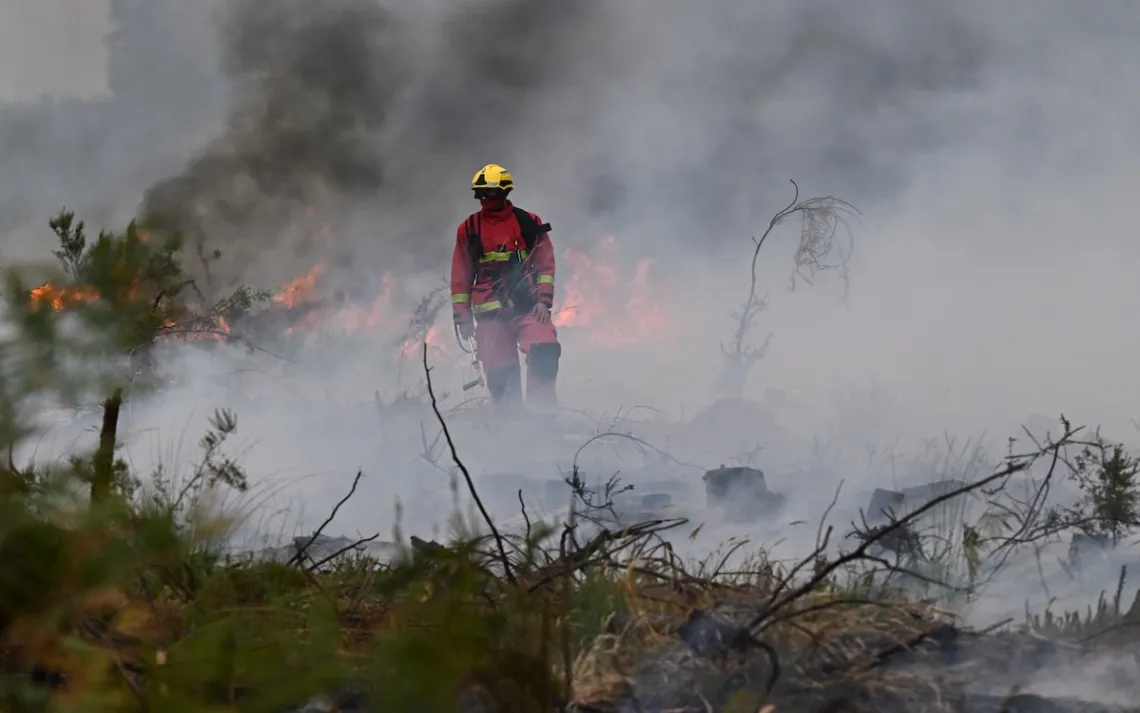
Firefighters battle a wildfire in France on July 26, 2026. | AP Photo/Emma Da Silva
As more than 800 wildfires burned across Canada, millions of Americans experienced days of unhealthy air quality from the smoke that drifted across the border. Air quality alerts were issued in over a dozen states, outdoor activities were canceled, and public health agencies issued guidance for people to stay indoors or wear an N95 mask.
Some right-wing media figures slammed or mocked this advice. And some Republican politicians, including President Donald Trump, accused Canada of “willful negligence” and forest mismanagement while threatening to impose sanctions or tariffs on the Canadian government.
“We are holding Canada responsible for the fact that they are not properly maintaining their Forests, and Brush therein, and the United States is being unnecessarily invaded by filthy, polluted, and unhealthy air,” Trump posted on Truth Social.
Republican lawmakers, all recipients of significant sums of fossil fuel cash, also pointed fingers at Canada and claimed the fires and smoke were the result of forest mismanagement. Senator Bernie Moreno of Ohio introduced a bill called the Canada Fire Act, which would impose sanctions on Canada for the transboundary wildfire smoke impacting the US. Moreno’s office said in a statement: “Canada’s government failed to invest in wildfire-prevention methods including forest thinning, fuel reduction, prescribed burns, and stronger enforcement against arson.” Four Republican House members from Michigan, meanwhile, sent a strongly worded letter to Canada’s prime minister, Mark Carney, accusing the Canadian government of inaction and continued forest mismanagement.
Claims that wildfires can be prevented simply by forest thinning or raking up debris are not only inaccurate, but they are also part of a broader pattern of disinformation in response to climate-fueled extreme weather. That disinformation deflects from what experts say is the biggest driver of worsening fires: the rapidly warming climate.
“We have had bad fire seasons in the past, but we have bad fire seasons more often now because of climate change. That’s quite obvious,” David Martell, a University of Toronto forestry professor, told CTV News.
“The idea that the increasingly widespread and damaging wildfires can be explained away by ‘fire suppression’ practices etc. is an old denialist frame advanced by Trump and GOP,” climate scientist Michael Mann said in a social media post.
Jeopardizing public health and safety
A new report from the National Academies of Sciences, Engineering, and Medicine examines the field of climate science called extreme event attribution. According to researchers behind the report, while other factors like land management and ignition sources may help shape fire activity, climate change plays an important role. “Climate change is contributing to increased fire-weather conditions in many regions through warming, drying, and changes in vegetation, creating environments more conducive to wildfire,” the report states.
And yet, false claims and disinformation tend to spread rampantly in response to wildfires and other extreme-weather disasters linked to climate change. In the wake of climate-fueled disasters during the summer of 2023, for example, false claims and conspiracy theories attracted large audiences online.
Trump himself has a notable track record of platforming lies about extreme-weather events, from the “Sharpie-gate” incident where he appeared to alter the forecasted path of a hurricane to his claim during a visit to the California town of Paradise that was destroyed by a wildfire in 2018 that “raking” the forest could prevent these fires from happening. When wildfires torched the Los Angeles area last year, Trump cast blame on California Governor Gavin Newsom and local officials, claiming they diverted water resources to protect an endangered fish species. There was no factual basis for that claim. Still, the falsehood formed the basis of an executive memorandum that Trump signed on his first day back in office titled “Putting People Over Fish: Stopping Radical Environmentalism to Provide Water to Southern California.”
While this pattern of disseminating false claims or inaccurate information about extreme-weather events is by no means new, it is still dangerous. When disinformation about climate change is taken up as true, it muddies the public’s understanding of why these disasters are happening and what can be effectively done to mitigate or respond to them.
“Misleading claims about the causes of wildfires distract from evidence-based public health messaging and create confusion during emergencies, when people need clear, trustworthy information,” Samantha Green, president of the Canadian Association of Physicians for the Environment, told Sierra. “During wildfires and other climate disasters, accurate information is a public health intervention. When false claims spread, they can put people's health and safety at risk.”
“As a primary care doctor, I see firsthand that climate-fueled disasters are becoming more frequent and severe,” Green added. “We should be focused on protecting people, not wasting valuable time countering false narratives. False claims about the causes of wildfires distract from the urgent work of protecting communities and preparing for increasingly severe wildfire seasons.”
Social media platforms are part of the problem too
From blistering hot temperatures to flooding and wildfires, extreme weather gripping the United States this summer has already broken records. But while climate scientists have long been warning that such extremes are consequences of human-caused global warming, climate deniers and industry-funded politicians are once again amplifying false or misleading claims about these events—further fueling a toxic digital discourse that is going unchecked by Big Tech firms and social media platforms.
A new brief published by Climate Action Against Disinformation examined disinformation and false narratives circulating online in response to the recent smoke episode from Canadian wildfires, as well as the unprecedented heat wave that scorched Europe in June. Titled “A Summer of Extreme Lies: Heatwave and Wildfire Climate Disinformation in 2026,” the brief argues that social media companies should be held accountable for facilitating the rampant spread of falsehoods during extreme-weather disasters, which can distract from accurate information and undermine public safety.
“Climate change is already making extreme weather more frequent, more intense, and more dangerous,” the brief states. “The public should not also have to contend with social media platforms amplifying falsehoods that undermine public understanding and can put lives at risk. We don’t have to tolerate social media companies making it harder to protect lives during these increasingly dangerous and destructive events.”
The brief follows a July 2025 report from the Center for Countering Digital Hate (CCDH), which examined how Big Tech and social media companies facilitate the rampant spread of false and misleading claims about extreme-weather events. The report found that false and misleading claims about extreme weather tend to proliferate on major social media platforms with virtually no fact-checking, reaching millions of viewers. False or misleading claims about recent extreme-weather events, such as Hurricanes Helene and Milton and the Los Angles fires, were viewed more than 221 million times across platforms including Meta (Facebook and Instagram), X, and YouTube. The study looked at 300 of the most-liked posts about extreme weather made on these platforms between April 2023 and April 2025.
“The social media views of just one well-known superspreader of conspiracy theories and lies, Alex Jones, outnumbered the views of official emergency response information amid the LA wildfires. His false claims, including accusations of FEMA ‘food confiscation’ and globalist plots, amassed over 400 million views on X—more than double the combined reach of FEMA and ten major news outlets. By undermining trust in first responders and sowing confusion in moments of crisis, platforms are sabotaging disaster response for profit,” CCDH CEO Imran Ahmed writes in the report’s introduction. “As climate disasters become increasingly severe and frequent, we must confront the reality that tech giants are active participants in the spread of falsehoods that endanger our communities and the planet.”
Phil Newell, communications co-chair of Climate Action Against Disinformation, said that CAAD and other groups have been warning for years now about the swell of disinformation in the wake of extreme-weather disasters.
“Every year, there’s this wave [of lies] that follows this sort of seasonal cycle, whether it’s a heat wave or wildfire or hurricanes, where online dis-influencers provide whatever excuse they can for people to recontextualize this as not a symptom of climate change,” he said.
Climate deniers like Trump also cling to false narratives in the face of increasingly severe and frequent extreme weather.
“As the impacts of climate change get worse, they have to come up with excuses to talk about anything but climate change,” Newell said.
In terms of curbing the unchecked spread of climate disinformation online, Newell said that it is “absolutely a solvable problem.” For tech companies and social media platforms that are unwilling to act on their own accord and put in place information integrity policies, he said it is up to policymakers to step in and hold them accountable.
“Ultimately it’s up to policymakers, and it’s up to the public to demand that from the policymakers.”