Trump, DOGE Slashed Firefighting Resources Before One of the Worst Fire Seasons on Record
Budget cuts and policy shifts have curtailed the federal government’s ability to respond
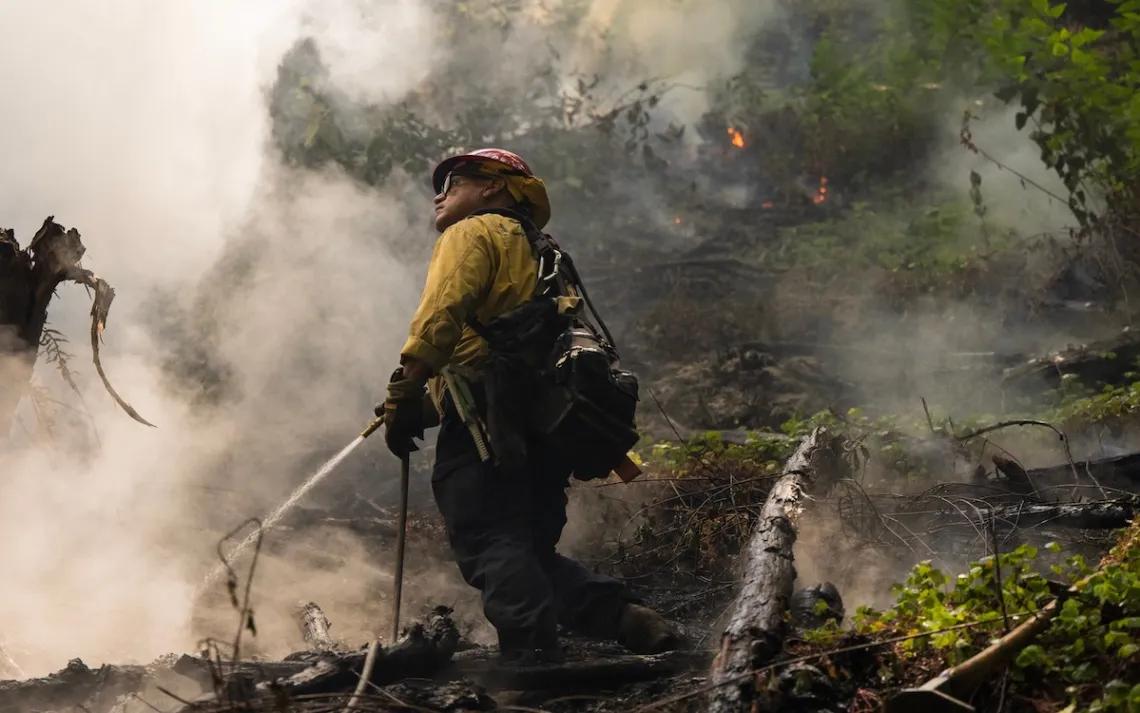
A firefighter sprays water on hotspots in Castro Canyon during the Timber Fire in Big Sur, California, on August 13. | Photo by AP Photo/Nic Coury
The federal government’s ability to respond to wildfires has been dramatically curtailed in the midst of one of the worst fire seasons on record in the United States.
Staffing and resources to combat these blazes are now at critically low levels due to budget cuts and workforce reductions that have compounded under the Trump administration. These cuts, combined with questionable policy moves made by the administration around forest management and wildland firefighting, are aggravating an already hazardous situation and threatening to increase rather than curb wildfire risk, critics say.
“Doubling down on past mismanagement strategies, eliminating the current land stewardship responsibilities that agencies were expected to follow, and on top of that, you add exacerbated wildfire conditions across much of the West. The actions taken to get here have made the situation worse than it ought to be,” said Alex Craven, forest campaign manager at the Sierra Club.
A record low winter snowpack in the western US along with hot and dry conditions have heightened the risk for severe wildfires this year. Over 50,000 wildfires have burned more than 7.8 million acres so far, according to the National Interagency Fire Center. These numbers are the highest in over a decade and far above the 10-year average.
Before this fire season even began, the Trump administration put into motion sweeping changes that have impacted the federal agencies charged with wildfire response and mitigation work. The US Forest Service, for example, lost about 20 percent of its workforce during the mass federal reductions led by Elon Musk’s Department of Government Efficiency. Thousands of Forest Service personnel left the agency in the first few months of the new administration; veteran wildland firefighters and staffers that supported large firefighting operations were pushed out of their jobs.
“It’s not just firefighters. It’s all of the support personnel that go along to support the fire operations.”
Forest Service firefighters had been facing mounting pressure for years due to budget cuts, increasing job demands, and relatively low pay. Some had decided to leave before the Trump administration took office. The widespread workforce cuts that then began in 2025 “just exacerbated the problem,” according to Bobbie Scopa, a retired wildland firefighter with 45 years of experience and vice president of Grassroots Wildland Firefighters.
“What [the Trump administration] did is they used a blunt tool to make cuts, and many of those people who were cut had fire qualifications,” Scopa told Sierra. While firefighters and hotshot crews weren’t directly targeted, a lot of the cuts affected wildfire incident management teams—the people who support the firefighters out in the field, Scopa explained. “It’s not just firefighters. It’s all of the support personnel that go along to support the fire operations.”
Scopa said there are also vacancies in leadership roles that call for people with management experience who can supervise hotshot or fire engine crews.
The mass layoffs and chaos inflicted upon federal agencies including the Forest Service, at a time of worsening wildfires and other extreme weather disasters as the planet logs record temperatures, has rendered the nation less prepared and more vulnerable, Craven noted.
“This was foreseeable,” he said. “And to walk right into this without the capacity or organization or lines of communication that are needed is negligent. That’s what we’re seeing right now.”
“This plan would dismantle the world’s premier—and largest—wildfire research agency when wildfire risk, climate impacts, and economic losses are accelerating."
In addition to wildland firefighting workforce reductions, the administration has considered axing critical wildfire research stations as part of a proposal to close 57 of the Forest Service’s 77 research facilities.
“This plan would dismantle the world’s premier—and largest—wildfire research agency when wildfire risk, climate impacts, and economic losses are accelerating,” the Union of Concerned Scientists’ Julian Reyes wrote in a blog post. “Given future drier and hotter conditions and increasing severity of wildfires, losing this research would diminish our understanding of effectively managing forests under climate change.”
Randy Erwin, national president of the National Federation of Federal Employees, condemned the Trump administration’s actions, saying in a statement that they are making it more difficult to fight dangerous wildfires. “DOGE recklessly cut more than 6,000 USFS workers, thousands of them qualified wildland firefighters, and the Trump administration now threatens pointless relocations or terminations of many more, including shuttering 57 of 77 research labs critical to fire preparedness and response,” Erwin said.
“The president is directing an illegal and irresponsible reorganization of the Forest Service, forcing qualified professionals to relocate or quit at the height of the fire season,” he added. “This has extremely dangerous ramifications, as wildland firefighters on the front lines will face logistical hurdles from managerial restructuring and resource deployment issues.”
Last year, Trump ordered a consolidation of the government’s wildland firefighting workforce, shifting thousands of firefighters away from the Department of Agriculture’s Forest Service and creating a new centralized program under the Interior Department called the Federal Wildland Fire Service. Former Forest Service officials warned that the move would be costly and could undermine wildfire response.
With the reduction in Forest Service resourcing and staff, there has also been a drop in wildfire prevention and mitigation work. A 2025 analysis from Grassroots Wildland Firefighters found that hazardous fuels reduction work on Forest Service land—involving prescribed burns, thinning overgrowth, and brush clearing—declined 38 percent for the first nine months of the year compared with the same period in previous years. “It was a considerable reduction in acreage treated,” Scopa said.
Policies exacerbate wildfire risk
The administration’s policies around forest management and wildfires—prioritizing logging of old-growth forests and larger trees that are more fire-resilient and mandating a full fire suppression approach that disrupts natural fire cycles—only make the situation worse, Craven said.
“All of that, coupled with their general attitudes toward climate change and fossil fuel use, combine to exacerbate wildfire conditions,” he told Sierra.
Susan Prichard, a research scientist at the University of Washington who studies fire ecology, landscape vegetation, and fire dynamics, said that an aggressive fire suppression approach like the one the Trump administration has embraced is not aligned with science-backed best practice.
“Full suppression policies haven't worked in the past, and they certainly won't work under the drier, hotter, and windier summers that we've all been living through in the western US and Canada,” she said. “We absolutely need firefighting resources to be well funded and to respond to fire starts in the height of wildfire season. However, there are many fires in the late season or early spring that can add to the beneficial work of intentional burning such as cultural burning and prescribed burning.”
“When you’re punching more roads into wild places, you’re going to increase the likelihood of wildfires starting.”
Less protected forests without the Roadless Rule
The Trump administration is now moving forward with plans to strip away protections for nearly 45 million acres of national forests, under the guise of addressing wildfires. USDA head Brooke Rollins just announced a proposed rule to “rescind in its entirety” the 2001 Roadless Area Conservation Rule, arguing it “served as a barrier to wildfire risk reduction work across large swaths of America’s national forests.”
The Roadless Rule protected around a third of national forest lands from logging and development. The Trump administration claims that this restriction limits the Forest Service from carrying out active forest management and fuel reduction work to mitigate wildfire risk.
But conservation advocates and critics of the proposed rescission say that opening up these lands to roads could actually increase wildfire risk, as most fire ignitions are caused by human activities. A peer-reviewed study published in January found that wildfire ignition density in forested lands was highest in areas close to roads. Fires in those areas were about four times as likely to ignite compared with roadless areas.
“It’s not a complicated sequence to follow. When you’re punching more roads into wild places, you’re going to increase the likelihood of wildfires starting,” Craven said.
Proposed legislation addresses wildfire preparedness and workforce support
As fires continue to burn across large swaths of the West, federal firefighting crews that are already stretched thin are facing even greater demands, yet the support they need is not keeping pace. Many firefighters are considering leaving the profession.
“It’s a tough situation, it’s a tough work environment, and I don’t think the public realizes the pressure that our federal firefighters are put under,” Scopa said. She noted that wildfires are different than they were just a few decades ago, with bigger blazes and longer fire seasons, and yet the federal government’s approach to managing them has not changed much to reflect this new reality.
Several Democrats in the House recently introduced a package of bills called the Wildfire Response and Readiness Act, which would start to address this gap. The legislation focuses on fire planning and resilience to help protect public lands and communities and also supports the wildland firefighting workforce through better pay and benefits, including leave.
“The Wildfire Response and Readiness Act advances critical prevention, mitigation, and response strategies while delivering long-overdue support for our brave and heroic wildland firefighters, who risk life and limb to protect our communities and deserve fair compensation and benefits,” Colorado Representative Joe Neguse said in a statement.
Scopa said that improved pay and benefits such as medical support are critically needed to help ameliorate the crisis facing federal wildland firefighters.
“We have to do better for our firefighters,” she said. “We have to do better for their health, and we have to take care of them.”