Two Florida Coral Species Were Nearly Wiped Out by a Heat Wave
Corals are the canary in the coal mine for oceans, and they’re sending researchers troubling signals

Dead elkhorn coral in 2024 at Carysfort Reef, northeast of Key Largo, Florida. | Photo courtesy of Ben Edmonds/NOAA via AP
Researchers have declared that two species of coral off the coast of Florida are “functionally extinct.” The findings, published in the October 23 edition of the research journal Science, reveal that the extreme temperatures during a heat wave in 2023 warmed coastal waters to 100°F, and elevated temperatures lingered for months. According to scientists, the heat streak was unprecedented in its duration, intensity, and extent, all of which threatened an already eroding undersea ecosystem.
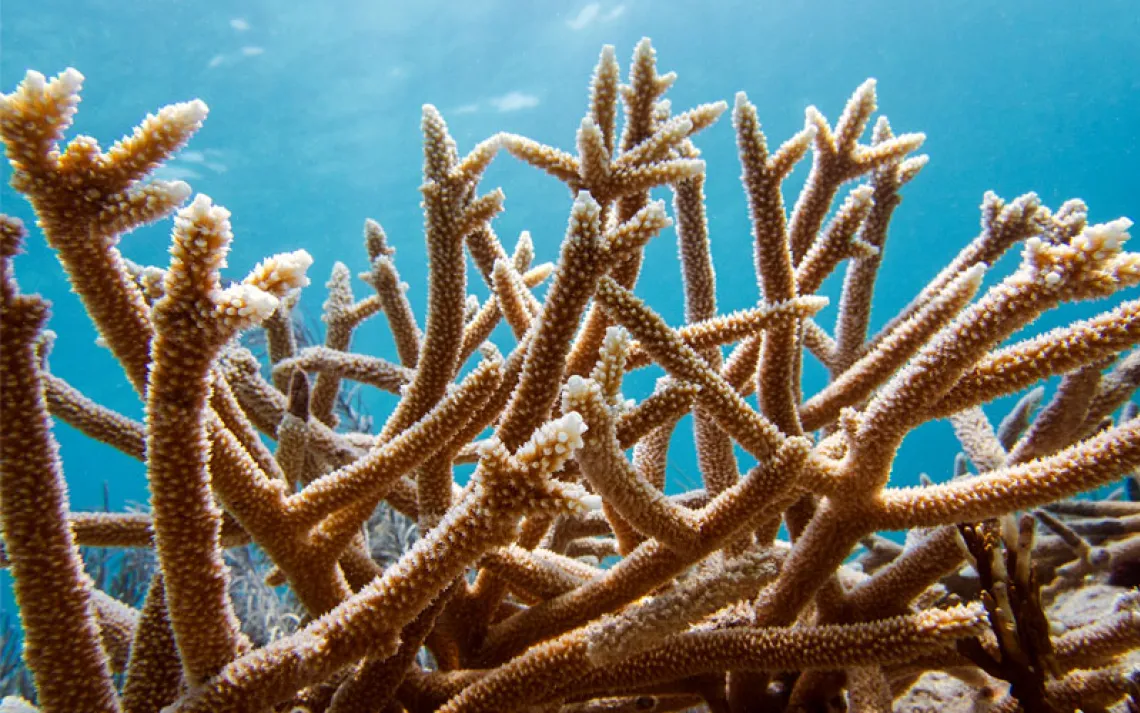
More than 40 marine experts from a dozen-plus institutions found that two small, stony coral species, commonly known as elkhorn and staghorn coral, have declined to the point that they no longer play a role in the ecosystem, hence being functionally extinct. These fast-growing, branching corals, which belong to the genus Acropora, were the foundation of the 350-mile Florida Coral Reef, the third-largest barrier reef ecosystem in the world. The imperiled reef serves as an economic engine for Florida, supporting 71,000 jobs and generating $1.1 billion in annual tourism revenue.
“I want people to understand just how serious this is and take a moment to digest the fact that we are now seeing heat waves on our planet that are exceeding the ability of whole species to survive in places where they have been doing so for hundreds of thousands of years,” said study coauthor Ross Cunning, a coral research biologist at Shedd Aquarium in Chicago.
The researchers monitored the health of more than 52,000 Acropora colonies, finding a mortality rate between 97.8 and 100 percent in South Florida, specifically in and around Dry Tortugas National Park and the Florida Keys. Heat-related mortality was lower near Miami; however, the staghorn and elkhorn populations there were already significantly depleted. The two coral types had been listed as threatened under the Endangered Species Act and critically endangered by the International Union for Conservation of Nature.
Globally, an estimated 30 to 50 percent of coral have already perished, according to the National Oceanic and Atmospheric Administration. The Florida Coral Reef, likewise, has been declining for decades, a worrying sign given the important role reefs play in ecosystem health. Coral reefs provide habitat for about a quarter of all marine species and help protect shorelines from flooding, storm damage, and erosion.
“Before this all started, we were already down to something like 2 percent coral cover,” said coauthor Erinn M. Muller, the associate vice president for research of the Coral Health & Disease Program at Mote Marine Laboratory in Sarasota, Florida. White band disease, which primarily strikes staghorn and elkhorn corals, reduced the reef’s cover by about half in the 1970s and '80s, she explained. Other diseases and heat events further eroded those and other coral species.
This die-off was the result of a phenomenon that researchers refer to as “coral bleaching.” Healthy coral live in tandem with a type of algae that uses coral as hosts, and, in turn, provides the colonies with oxygen, nutrients, and waste removal services—along with giving corals their distinct colors. When exposed to prolonged high temperatures, stressed corals expel their algae, resulting in a skeletal-like appearance. Coral die if they go too long without algae’s life-giving support.
Some 90 percent of corals in Florida bleached in 2023 due to warming waters, Cunning said. The episode, which reverberated globally, is considered the world's fourth coral bleaching event. Although the heat-sensitive Acropora succumbed, other types, such as boulder and brain corals, recovered—an important clue for scientists who are studying how to make reefs more resilient.
The Acropora species are not the first to be deemed regionally or functionally extinct, Cunning said. Florida’s pillar coral, for example, was given the grim designation in 2020. But the loss of elkhorn and staghorn corals is significant for their “outsized” role in reef building, he said.
However, even these coral species are not entirely lost.
During the heat wave, scientists saved about 150 genotypes, a.k.a. genetic material, of elkhorn coral and 250 genotypes of staghorn. They’re stored in biobanks at the Mote laboratory and The Reef Institute in West Palm Beach, Florida. The material will be used to propagate and reintroduce staghorn and elkhorn corals once conditions are more favorable.
“One of the most important things that we are doing is ensuring that no matter what happens out on that reef—tomorrow or 10 years from now—that we have a critical safe haven of species and genetic richness,” Muller said, who is also the manager of the Coral Health & Disease Program at Mote Marine Laboratory.
Florida is an epicenter for coral restoration, where scientists have planted hundreds of thousands of nursery-grown specimens to aid the reef’s survival as coral colonies battle temperature surges, disease, declining water quality, and other stressors that have limited their natural reproduction.
Scientists are investigating new approaches to reintroduce coral and bolster heat resilience. These include using heat-tolerant species in restoration projects; identifying algal types less likely to be expelled; understanding how some corals survived the heat wave; and introducing genes from those survivors into more vulnerable populations.
“It’s too soon to give up on these corals,” Cunning said. He cautioned, though, that saving coral will require collective action. “How do we want to respond, in this moment, when we’re seeing species disappear from our ecosystems?”
Michael Goldberg, the owner of a conservation-minded dive shop in the Florida Keys and cofounder of I.CARE (Islamorada Conservation and Restoration Education), said he’s choosing to remain optimistic, despite the new study’s findings. I.CARE is a community-driven coral restoration organization that partners with Mote Marine and other institutions. He’s buoyed by the coral colonies that rebounded after 2023 and the young corals that survived in the nurseries.
“If we just look at the coral loss and talk about that, it gets pretty dour,” he said. “But there is tremendous hope.”