 The Magazine of The Sierra Club
Watching Logs Decay Is More Interesting Than You’d Think
Logs can act like “giant teabags” to leach nutrients into ecosystems
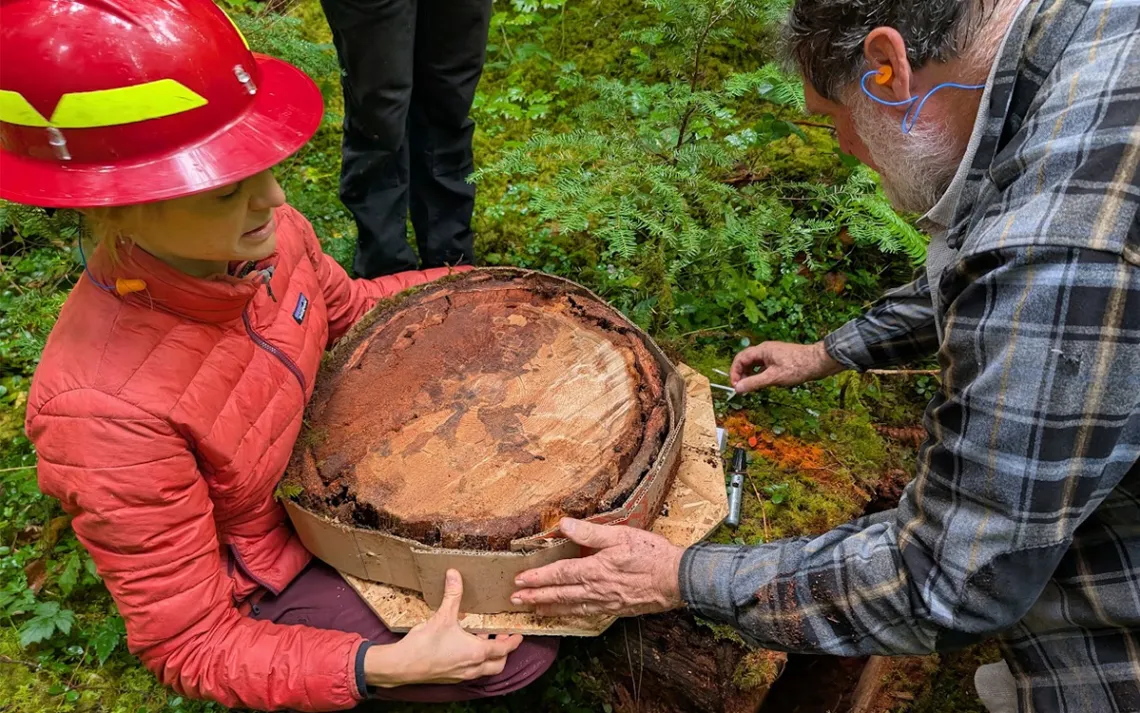
Assistant professor Georgia Seyfried and emeritus professor Mark Harmon secure a "cookie" extracted from a decayed Douglas fir log for transport to the laboratory. | Photo courtesy of Jacob Bukoski
In 1985, ecologist Mark Harmon directed 528 healthy logs be trucked and installed at six sites across the Andrews Experimental Forest in central Oregon. He wanted to better understand how logs decompose in old-growth forests, and he figured 200 years was a good length of time for the experiment.
Not everyone thought “wasting” hundreds of perfectly good logs on this study was a brilliant idea. Harmon recalls an equipment operator yelling at him about his “ridiculous” project as he helped move logs into place.
“It was just a blue streak coming out of his mouth,” recalls Harmon, who was a PhD student at Oregon State University at the time. “By the end of it, he was proud to have worked on the study.”
In the mid-1980s, scientists at Andrews were only beginning to ponder the role dead wood plays in the forest ecosystem.
“There are tons of logs and snags in the forest,” says Harmon. “We started asking, What are they doing? What controls when they disappear?”
At that time, Andrews was one of several sites taking part in a new National Science Foundation initiative called the Long Term Ecological Research Network, or LTER. Its purpose was to study processes in ecosystems, from forest to grassland to tundra, that take years or even decades to unfold.
Among other things, Harmon and his colleagues wanted to learn how water and nutrients moved in and out of the logs. Early on, they noticed the logs leached large amounts of organic matter, “like giant teabags.” They also discovered mushrooms were transporting nutrients from the dead tree to the forest floor.
Findings like these immediately started informing forest management.
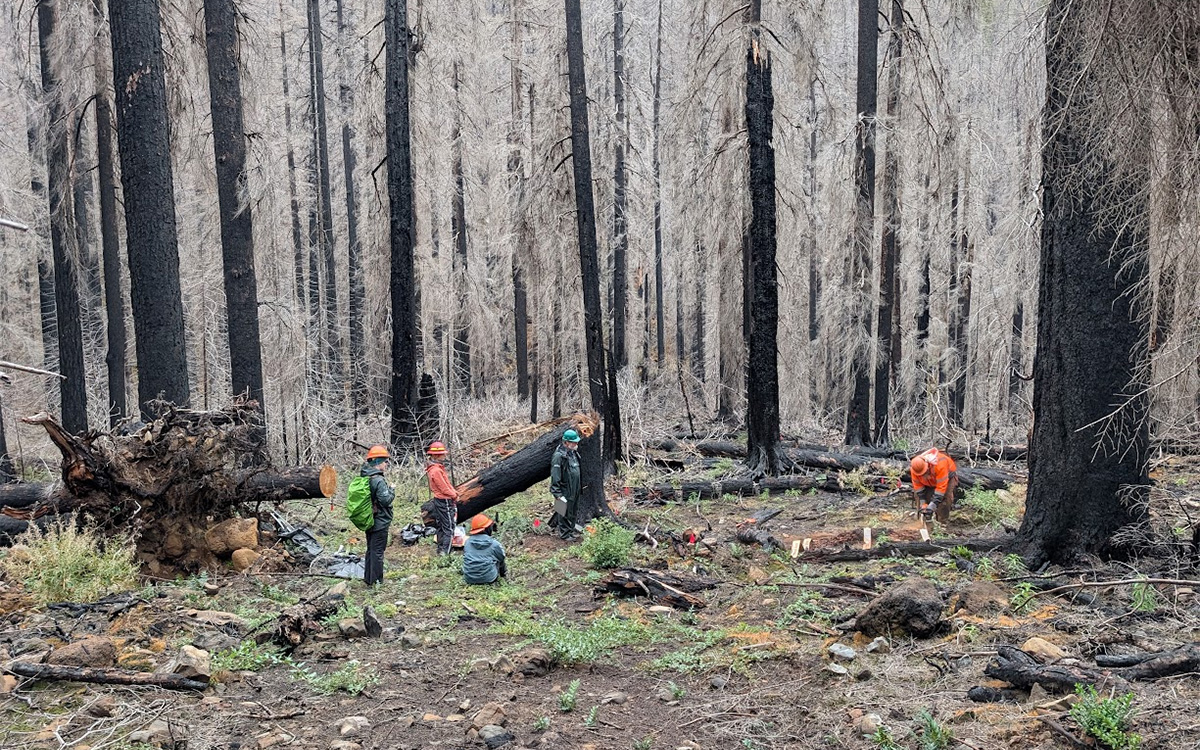
The log decomposition team extracts a cookie from a burned log at Site 6. | Photo courtesy of Jacob Bukoski
Up into the 1980s, dead and fallen trees were viewed as “waste” that harbored diseases and helped spread fires. It was common practice to remove them, even though yarding or piling all of this unmerchantable timber was costly.
“Hundreds of managers came out to see this study and hear us talk about the role of dead trees,” says Harmon. “They started to rethink management.”
Willamette National Forest, where the Andrews Experimental Forest is located, was the first to implement the new policy of leaving dead trees where they are. It saved upwards of $10 million a year. Other Northwest forests followed.
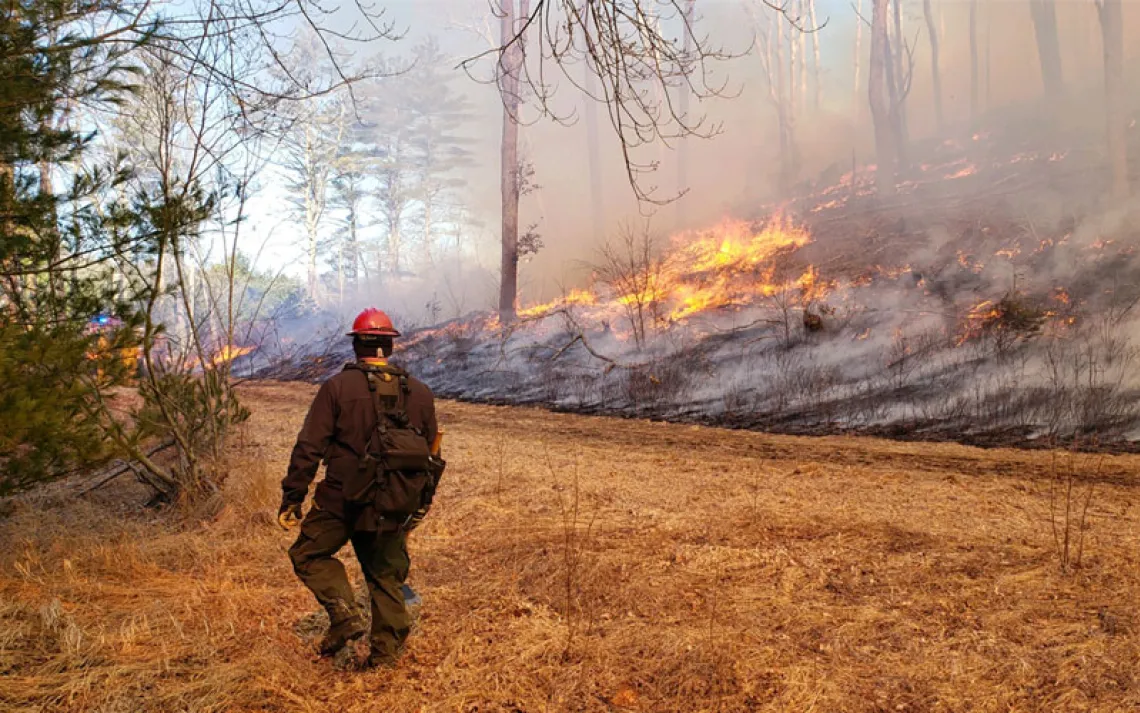
Then in August of 2023, the Lookout Fire broke out near the forest’s eastern boundary. About 70 percent of the 1600-acre experimental forest, including half of the log decomposition sites, burned in the fire. Logs in the burned sites are visibly charred, with new plants starting to grow up around them.
“Now we have this perfect experimental study design with three replicates of a burned forest and three replicates of the unburned logs,” says Jacob Bukoski, assistant professor and director of the Forests and Climate Change program at OSU, who is now co-managing the study with Georgia Seyfried.
Bukoski and Seyfried are just starting to learn how wildfire has affected the logs. They expected charred wood to be less biologically active than unburned wood, but one year after the fire, Seyfried, who is assistant professor of Belowground Forest Ecology at OSU, discovered the opposite was true.
“It’s got us puzzled,” says Harmon, who is now professor emeritus at OSU. “How is it more active biologically? Is it because the site’s warmer? We don’t know.”
That's the importance of the long-term research, adds Bukoski. “We don't really know what those logs will do.”
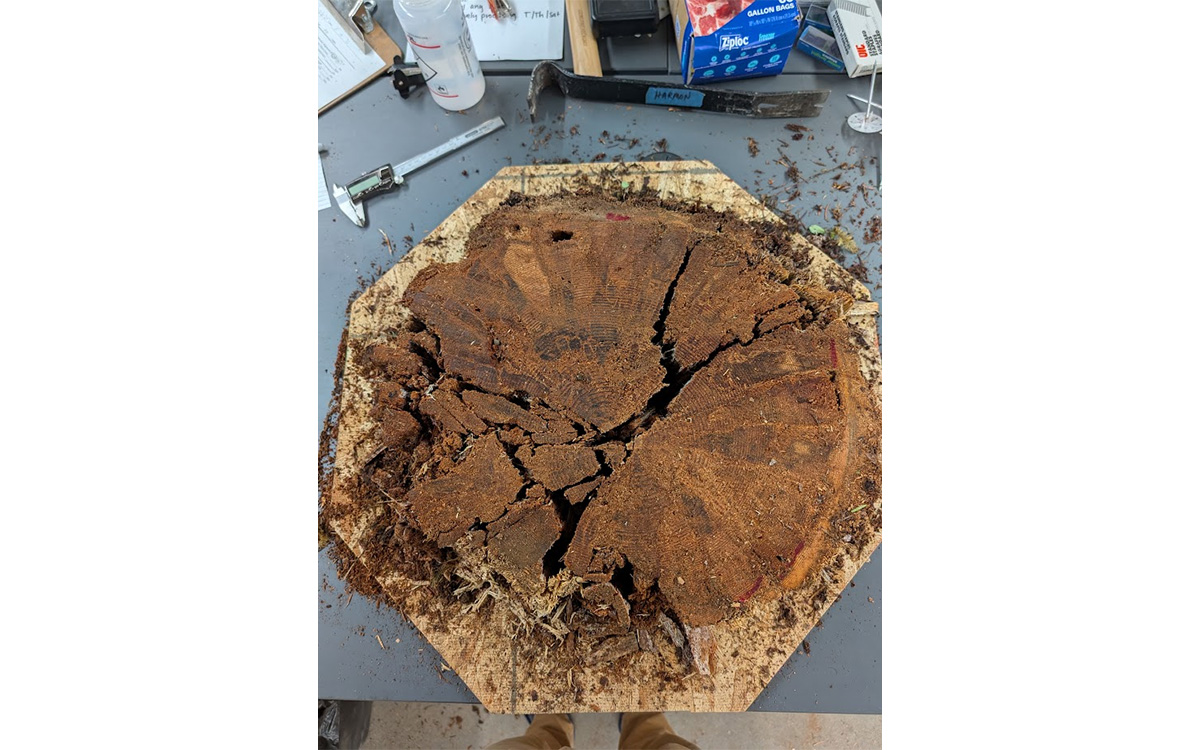
An extracted cookie, having gone through 40 years of decomposition, ready to be processed in the laboratory at Oregon State University. | Photo courtesy of Jacob Bukoski
The National Science Foundation, which funds the Long Term Ecological Research Network program, has been targeted by the Trump administration. Now, NSF has proposed changing its grant-making process so that political appointees can award and terminate grants. The administration has also recommended zeroing out the Forest Service budget for research, and staffing cuts have made it harder for scientists to maintain the many projects at Andrews.
“It's really disheartening to see the federal government doing its best to undermine science,” says Harmon. Science is not political, he adds, but a “non-partisan long-term process intended to advance objective knowledge of the world around us.”
Tracking rates of decay
In the study’s early days, Harmon and his team sampled the decomposing logs every year. It’s a meticulous process that involves cutting cross sections, or “cookies” out of a subset of the logs, labeling and photo documenting them. Then the researchers separate out the different types of wood and dry and weigh the components.
Over the decades, the sampling interval has lengthened. Last summer, Bukoski and Seyfried sampled logs for the first time.
Bukoski has been surprised to see how much variation there is in the rates of decay, both among the different types of wood and among the four conifer species that are part of the study (Douglas fir, western red cedar, western hemlock, and Pacific silver fir). After 40 years, the Pacific silver fir is practically mulch, whereas the red cedar heartwood has barely decomposed, if at all.
These differences make an argument for diversity, says Bukoski. “In plantation forestry, where you have monocultures, you're probably not getting kind of the same nutrient cycling processes as in a more biodiverse forest.”
Experimental forests and ranges are specially designated living laboratories where long-term field research can take place uninterrupted. Thanks to long partnerships with the Willamette National Forest, Pacific Research Station, and OSU, Andrews has been fertile ground for collaborative research, bringing together scientists, undergraduates, graduate students, post-docs and full professors from all over the country.
“It's a really wonderful community and it highlights how science is a social process that's done by communities of people,” says Bukoski.
The log decomposition study in particular has captured the imaginations of scientists and artists alike. As part of a long-running arts and humanities program at Andrews called Reflections, a group of poets, writers, and visual and performing artists created work for an exhibit called Rot: The Afterlife of Trees that was hosted at the World Forestry Center and elsewhere.
The arts and humanities play a critical role at Andrews, says Fred Swanson, a retired geologist who has championed the Reflections program since its inception. “When we make decisions about what we do in the world, we need facts, but we need to be clear about our values and remember them.”
In 2018, poet Derek Sheffield was a writing resident at the Andrews Experimental Forest. Inspired by the log decomposition study,, Sheffield wrote the following poem, which begins:
Below thick moss and fungi and the green leaves
and white flowers of wood sorrel, where folds
of phloem hold termites and ants busily gnawing
through rings of ancient light and rain, this rot
is more alive, says the science, than the tree that
for four centuries it was.