 The Magazine of The Sierra Club
What’s Behind Florida’s Push to Ban Shark Feeding?
It’s more complicated than it seems
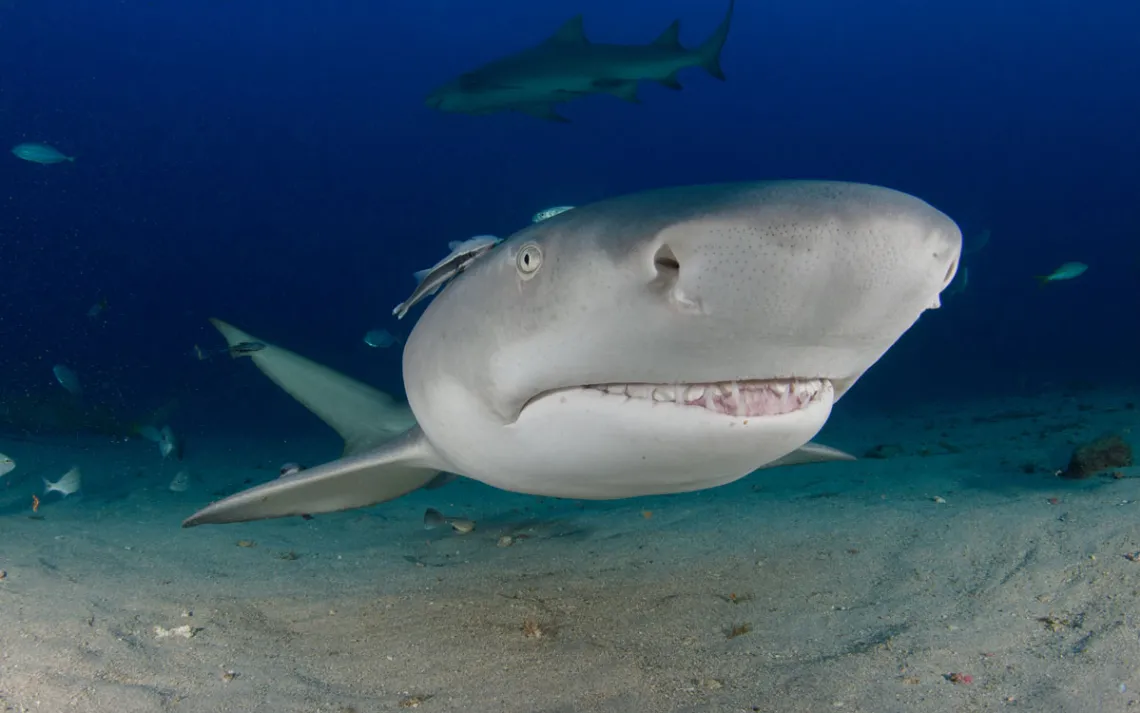
A lemon shark near West Palm Beach, Florida. | Photo by Julian Gunther/Getty Images
Every month, Joshua Eccles takes curious clients three miles offshore of Jupiter, Florida, to swim with sharks. His company, Dive Time Charters, is one of just under a dozen operators in the entire state that specialize in this unique form of ecotourism, giving residents and visitors the opportunity to safely view sharks in their natural habitat.
To do so, operators, including Eccles, release frozen or fresh fish remains to attract the sharks, also called “chumming.” Over the past decade, Eccles has seen—and safely removed—hundreds of fishhooks lodged in the cartilaginous corners of sharks’ mouths.
But a group of Florida lawmakers is now proposing legislation, HR 3831, that would make it illegal for tour operators to chum in most of the waters off the coast of Florida. This area is called the Exclusive Economic Zone (EEZ), and it includes everything up to 200 nautical miles offshore. If passed, the measure would effectively put Eccles and his shark-diving colleagues out of business.
Proponents say the bill, nicknamed the Florida Safe Seas Act, is needed to protect humans from shark attacks and to curtail the incidents where sharks nab anglers’ hooked catch—a phenomenon that many refer to as “depredation,” which fishing enthusiasts say has become a huge problem. But scientists say there’s no evidence to suggest that banning these activities will solve either of those concerns.
“It's really scary because they're willing to wipe out a whole industry without any science backing [the bill],” Eccles said. “They're kind of fast-tracking it to make sure that no one's paying attention to it.”
There’s evidence that feeding animals does habituate wildlife, such as sharks, but shark tourism is one of many activities implicated, said Jasmin Graham, a marine biologist and cofounder of science nonprofit Minorities in Shark Sciences. For instance, the legislation completely overlooks how fishing, which requires bait, habituates sharks, she said.
“You can chum if you're going to harvest the sharks, which [seems] like it's rewarding harvesting sharks,” she said. “It’s weirdly written.… The bill itself does not actually deal with the main issues surrounding depredation.”
Jimbo Thomas, owner and captain of Thomas Flyer Fishing Charters in Miami, told Sierra that sharks eating anglers’ catch seems to happen more frequently now than it used to, often from sandbar sharks—one of the most common species that preys on hooked fish, according to research published in April 2026. But when it comes to the shark-diving industry’s role, “I don't think that [operators] feeding those sharks is the cause of depredation on our fish,” Thomas told Sierra. The problem, he added, is their learned association of fishing boats with food. “It's something that's not going away, unless they just decimate the sharks,” Thomas said, which he doesn’t support.
However, that’s exactly what some outraged anglers have proposed. Bullets have been found lodged in sharks’ cartilage in apparent attempts to kill them.
Culling sharks isn’t the answer, Graham said, and neither is the idea that shark populations are “out of control.” It might seem like there are more sharks now than before because of successful conservation measures, she said; in fact, over the past three decades, some Atlantic shark species have seen slight population increases. But these increases are nowhere near their original population sizes from the early 20th century.
Yet, sharks eating anglers’ quarry is not a new concept. Sharks have been nabbing anglers’ game for more than a century. Famously, it’s the central challenge for the protagonist in Ernest Hemingway’s 1952 novel The Old Man and the Sea as sharks strip the flesh away from his prized marlin during a fishing trip off the coast of Cuba.
The role of fishing, scientists emphasize, can’t be ignored. Florida is known as the fishing capital of the world, boasting a saltwater fishing industry worth $9.2 billion and hosting an estimated 4 million anglers annually.
“They both represent the same thing to the sharks,” Hannah Medd, a marine conservation scientist and founder of the American Shark Conservancy, said of shark feeding, whether it’s due to tourism or recreational fishing. “It seemed odd that this would be a solution.”
With the rise in predation on hooked catch, researchers have started to focus their research on the behavior, especially in the Southeast. Early solutions have included deterrents and fishing devices that are less attractive to sharks. “Scientists are very aware that it's an issue, and there are a lot of people working on it,” Graham said. “The issue is that research and that knowledge is not getting to policymakers.”
This isn’t the first time legislators have proposed a bill that aims to tackle shark feeding habits. Another related bill, called the SHARKED Act, aims to establish a task force to resolve the issue. It has been sitting in the Senate since January 2025. Both the SHARKED and Florida Safe Seas Acts “are two pieces of pasta that we've thrown at the wall,” Graham said. “This is yet another attempt to deal with a very important and complex issue with a not-complex or well-thought-out solution.”
A more nuanced approach would consider shark prey populations, fisheries management issues, angler education, shark population monitoring, and shark behavior, Graham said. “All of those are things that are actually helpful,” she said. “None of that is in this bill.”
Aside from predation concerns, the bill’s safety priority has little to do with shark-diving operations. While Florida leads the nation in shark bites, the majority of these encounters happen in Volusia County, roughly 200 miles north of where all the shark-diving operators take their clients.
In fact, there’s been a decrease in shark bites over the same period that there's been an increase in operators, Medd said. Most shark encounters happen closer to shore, she added, yet Florida allows land-based shark fishing. That means anglers can legally catch and reel sharks to the shore, where beachgoers, snorkelers, and other swimmers are most likely to encounter sharks.
Data analysis shows that it is significantly more likely for somebody to suffer a dog attack than a shark attack, and Florida is no exception. In 2025, Florida logged 11 shark bites with zero fatalities. Meanwhile, it’s over five times more likely for someone to die from a dog bite than a shark bite in Florida.
Supporters of the bill include Florida’s wildlife agency (which also supported a constitutional amendment to make hunting and fishing the “preferred means” of wildlife management in 2024) and the American Sportfishing Association. Representative Daniel Webster, the bill’s Republican sponsor, and Representative Darren Soto, the only Democratic co-sponsor of five, did not accommodate an interview with Sierra.
The House of Representatives passed the bill in June. To become law, it would still need to go through the Senate. (The Florida Chapter of the Sierra Club does not hold an official position on this issue.)
Passing the Florida Safe Seas Act to protect people from shark attacks “makes no sense,” said Jason Poblete, a Florida-born federal regulatory lawyer who is not involved in the legislation but has analyzed it in his personal Substack. Having grown up fishing and snorkeling alongside sharks in Miami, he says the bill seems to reflect Jaws-inspired fearmongering.
The strangest part of the legislation process, Poblete said, was that the shark-diving industry was left out of the conversation every step of the way, from introduction to drafting to witness testimony. “Any time I see a bill drafted a certain way with a significant stakeholder not being there, it's kind of a flag,” Poblete said. “Why not give them a voice in that process?”
Eccles confirmed that he and his colleagues were not contacted for input, adding that similar legislation in Hawai'i specifies a zone where operators can still conduct business. “If we were actually brought to the table,” he said, “we could have mentioned that.”