This Toxin Is Killing California's Marine Life
Researchers race to understand the impact of a fatal neurotoxin on wildlife and people
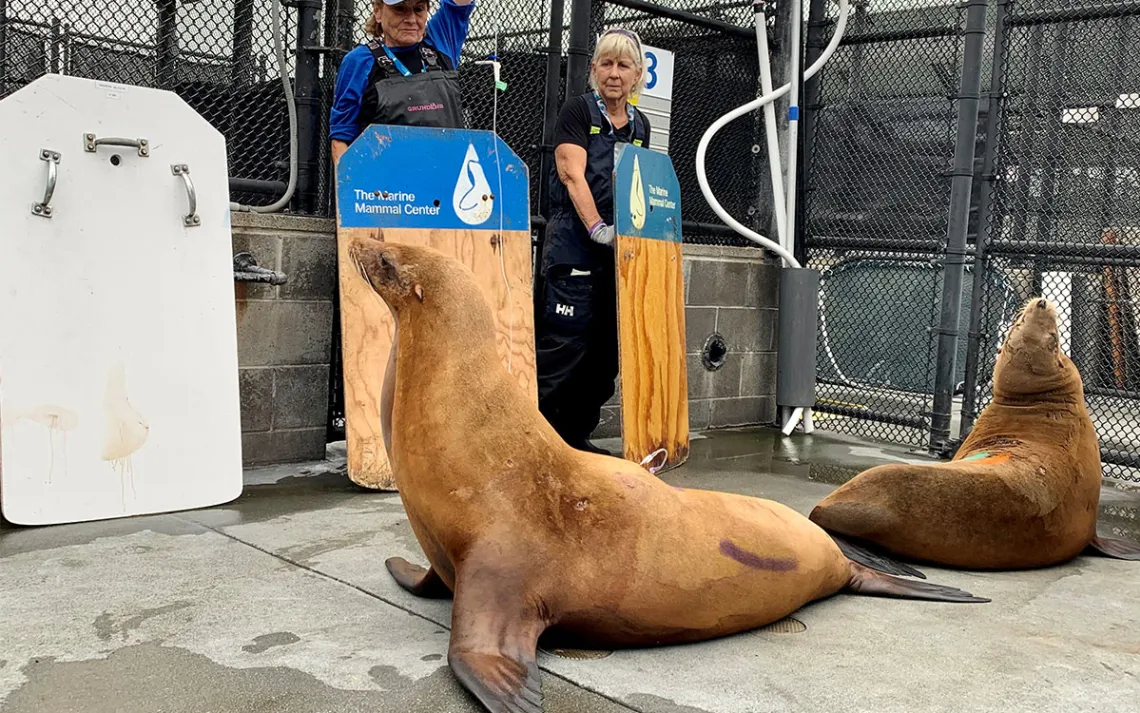
Volunteers Jennifer Weller (left) and Sally Campbell (right) administer fluids to two California sea lions admitted with domoic acid toxicosis to the Marine Mammal Center in Sausalito, California. | Photo by Giancarlo Rulli/The Marine Mammal Center
Sea lions were washing ashore along California’s central coast, lethargic, disoriented, and convulsing from seizures. By mid-August, Giancarlo Rulli was fielding more than 300 calls a day about the sick and stranded animals. “It's highly emotional,” said Rulli, who is the associate director of public relations at the Marine Mammal Center in Sausalito. “Sea lions are an incredible window into the health of our ocean.”
When the center is called, the response team deploys four to six other volunteers, who then must carry a 100-pound carrying crate to save animals that are poisoned. The culprit is a marine neurotoxin called domoic acid, produced by Pseudo-nitzschia algae. When marine animals eat the naturally occurring material, toxins accumulate in their bodies. As larger predators eat smaller prey, it spreads through the food chain, endangering both apex predators, such as sea lions, and people.
The federal government and most states consider domoic acid toxicity levels of 20 parts per million in shellfish tissue unsafe for human consumption. While in seawater samples, toxicity levels are measured in nanograms per liter. Anything above 500 ng/L signals the red alarm. Beyond this range, California regulators say they tend to see strandings as the toxin builds in animal tissues. By the middle of September, seawater samples around the center revealed that at 75 feet under the surface, domoic acid levels were 1,000 nanograms per liter (0.001 ppm), more than double the acceptable level. Pseudo-nitzschia thrives in sunlight, which fosters photosynthesis and growth. Animals that feed near the surface tend to ingest higher levels of toxins.
Rulli, who has volunteered with the center for over two decades, says the outbreaks, which used to occur seasonally, are now occurring with more frequency. One reason for this, he said, is rising water temperatures, spurred by climate change. As this year’s super El Niño heats up, scientists say the algae blooms may be enhanced by the very conditions the climate warming pattern generates—warm, nutrient-rich water.
“We know that during El Niño in our area, oftentimes we get longer, bigger blooms,” said Raphael Kudela, a professor in the Ocean Sciences Department at the University of California, Santa Cruz.
These super blooms are considered one of the most prominent threats to marine mammals, including sea birds, say researchers at the National Oceanic and Atmospheric Administration. Repeated exposure can cause severe, lasting effects and can take anywhere from a few weeks to two months to treat. If sea lions are on medication but experiencing “breakthrough” seizures, it can be an indication of permanent brain damage, resulting in euthanasia, according to Rulli. The condition has also been documented in humans, where it’s known as amnesic shellfish poisoning (ASP), reflecting its relationship to the eating of crustaceans and mussels. A 2024 study argued that the current threshold of 20 ppm should be lowered, as vulnerable adults and pregnant women are susceptible to neurological side effects, such as tremors, from even smaller levels.
“The toxin can cause vomiting, abdominal cramps, and diarrhea in the first 24 hours and neurological symptoms within 48 hours, with symptoms including headache, dizziness, confusion, disorientation, seizures, coma, and death,” Jerry Borchert, the Washington Department of Health marine biotoxin lead, wrote in an email.
Severe cases were documented in 1987, on Prince Edward Island in Canada, where 200 people fell ill after eating contaminated mussels. Four people even died of ASP.
Currently, there’s a ban on purchasing or consuming northern anchovies in Monterey Bay due to high levels of domoic acid. As of October 22, levels in anchovy guts were measured at 47 ppm, or 135 percent over the limit.
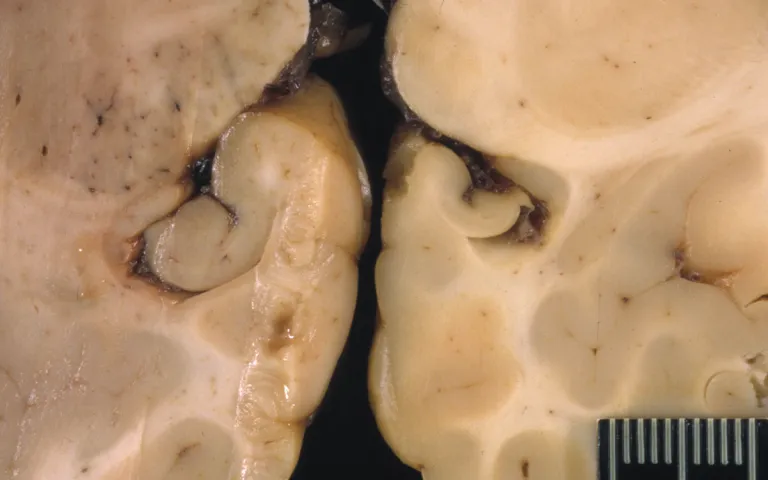
A side-by-side comparison of two California sea lion brains. The left shows a normal brain section. The right depicts a California sea lion brain that has been affected by domoic acid exposure, where there is a noticeably shrunken hippocampus in the center. | Photo courtesy of the Marine Mammal Center
Hint of an outbreak
Since July 1, volunteers with the Marine Mammal Center have rescued 150 animals. This is 66 percent higher than the average annual rate of rescues due to intoxication. As of late October, it was the largest marine mammal poisoning event the center has ever recorded.
Meanwhile, leaders in Oregon and Washington closed the harvesting season for razor clams last month due to high levels of domoic acid. In Washington, at one point, toxin levels in some shellfish were 22 ppm in Long Beach, according to Borchert. And they were even higher along other parts of the state’s coast and in Oregon.
“The level of domoic acid in the most recent razor clam sample collected from Clatsop beaches does represent a hazard to human health, which is why we issued the closure,” Alexis Manderson, the food safety specialist with the Oregon Department of Agriculture, wrote in an email on October 28. “The concentration was found to be at 96 ppm domoic acid in the razor clam tissue.”
Back in California, the Marine Mammal Center has reported that calls in response to poisonings have slowed down but are still happening at a higher rate than usual. But the center still receives roughly 150 to 300 on some days. In addition to California sea lions, the center has rescued 18 northern fur seals. And two juvenile humpback whales beached themselves due to domoic acid poisoning earlier this summer.
“We've seen humpbacks get domoic acid poisoning, but it's not super common,” Kudela said, “Whales are huge, so they need to eat a lot to get enough domoic acid for it to cause problems.”
A nutrient imbalance
Scientists are still working to understand exactly what goes awry with the algae, but they believe there are a series of prominent factors triggering these toxic blooms. “We think it's turned on through an imbalance in different ratios of nutrients,” said Clarissa Anderson, who first began studying the blooms over 20 years ago.
Some of these nutrients may contain silica and nitrogen. Small, single-celled algae absorb dissolved silica from surrounding seawater, which serves as a defense mechanism. When excessive amounts of nitrogen from runoff linked to fertilizer, sewage, or increasing human activity enters the water, they can become stressed and may produce the toxin, according to a study.
“They need silica, but now there's a lot less of it compared to all the nitrogen coming off of land in that water,” said Anderson, who is also the director of the Southern California Coastal Ocean Observing System at Scripps Institution of Oceanography in San Diego. “And the type of nitrogen can actually encourage them to make more domoic acid.”
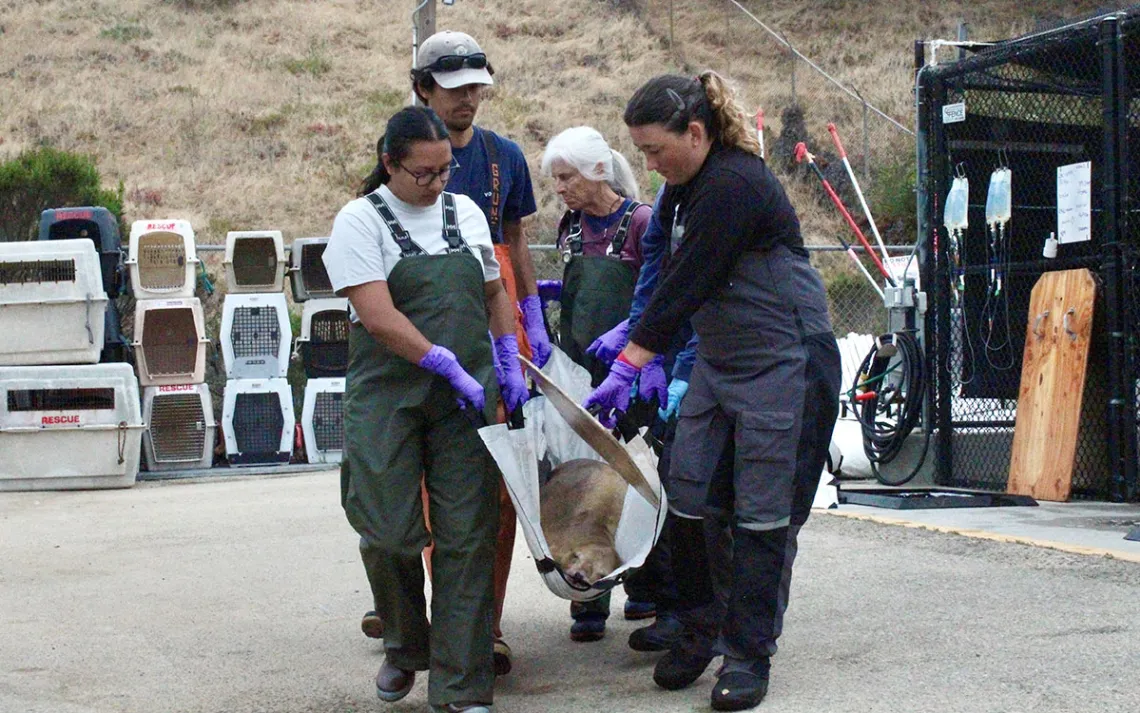
A lethargic California sea lion with domoic acid toxicosis is transported by the Marine Mammal Center’s Morro Bay response team to be treated. | Photo by Giancarlo Rulli/ The Marine Mammal Center
Just as they do in Monterey, researchers at the Santa Cruz Wharf sample the amount of algae and domoic acid in the water. Acid is measured through dissolved toxin, how much is floating in the water, and particulate toxin, the rough amount that would build up in animals and humans. They are also receiving samples from mussels and water from Humboldt Bay. There are several other sampling locations all along the coast: from Bodega Bay at Bodega Marine Lab to Cal Poly in San Luis Obispo, and in Newport Beach.
Even though the reports have slightly steadied, as of October 6, Rulli and Kudela said they are anxiously preparing for a continued outbreak from the one that surfaced in July. El Niño traditionally peaks in the coming months.
“We're definitely keeping an eye out to see if this keeps building up or if it goes away,” Kudela said. “Based on past years, there's a probability that we might see the bloom intensify and cause even more problems.”