The Race to Farm the Ocean
The industrial agricultural complex is taking over fisheries
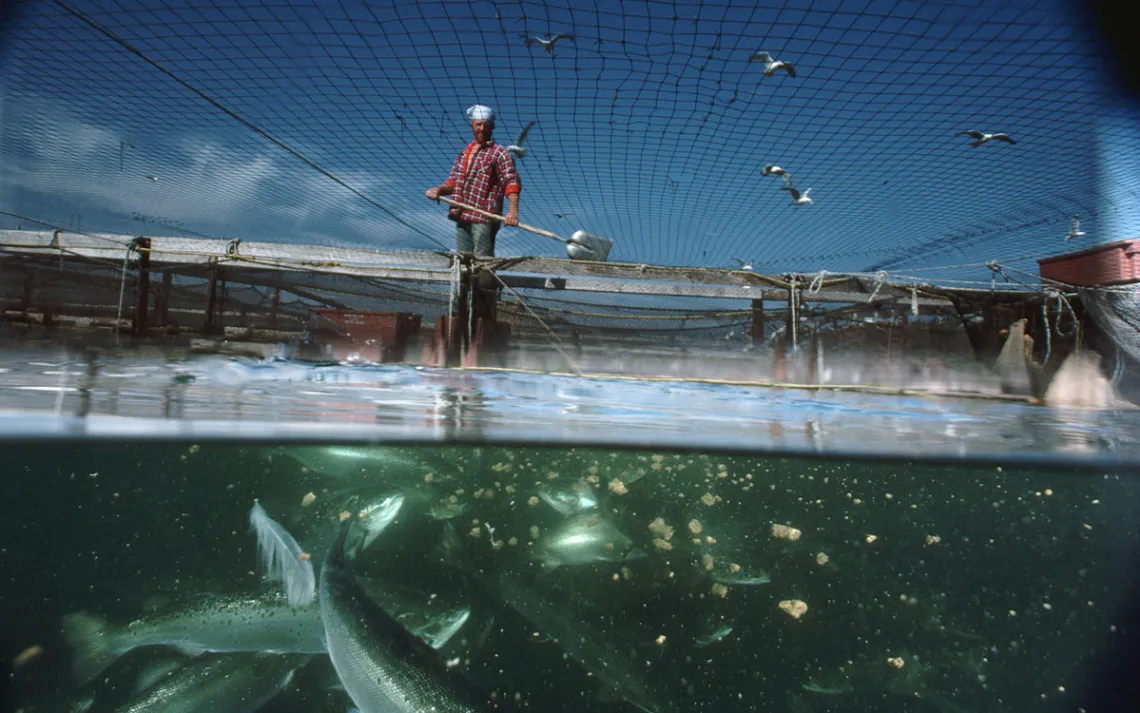
A fish farmer worker shovels salmon chow to Atlantic salmon raised in pens at Ocean Products fish farm. Eastport, Maine. | Photo by Kevin Fleming/Getty Images
For more than two decades, one company has dominated the salmon farming industry in Maine. Cooke Aquaculture, a billion-dollar multinational corporation based in New Brunswick, Canada, currently holds 23 active leases across the state, raising millions of salmon in open ocean net pens. Critics say its operations have forever transformed Maine’s coastal waters and reshaped its fishing industry.
“This is a $4 billion worldwide corporation that takes the profits — whether it’s in Maine or Tassal in Tasmania — back to Canada,” said Crystal Canney, the executive director of Protect Maine’s Fishing Heritage.
As questions rise over the future of domestic seafood production, the Trump administration is pushing to expand industrial aquaculture operations like these in federal waters.
Sometimes referred to as the “chickenification” of fish for its similarities to factory farming, industrial fish farming, or finfish aquaculture, is the commercial production of fish in high-density, controlled environments, including cages and pens.
In April 2025, Trump signed “Restoring American Seafood Competitiveness,” an executive order designed to streamline aquaculture development in federal waters. That same month, Agriculture Secretary Brooke Rollins created the USDA Office of Seafood to promote the production and export of American aquaculture products. And then the National Oceanic and Atmospheric Administration (NOAA) launched a new partnership with the University of New Hampshire to “advance American marine aquaculture.”
To help foster these efforts, Senators Roger Wicker (R-Miss.) and Brian Schatz (D-Mich.) introduced the Marine Aquaculture Research for America Act (MARA), a bill that would authorize NOAA to establish commercial-sized aquaculture projects in federal waters. In response, earlier this year, more than 400 fishermen, environmental groups, chefs, and tribes signed a letter to Congress opposing the bill. It was recently dropped from the Senate Commerce Committee's agenda, but advocates warn it will likely be reintroduced early next year.
Proponents of industrial aquaculture claim it is essential to expand domestic seafood production and meet the growing seafood demand. But environmental groups and local residents warn the industrial expansion of finfish farming in both state and federal waters could have detrimental impacts on marine life and coastal communities if it's not regulated properly.
“The oceans are publicly held for all of us,” said James Mitchell, the legislative director at Don’t Cage Our Oceans, a coalition of organizations that oppose the development of offshore finfish farming in the United States. “What the MARA Act and other versions of it have sought to do is to basically create a de facto privatization for an exclusive company to enrich themselves, unfortunately, at the expense of everybody else.”
In the United States, finfish farming in ocean-based net pens is only allowed in the coastal waters of Maine. It is banned in all other states and not currently permitted in ocean areas beyond three nautical miles from shore, which are managed by the federal government.
In other parts of the world, however, industrial aquaculture has taken off. In 2022, aquaculture took over capture fisheries, which are wild fisheries, as the main source of aquatic food, with global aquaculture production reaching 130.9 million tonnes. The Food and Agriculture Organization of the United Nations promotes the "intensification and expansion” of sustainable aquaculture as a priority to meet the global demand for aquatic foods.
But industrial aquaculture also comes with proven, well-documented risks. Carnivorous species, such as salmon, are fed fishmeal and fish oil made from wild-caught foraged fish, which has decimated wild fisheries in Western Africa. Research from the Changing Markets Foundation found that if industrial fish farming continues to expand at its current rate, about 4.6m tonnes of wild fish could be caught and fed to farmed species annually by 2040.
Fish farms can also release untreated waste and pollution directly into surrounding waters, threatening marine life with parasites, disease, and sea lice.
“These operations are very harmful to wild fish populations,” said Maggie Nivison, a senior attorney at the Conservation Law Foundation. “Because fish are kept in open-water net pens, sea lice can move quickly and easily across significant distances, which can endanger wild populations, " she said.
If farmed fish escape, they can harm wild fish populations by introducing competition and genetic differences into natural ecosystems. In fact, that’s the very reason the state of Washington banned commercial finfish aquaculture. In 2017, more than 250,000 non-native, disease-infected Atlantic salmon escaped after a net-pen collapse in the Puget Sound. A similar disaster occurred five years later in Maine, where 50,000 juvenile salmon escaped from two of Cooke Aquaculture’s sites at Cross Island and Machias Bay.
In January 2025, the Conservation Law Foundation launched a lawsuit against Cooke Aquaculture, claiming its operations violate the Clean Water Act by polluting the ocean floor with excess salmon feces, chemicals, and sea lice. The company is under further investigation by the Maine Department of Agriculture after an undercover video appeared to show animal abuse at one of its salmon hatcheries.
The Conservation Law Foundation is just one of many groups pushing back against industrial finfish aquaculture in Maine. Canney of Protect Maine’s Fishing Heritage works directly with coastal communities in Maine to pass local ordinances against industrial aquaculture development. Since the group's formation in 2020, it has helped pass local regulation in more than eight towns across the state. Cooke’s salmon farms take up areas of Maine’s coastal waters that small-scale fisherman could otherwise use to fish, making it harder for them to access the waters they’ve depended on for generations, Canney said.
“I have been invited into a lot of homes along the Maine coast to sit and talk with people, and I think that intimate conversation and being allowed into people's lives help you see how they live, how hard the work is, and that they don't want to be eaten up by something that's out of their control,” Canney said. “They don't want to be destroyed by something that they have no say in.”
However, other groups, such as Protect Maine’s Fishing Heritage, aren’t entirely against all forms of aquaculture. They are very much in support of properly regulated, small-scale aquaculture operations owned by local entities or individuals. Other forms of aquaculture, including oyster, clam, and kelp farming, also have proven environmental benefits and don’t require wild-caught food.
But with finfish farming — species like salmon, trout, sea bass, and tuna — there are few limits on scale and procedure, meaning that mitigating the environmental, social, and economic impacts of such industrial aquaculture operations is challenging. Maine currently does not limit the amount of fish feces or nitrogen fish farms can dispose of in the ocean, nor are companies required to test most of their water quality impacts.
To Joshua Stoll, an oyster farmer and professor at the University of Maine, what matters in all seafood production — whether it’s wild-caught fisheries or aquaculture — is who benefits.
“Are those riparian communities, those coastal communities where the activity is happening, are they benefiting socially, economically, nutritionally?” Stoll asked. “If that is not the case, then regardless of scale … there are big questions about its value.”
Many of the same multinational companies that dominate the US food and agriculture industry — Cargill, Sysco, JBS — are also leading the push for aquaculture development. All three companies, along with a dozen others, are part of the lobbying group, Stronger America Through Seafood, which aims to “influence US policymakers to enact legislation establishing a workable regulatory framework for all US aquaculture production.”
When billion-dollar corporations are making decisions on behalf of a community, or fishermen, that know their waters best, the complexity of how an ecosystem works can get lost, said Sarah Schumann, a commercial fisherman based in Rhode Island. “I think a lot of times larger organizations or corporations have sort of a single objective in mind,” Schumann said. In contrast, people who depend on the ocean for their livelihood think about it in a much more interconnected way.
“Tor fishermen, it's catching fish, but it's also sustaining a heritage,” she added. “It's also sustaining a coastal identity, it's also sustaining the relationships between the people in that place.”
Schumann is a strong advocate for fishermen-led policy and solutions. To that end, she’s involved in the Seafood Donations Program at the Commercial Fisheries Center of Rhode Island. The program pays fishermen to catch undercaught and underutilized species of fish, which are then distributed to families facing food insecurity across the state.
Community-led, sustainable seafood solutions are exactly what government funding should be supporting over mass-industrial production, said Mitchell. He added that low-impact aquaculture, shellfish and seaweed farming, and community-based seafood processing are also important alternative investments.
“They're not the full solution,” said Mitchell. “But they're a step in the right direction on protecting coastal communities from this kind of exploitation.”