When Ships Slow Down, Everybody Wins, Including Endangered Whales
An incentive-based program protecting whales from ship strikes also reduces air pollution
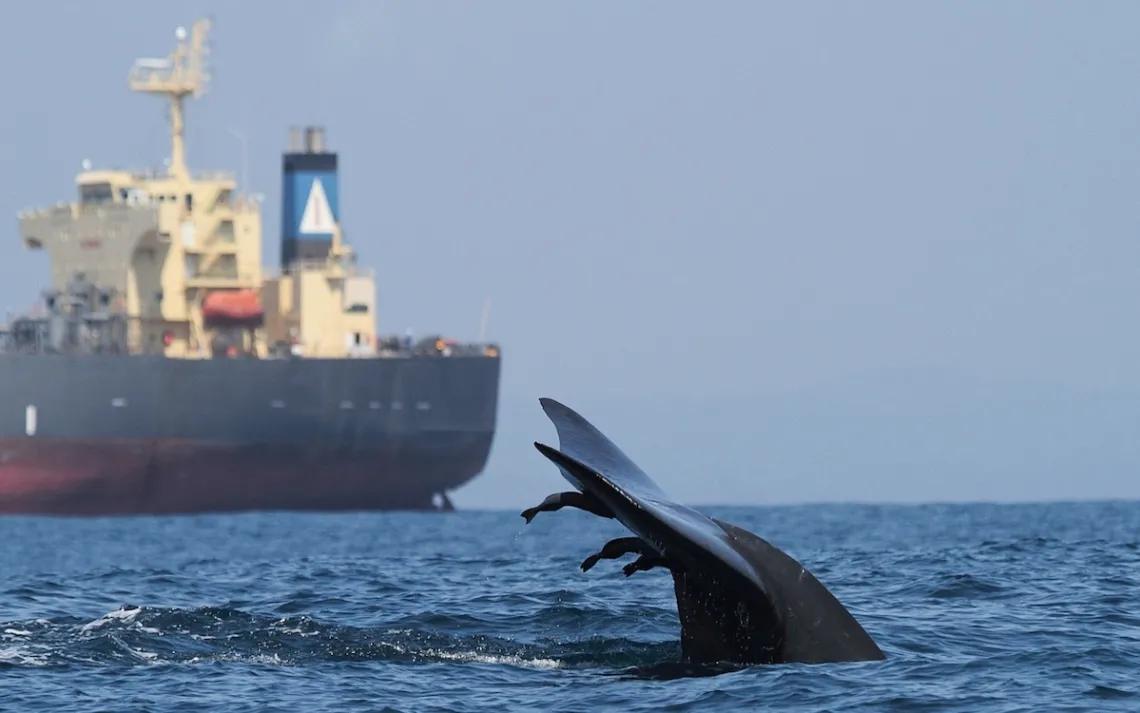
Photo by Asha De Vos
More than a thousand cargo ships slowed down last year as they neared the California coast in areas where endangered whales migrate and feed, part of a voluntary effort to avoid deadly whale strikes. The inducement to take it slower and thus delay their arrival at port? A sculpted award shaped like a whale’s tail, and kudos for environmental stewardship.
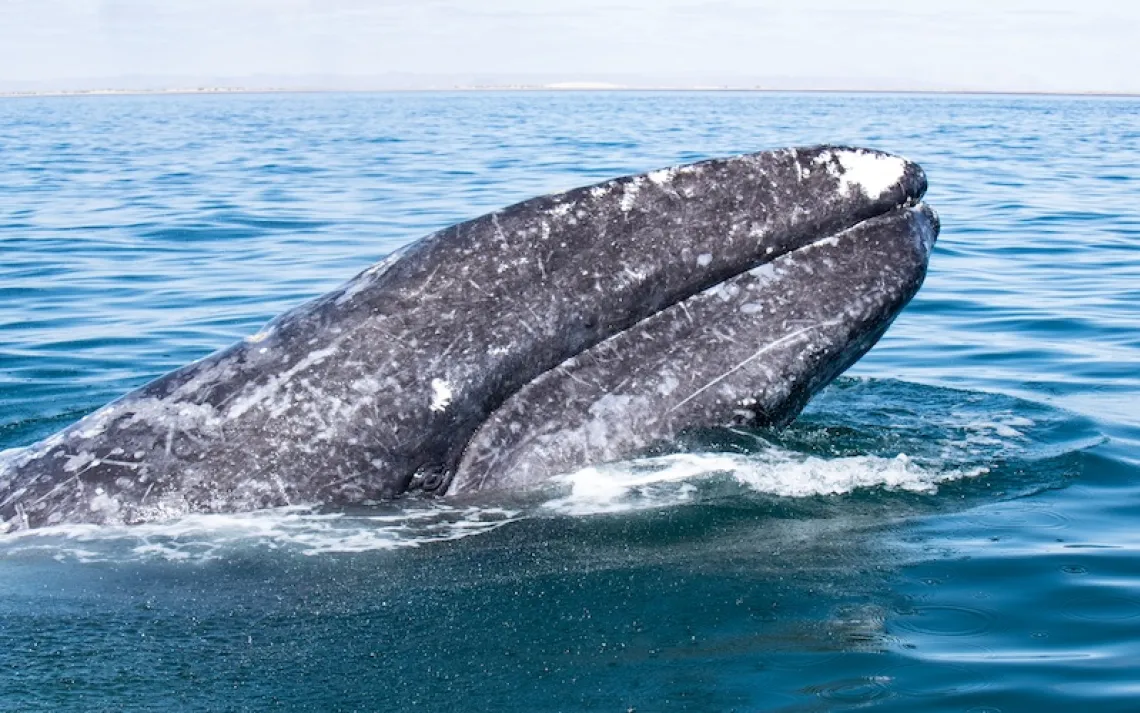
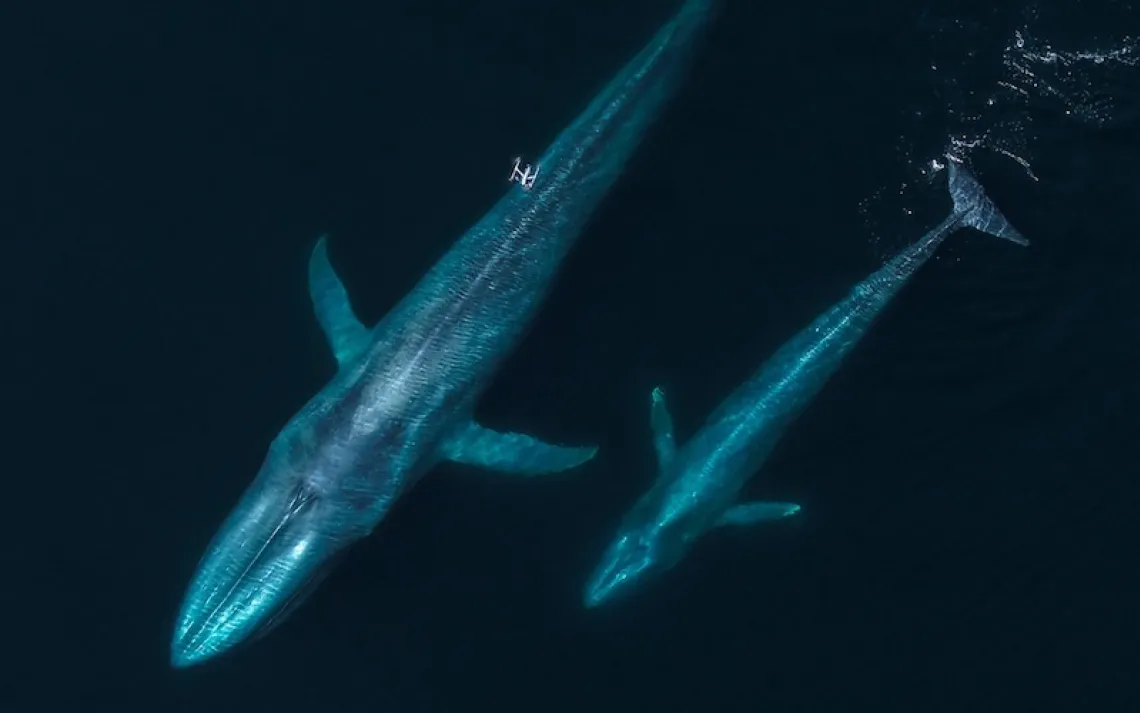
A coalition of national marine sanctuaries, air quality districts, environmental organizations, and other nonprofits runs an incentive-based, voluntary program called Protecting Blue Whales and Blue Skies. It began in 2014 to reduce ship strikes of endangered blue, humpback, and fin whales, as well as gray whales, along with lowering emissions. Every year since, participation has increased and now includes the world’s largest shipping companies.
“They’re very proud to say they are cooperating with this program,” said Jacqueline Moore, vice president of the Pacific Merchant Shipping Association. “They love their Whale Tail awards.”
And ship staff share the aversion to hitting whales, Moore said. “It’s like when we’re driving down the road, we don’t want to hit deer or other wildlife. It’s tragic.”
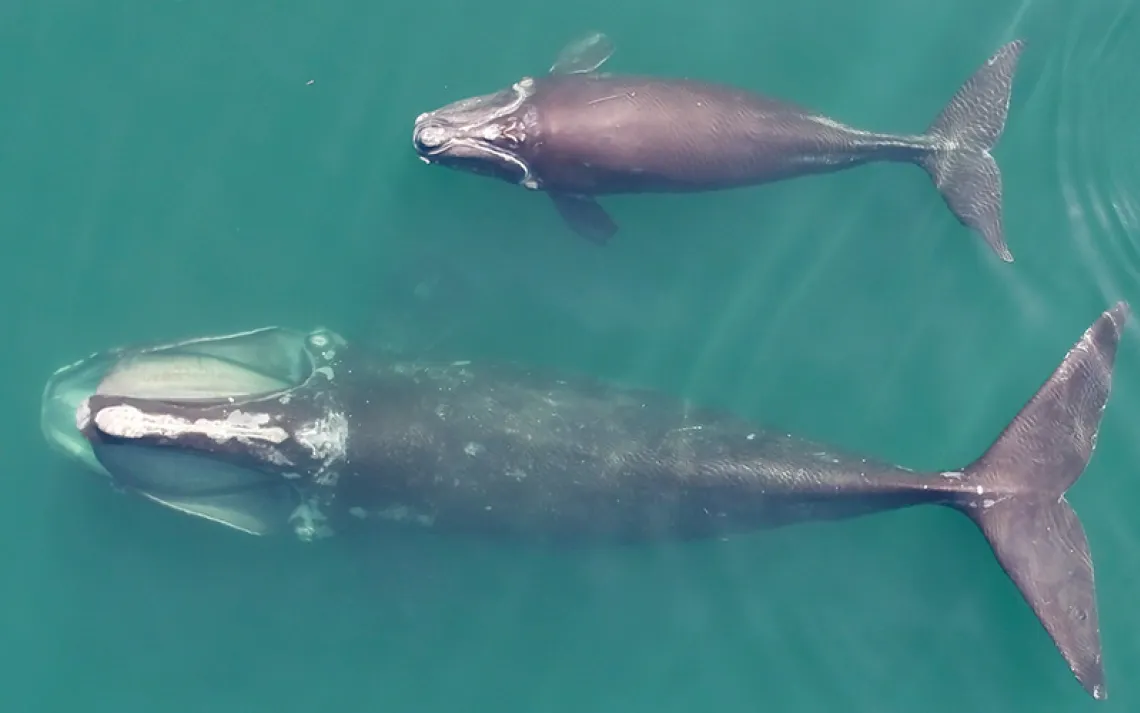
Scientists estimate that vessel strikes kill roughly 80 endangered whales a year along the West Coast, although it’s difficult to know as struck whales sink quickly and crew on most large ships don’t know they’ve hit one. The huge marine mammals, whose ancestors first appeared 50 million years ago, never evolved quick-moving strategies to avoid threats. And yet their migration and feeding grounds often overlap with today’s busy shipping lanes.
Program leaders award these trophies to shipping fleets that travel 10 knots (roughly 11.5 mph) or less at least 85 percent of their distance in “voluntary vessel speed reduction” zones off the coast of California during peak whale season from May to December. Those that do earn Sapphire-tier status and the Whale Tail award, handcrafted by a Pacific Northwest artist using wood sourced from vintage ships. Gold-tier winners, with a minimum 60 percent cooperation, receive a plaque, while third-place Blue Sky recipients, who comply at least 35 percent of the time, get named as participants.
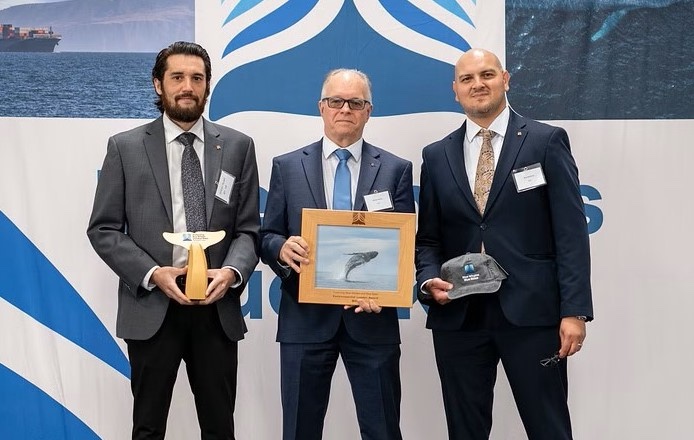
Photo by Katie Abbott
Marine life and coastal communities also benefit. The slower vessel speeds last year reduced the risk of fatal whale strikes by 50 percent in the reduction zones, according to the Blue Whales and Blue Skies program. They also reduced by nearly 40 percent the underwater noise harmful to many marine species and avoided emitting 1,400 tons of smog-forming pollution and nearly 50,000 metric tons of greenhouse gases.
Blue Whales and Blue Skies reached a new record for participation in 2024, with 49 shipping firms, including the world’s biggest container fleets. Twenty-three won the top-tier Sapphire status—double the number from last year. Eighteen shipping lines achieved Gold, while eight ranked in the Blue Sky tier.
The Switzerland-based container shipping firm MSC, the world’s largest, for seven consecutive years has earned the top-tier Whale Tail prize. Other leading shipping companies, among them Maersk, CMA-CGM, COSCO, Hapag-Lloyd, ONE, Evergreen, and Yang Ming, also participate and bring in prizes.
“We’ve now kind of cornered the market, especially for the container and car carrier industries,” said Jessica Morten, a director with the California Marine Sanctuary Foundation who oversees the Blue Whales and Blue Skies program.
Participating shipping lines also tend to improve compliance each year, she said, and many consistently go 9.8 knots in these voluntary slow-speed zones. “I have yet to have a year where I don’t see a better result than the year before,” she added.
During its first eight years, her team also awarded cash incentives, ranging from $1,000 to $50,000, Morten said. However, in 2022 the grant-funded organization faced a funding crunch that jeopardized the next year’s operation. They decided to ask the shipping companies if they’d consider reinvesting their prize money into the program.
About 70 percent of the companies said yes. “It was a clear indication that that was not what was motivating them,” she said.
The Blue Whales and Blue Skies coalition realized that the companies largely valued public recognition of their operational changes to protect marine life and to reduce emissions and underwater noise.
The Benioff Ocean Science Laboratory at UC Santa Barbara, another coalition partner, developed an automated tool called Whale Safe that now processes the ship speed data for the awards program. In addition, it posts report cards on its website, with an A to F grade for slow-speed compliance—another motivator for improved performance.
Whale Safe also deploys acoustic buoys—one in Southern California, the other outside San Francisco Bay—which detect the presence of whales and transmit that data to cargo ships through its proprietary software.
The shipping line MSC took it a step further and integrated the Whale Safe software into its navigation tool, with whale detections now showing on its ships’ consoles. The firm also convened an industry conference at its Geneva headquarters in 2023, focused on emerging technologies for enhancing whale detection. Stanley Kwiaton, a regional manager with MSC, added in a written response to Sierra that the firm in 2022 heeded the recommendation of several international environmental organizations and rerouted its vessels off the coasts of Greece and Sri Lanka to avoid whale collisions.
Cargo ships transport about 80 percent of the world’s goods, with more growth projected. The Port of Los Angeles and the Port of Long Beach are the first and second largest ports in the nation, with the Port of Oakland ranking eighth—and all three are near national marine sanctuaries.
The National Oceanic and Atmospheric Administration first established seasonal voluntary vessel speed reduction zones in Southern California in 2007, after ship strikes that year killed four blue whales in the Santa Barbara Channel.
But NOAA’s voluntary request proved “ineffective” in reducing shipping vessels’ speeds, according to one analysis. That led a coalition of stakeholders in 2014 to test adding incentives for compliance, with cash prizes and public recognition. Seven firms signed on that first year, with encouraging results. It’s grown every year since, and NOAA expanded the voluntary zones to larger areas in Southern California, and added all the national marine sanctuaries off central California and the San Francisco Bay region.
On the East Coast, NOAA enacted mandatory 10-knot-or-less rules for cargo ships in 2008, given that the critically endangered North Atlantic right whale population had declined to 313 individuals. On the West Coast, more robust whale populations led the agency to focus on voluntary efforts.
Others disagree with NOAA’s assessment and say mandatory measures are in order on the West Coast. The Center for Biological Diversity in 2021 petitioned the agency to change the voluntary speed reduction zones into mandatory ones, citing uncertain prospects for the endangered whale species’ recovery. In 2022, NOAA declined the petition, citing stable or increasing populations and growing cooperation with the voluntary vessel speed reduction program.
“Years ago, I felt very strongly that regulations should be considered for these species on the West Coast,” Morten said. “But because we’re continuing to see the trajectory of cooperation go up with this incentive program, it’s showing potential for maybe not needing regulations to achieve the same levels of compliance.”
New legislation called AB 14, poised to head to Governor Gavin Newsom’s desk later this summer for approval, would also establish statewide leadership for the Protecting Blue Whales and Blue Skies program, by appointing the state’s Ocean Protection Council to an advisory role over the program. It passed through both legislative chambers with unanimous bipartisan approval.