Why the Next Wave of Climate Action Will Be Led by States
New leadership at the local level could have an outsize impact on environmental policy
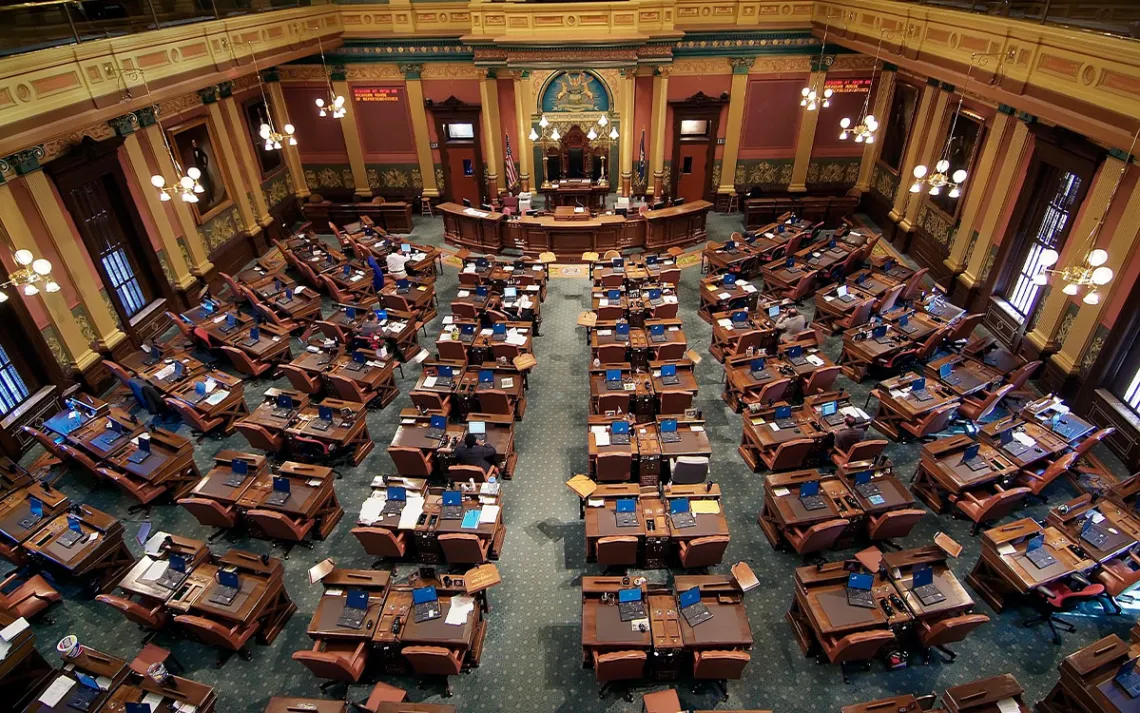
The House of Representatives chamber at the Michigan State Capitol. | Photo by Dennis Macdonald/Getty Images
On November 3, millions of voters across the country opted for change, resulting in a historic victory for Democrats. For the first time in three years, the party will lead both the US House and Senate. But the tilt left didn’t stop at the federal level.
Some of the most sweeping changes happened within the states. In two months, 24 state legislatures will be led by Democrats, and about 75 percent of Americans will have a Democratic governor. Six states shifted from mixed partisan control of state government to Democratic trifectas, and at least five moved from Republican trifectas to mixed power.
“Voters across generations, geographies, ideologies, and different backgrounds demonstrated that they want a responsive government that will address their concerns, including the immense and interconnected challenges facing wildlife and people,” said Collin O’Mara, president and CEO of the National Wildlife Federation.
While President Trump will still have veto power for federal legislation, the added advantage at the state level is expected to have a real impact on climate and conservation policy. Some experts even expect it could help slow the Trump administration’s assault on clean energy. Here are some of the ways newly elected state leaders are most likely to take the lead on environmental policy.
State legislatures take the lead
In 2025, Arizona Democratic Governor Katie Hobbs set a new state veto record, and this year she added to her cumulative veto record by thwarting 151 Republican-led bills that would have impacted water supply, endangered species conservation, public transit, and more. Now, Democrats will control both chambers of the legislature, and Hobbs’s second term is likely to look a lot different.
An example of the kind of bill that might come out of this new Arizona legislature is HB 2141, a change to environmental permitting that adds new requirements for polluters and prioritizes environmental justice for overburdened communities. In this year’s Republican majority session, the bill didn’t even get a hearing.
Democrats also won new state House majorities in Georgia, Michigan, Wisconsin, New Hampshire, North Carolina, and most notably, Texas. In Minnesota, the state House had been tied but is now majority blue. New Democratic state Senate majorities will take over in Arizona, Pennsylvania, New Hampshire, and Wisconsin. Some of these legislative shifts could be especially important because they put lawmakers with strong environmental records in leadership positions.
The outgoing Republican leaders of the Arizona House and Senate, Representative Steve Montenegro and Senator Warren Petersen, both received F grades in this year’s AZ Environmental Report Card, published by the Sierra Club's Grand Canyon Chapter and partner organizations. The Democrats taking over those leadership jobs, Representative Oscar de los Santos and Senator Priya Sundareshan, both got A grades in the report.
In Michigan, outgoing Republican Speaker Matt Hall has a lifetime score of 40 percent from the Michigan League of Conservation Voters. LCV has also tracked Hall as receiving over $317,000 in donations from corporate utilities over his career. His replacement in the speaker’s chair, Ranjeev Puri, has a 95 percent score and agreed not to accept any utility donations in this year’s election.
The Georgia state House flipped to a Democratic majority for the first time since 2002. Outgoing House Speaker Jon Burns will likely be replaced by current Minority Leader Carolyn Hugley. This September, Hugley called for the legislature to start assessing the impacts of climate change on Georgia’s economy, environment, and public health, and promised to introduce a bill in January. Now, she can do so from the speaker’s chair.
Democratic governors sweep the nation
Like Democrat Katie Hobbs in Arizona, Nevada’s Republican governor has been busy with the veto pen. In the 2023 legislative session, Joe Lombardo set a state record for vetoes. He killed bills meant to ban harmful refrigerant chemicals, phase out certain fluorescent lights that contain mercury and other pollutants, and establish heat mitigation plans to help Nevada’s most populated counties adapt to climate change. In 2025, he broke his own record, vetoing 162 bills, including pollution-reduction and climate-mitigation measures.
In the November elections, Aaron Ford became Nevada’s first Black governor and flipped the governor’s mansion to blue. Legislative leaders have expressed an interest in revisiting bills from the past few sessions now that the veto power has shifted to Governor-elect Ford. But they stopped short of mentioning specific environmental bills.
As in Nevada, Georgia will have its first Black governor in January. She is also America’s first Black female governor. As mayor of Atlanta, Keisha Lance Bottoms successfully blocked a fuel terminal from being built near the Chattahoochee River. In her run for governor, she championed improved flood infrastructure and protection for environmental-justice communities, and vowed to assess the rapid expansion of data centers.
“We are so excited to work with our newly elected governor and state lawmakers," said Sierra Club Georgia Chapter director Adrien Webber. "We have been fighting for strong environmental policies in the Georgia capitol for years, but under previous administrations, most of the bills we championed were sent to committees and left to languish, regardless of how much support they had from the people of Georgia. From protecting our public lands to making it easier and cheaper to bring more solar power online to addressing the influx of data centers and the issues they bring along with them, there will be plenty to do when these folks take office in January.”
Meanwhile, the election of Amy Acton as the next governor of Ohio has broken 15 years of one-party rule in the Buckeye State. Even with the legislature still in Republican hands, Ohio environmentalists are hopeful about Acton’s ability to wield executive appointment and veto powers.
“Acton will appoint some really important folks to leadership roles, including the head of the Public Utilities Commission, the Power Siting Board, and the Oil and Gas Land Management Commission,” said Rachel Kutzley, a board member of the public lands advocacy group Save Ohio Parks. “All of these positions are important in determining what land gets approved for fracking and also what kinds of power plants are approved to be built.
The incoming governor of Texas, Gina Hinajosa, was one of the legislative leaders behind a proposed Texas Climate Plan in 2021 that consisted of over 40 bills. But those proposed regulations came up against a Republican trifecta government, and most never even got committee hearings. Now, with both the governorship and the speaker’s gavel in Democratic hands, similar bills will at least be likely to get consideration. Hinajosa has also promised to put a moratorium on data center construction until the legislature can decide on new regulations in the next session.
The role of boards and commissions
Some of the changes with the most potential to make real change aren’t in legislative chambers or governor’s mansions. They are in the sometimes obscure, often ignored commissions that regulate industry and set policy in the states.
For example, Arizona is the only state in the country that elects a statewide mine inspector, a position that oversees the state’s $10 billion mining industry. This year, Brian Matlock became the first Democrat to hold that job in 50 years. Matlock made tribal concerns a key part of his campaign, highlighting the Havasupai Tribe's and Navajo Nation’s complaints about lax regulation of mines on their sacred lands.
New voices are also coming to Georgia’s influential Public Service Commission, which oversees utility companies. Democrats gained their first majority on the commission in 30 years. Commissioners Peter Hubbard and Shelia Edwards both listed clean energy, along with transparency and cost reductions, among their priorities for the board.
Jeanette Gayer, state director with Environment Georgia, hopes this result can end decades of corruption in regulating polluters. “Just in terms of not having a commission that is so captured by the utility that it is trying to regulate,” she said. “I think that will be huge.”
Despite its name, the Texas Railroad Commission no longer has much of anything to do with railroads. That regulatory power switched over to the state Department of Transportation in 2005. Instead, the commission is now the main state regulator of the oil and gas industry. Though newly elected commissioner Jon Rosenthal comes from an oil industry background, he has proposed ending gas flaring and blocking new permits for repeat violators of state law.
In a wave election this big, there are meaningful changes in nearly every state. Along with the new lawmakers taking office, dozens of communities also rejected AI data center construction by way of ballot measures, showing large, bipartisan support for heavy regulation of these resource-intensive projects. In agricultural states like Iowa, clean water issues have been another environmental issue that transcends partisan boundaries.
Andrew Bowman, president and CEO of Defenders of Wildlife, sees the election as an important chance to push back on the Trump administration’s harmful policies. “For those of us working to protect America’s wildlife and wild places,” he said in a statement, “this is a moment of renewed hope and possibility.”