 The Magazine of The Sierra Club
Why Won’t the Media Say “Climate Change”?
Climate coverage has been dropping even as extreme climate-supercharged weather gets worse
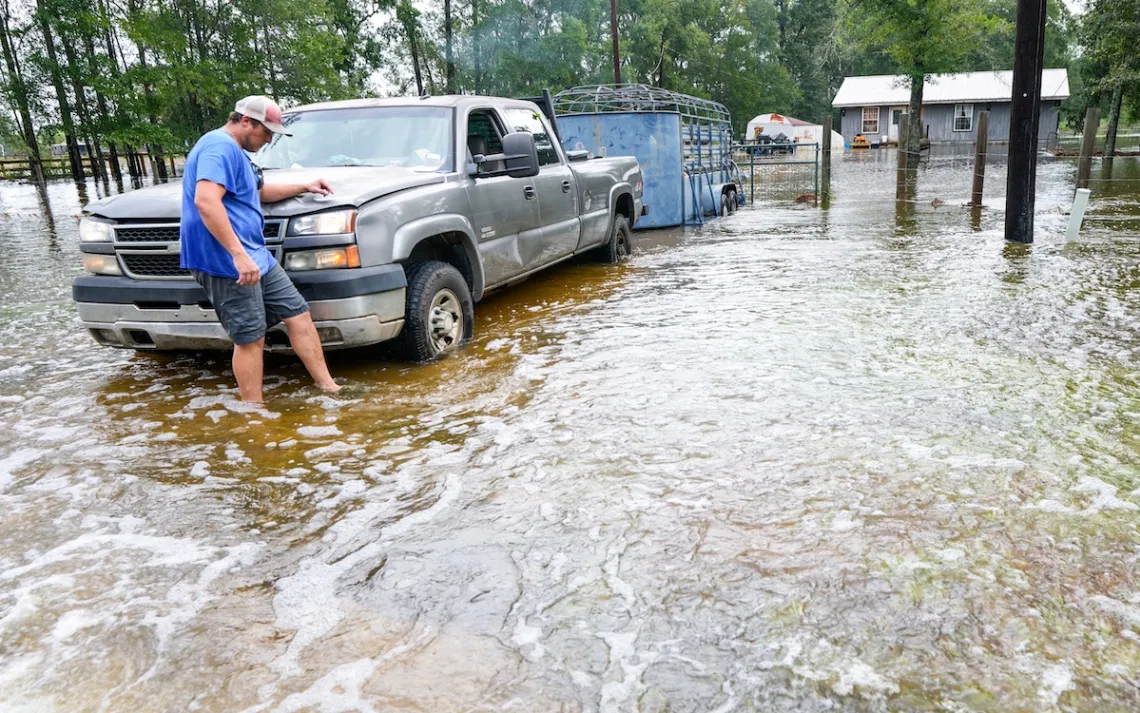
Floodwaters in the aftermath of Tropical Storm Edouard near Honey Island, Texas, September 2, 2026. | Brett Coomer/Houston Chronicle via AP.
When was the last time you heard the words climate change during a news broadcast? If you can’t remember, you are not alone.
While news reports abound of extreme weather disasters—scorching heat waves, dangerous flash flooding, monster wildfires, and wildfire smoke impacting communities across the country—few news broadcasters mention that these disasters are being supercharged by climate change. Even fewer air dedicated segments covering a global heating crisis that science has consistently made clear is being caused by human industrial activity like the burning of fossil fuels.
This pattern of news programs failing to connect the dots between extreme weather and the unfolding climate crisis is part of a larger trend in recent years. That trend runs parallel to the simple fact that fewer news organizations employ climate reporters who are paid explicitly to cover the topic as their beat. Even entire climate desks have been eliminated from some newsrooms amid a string of widespread media layoffs. The result, experts say, is a public less informed on what the United Nations has recognized as “one of the defining issues of our time.”
“We all suffer as a public,” Max Boykoff, an environmental studies professor at the University of Colorado Boulder, told Sierra. “It shrinks the touchpoints that we all have to just understand what is going on in this world.”
Boykoff leads the Media and Climate Change Observatory (MeCCO), a project that tracks climate coverage over time in more than 130 newspapers, radio, and television outlets in 59 countries. According to the project’s latest year-end report examining trends in 2025, global climate coverage was down 14 percent compared with that in 2024. Researchers identified 2021 as a peak year for climate coverage (the Biden administration passed the climate-oriented Inflation Reduction Act in 2022). Compared with 2021, there was 38 percent less climate coverage in 2025.
So far in 2026, climate reporting has declined even further. Boykoff said coverage has dropped about 28 percent for the first seven months of 2026 compared with 2025—a year that ranked 10th overall for climate coverage out of the 22 years that MeCCO has been tracking the data. This dip is happening as a super El Niño kicks into gear, supercharged by already extreme warming trends.
“While the earth continues to warm and we continue to break [temperature] records, it’s very troubling,” Boykoff said of this trend of the media’s declining coverage on the issue.
There are, of course, some important exceptions to this trend. The Guardian and Agence France-Press are two examples of global news organizations that continue to do solid reporting on the climate crisis, noted Mark Hertsgaard, executive director and cofounder of Covering Climate Now. The New York Times has also maintained or even increased its climate coverage. Hertsgaard said the rollback in climate coverage is “very much a US phenomenon,” especially in the broadcast media.
Climate change coverage across the three main US corporate broadcast networks—ABC, CBS, and NBC—declined by 35 percent in 2025 compared with 2024, according to an analysis from the watchdog group Media Matters for America. This marked the third straight year of declining coverage on the networks. “A sustained reduction in climate coverage risks leaving the public less prepared to understand the stakes of climate policy decisions, the material consequences of regulatory changes, and the growing disparities in climate risk across communities,” Media Matters explained.
“Failure to connect the dots”
During this summer’s sizzling heat waves in July—the hottest month on record in the US at that time—the three major broadcast networks aired a combined 194 segments over a four-week period, reporting on three extreme heat events affecting large parts of the country. Not one of those segments mentioned climate change, Media Matters reported last month.
This was not an anomaly, researchers found, but a trend of corporate broadcast networks omitting any mention of the words climate change in their extreme weather coverage. “Across recent summers, ABC, CBS, and NBC have repeatedly covered dangerous and record-breaking heat without consistently explaining how human-caused warming is making extreme heat more frequent and severe,” Media Matters wrote in its analysis.
A similar pattern has been observed in the UK. More than 70 percent of nearly 2,500 news articles about the record-smashing extreme heat event that hit the UK in June did not mention the link to climate change, according to an analysis by the Energy and Climate Intelligence Unit. Another analysis by the ECIU found that two-thirds of UK news articles about this summer’s wildfires failed to mention the climate change context.
“Part of it is a failure to connect the dots,” said Jill Hopke, associate professor of journalism at DePaul University who studies climate journalism and communication. What also seems to be missing in a lot of news coverage, Hopke said, is what is causing climate change—primarily the burning of fossil fuels—as well as climate policy obstruction and disinformation by the fossil fuel industry and other vested interests.
Widespread media layoffs
One of the factors contributing to the news media’s declining climate coverage is the axing of climate journalists as mass layoffs have roiled the industry in recent years. Climate reporters have been a casualty of this turmoil, with many mainstream media organizations downsizing or even eliminating their climate desks.
CBS News gutted its climate production team amid a round of layoffs last year after the Paramount-Skydance merger led to new management. Earlier this year, CBS cut its last remaining dedicated environmental correspondent, part of a larger set of layoffs affecting nearly 6 percent of its staff. The loss “means that when CBS does cover the issue, the reporting will be more likely to omit scientific context and elevate misleading or contrarian framing, a shift already visible in the network's limited coverage so far in 2026,” according to Media Matters.
In February The Washington Post slashed most of its climate reporters as part of a round of widespread layoffs impacting nearly one-third of the news organization’s employees. “The sad loss of another dozen jobs only adds to a sad trend of legacy media organizations pulling back from climate coverage, even as global warming accelerates,” former Los Angeles Times columnist Sammy Roth wrote in his Substack Climate-Colored Goggles.
NPR recently folded its climate desk and laid off the editor who had led that team. And at the end of August, Politico discontinued its dedicated energy, environment, and climate news site E&E News. The move to fold E&E News comes after EPA administrator Lee Zeldin announced last year that the agency would not be renewing its nearly half-million-dollar subscription with the news organization.
The current political climate in the United States, especially under the second Trump administration—which has claimed climate change is a hoax, tried to erase climate science from government websites, and taken a sledgehammer to climate policies—has led to a chilling effect for climate coverage. But the loss of dedicated climate reporters in newsrooms is also troubling, Hopke said.
“As audiences grapple with how to address climate change, I think we absolutely lose out when those positions disappear from newsrooms and when that expertise is lost when journalists are laid off. I’m very concerned myself as a scholar and an educator in journalism about these trends,” Hopke told Sierra.
Boykoff and Hertsgaard both pointed to the domination of much of the media landscape by corporate conglomerates as another factor behind the retrenchment in coverage of climate change and other important topics.
“That’s what I see in these layoffs by massive corporations who now own so much of the media, especially the broadcast media,” Hertsgaard said. “They don’t care and have no loyalty to the idea of the civic role of the media. They are putting their desire to maximize profit over their obligation to inform the public.”
A turning point?
There are still newsrooms and news organizations delivering important climate reporting. Even within corporate media, there are some journalists trying to do the right thing, Hertsgaard noted.
“We need a more nuanced understanding of the situation, that there are a lot of good journalists inside of these news organizations who are pushing back against these attempts at what basically amounts to censorship,” he said.
Hertsgaard also raised the possibility that the news media’s recent reporting on the devastating and deadly flood disaster in Nepal could “mark a turning point in climate coverage.”
“In this case, more news outlets are making the climate connection to global warming’s latest disaster than has ever been the case,” he said, pointing out that even CBS News, which now operates under the management of Bari Weiss, has linked climate change to the Nepal disaster.
Boykoff said it is critical to lift up independent media and journalists that are committed to covering the climate crisis.
“One of the key things everyday people can do is to support independent media,” he said.