 The Magazine of The Sierra Club
Wolverines Are One Step Closer to Returning to Colorado
The bear-like weasels could be reintroduced into the state after a 100-year absence
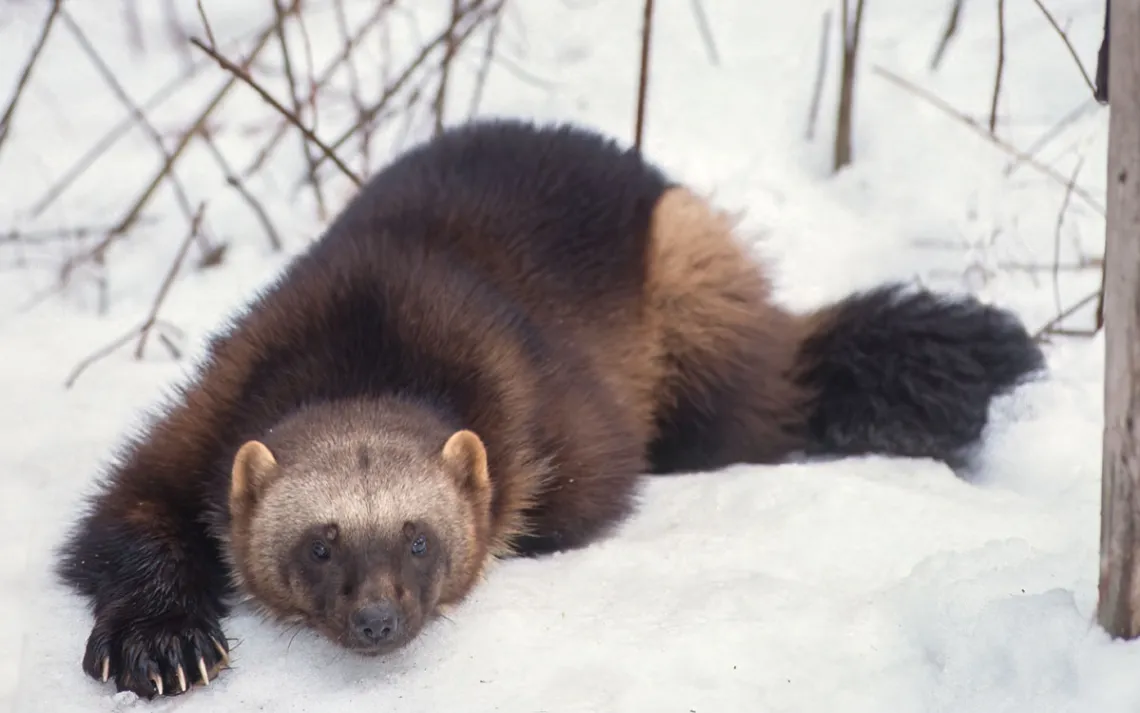
The wolverine (Gulo gulo luscus) is the largest land-dwelling species of the weasel family. It is a muscular carnivore and a solitary animal. | Photo by Gerald Corsi/iStockphoto
Wolverines were once a staple among Colorado’s high peaks. For more than a century, their absence has left ecosystems devoid of a native carnivore and Coloradans bereft of a long-sought wildlife recovery story. That void could soon be filled with paw prints if state leaders have their way.
Earlier this month, the Colorado Wildlife Commission approved a plan for reintroducing 45 of the bear-like weasels over a three-year period along the spine of the state, stretching from Wyoming to New Mexico. According to the restoration plan, these areas include abundant public lands—such as national and state parks, wilderness areas, and national forests—where habitat and food are plentiful and threats, such as roads, are limited.
This would be the first time a state has attempted to reintroduce the elusive mustelids, but the latest in a string of Colorado reintroductions, including wolves in 2023 and lynx in 1999. These efforts are part of the state’s goal of restoring native species, especially carnivores, which settlers killed on an industrial scale throughout the 19th and early 20th centuries. Today, the species is listed as endangered by the state of Colorado and as threatened by the federal government.
Restoring wolverine populations to Colorado would be a “huge step forward for wolverine conservation and … is probably the biggest positive step forward we can make for wolverines in the Lower 48 right now,” Robert Inman, the Colorado Parks and Wildlife (CPW) wolverine program manager, said. “If you put me on a recovery team … reoccupying Colorado is at the top of my list.”
There are roughly 300 throughout the entire lower 48 states, making them one of the rarest species in the country. Most of those individuals are cloistered in Idaho, Montana, and Wyoming. If biologists successfully release wolverines in Colorado, say proponents of the plan, this snow-loving creature would have somewhat of a buffer against climate change, given the plethora of high-altitude environments.
“Wolverines are adapted and thrive in the snow,” Kaitie Schneider, the Rockies and Plains representative at Defenders of Wildlife. “Every part of their body is made for winter.”
Leaders at CPW have wanted to bring the beagle-size animals back as early as the late 1990s. Those plans fizzled as the state pursued lynx reintroduction, but the goal was never fully scrapped. In 2013, the agency formed a working group to assess the feasibility of restoring wolverine populations. The group then took a stab at creating the first state restoration plan. In 2024, lawmakers passed a bill authorizing CPW to move forward with reintroductions.
According to the state plan, Colorado could hold anywhere from 100 to 160 wolverines, with most projections trending toward the lower end. This would still account for nearly a third of the current population in the United States. The preferred population sources include British Columbia and Alberta. These areas, according to Inman, offer terrain, food, and competition sources similar to what wolverines would face in Colorado.
The state plans to work with trappers and local wildlife agencies to capture about 15 wolverines during the winter season, after bears have started to hibernate. Then the CPW team will transport the wolverines to a facility called the Frisco Creek Wildlife Rehabilitation Center, where they’ll receive fitness and health assessments before being released. Biologists will GPS collar each animal to track their movements as they disperse throughout the state. While dispersals have happened in the past, researchers say that they’re rare enough that wolverines would never recover on their own.
"It's the best thing for the wolverine population compared to natural recovery," Inman said. "It'll be more numerous, it'll have a better chance of getting jump-started, it'll be in better shape genetically."
Instead of merely releasing every wolverine out into the wild, the state plans an A/B testing model. At least five females per season will remain at the Frisco Creek Wildlife Rehabilitation Center. This will allow biologists to closely monitor each animal and even provide supplemental feeding until their natural prey are active, most likely during the spring.
The other females and the males will roam the wilds of Colorado, in areas with premade dens. This testing model, where some females are captured and monitored, will allow the wolverine team to assess in real time which release method is most effective at bolstering restoration. Crucial to this effort, notes the restoration plan, is that most of the females are likely to be pregnant when they’re captured, improving the odds that kits will be born in Colorado and contribute to restoration efforts.
“The hope is that that helps the wolverines stick to where we release them,” Inman said. “But this is one of the big unknowns that we don't know how well females that are translocated will be able to retain pregnancies.”
Some close watchers of this effort have compared it to the recent effort to restore gray wolf populations. But Republican lawmaker Perry Will, who sponsored the legislation authorizing wolverine reintroductions, pushed back on that notion. He told the Colorado Sun that this effort is “completely opposite of wolf reintroduction.” And many proponents have lauded going through the legislature as the right way to do a reintroduction, as opposed to a ballot initiative, which is what was used to restore wolf populations.
For others, the two are just various forms of democracy. “Both are valid and legal ways to get that legislative approval that they need,” Schneider said. “One was just more preferred by lawmakers than the other.”
Despite the momentum behind the reintroduction of wolverines, the effort is still not assured. Wolverines were listed as threatened in the lower 48 states by the federal government in 2023, making any reintroduction plans subject to approval by the US Fish and Wildlife Service. The legislation behind wolverine restoration requires the agency to devise a special rule, subject to a public comment period, that would allow the state to take action if one of the federally protected wolverines poses a threat to livestock producers or agriculture. This rule, called the 10(j) rule, has yet to be crafted. According to Inman, the state is in the process of submitting a request to the federal government.
The state also still needs to devise a compensation program for ranchers and other types of agricultural producers, despite attacks on livestock being incredibly rare—there have been no documented attacks on cattle, and only two recorded instances with sheep. Additionally, there needs to be a formal communication plan between CPW and constituents so that the state can keep people informed about where wolverines are traveling.
Perhaps the biggest outstanding question is how the federal government will respond. The new director of Fish and Wildlife, Brian Nesvik, has been skeptical of Colorado's efforts to restore gray wolves, claiming that the state didn’t have the authority to get wolves from Canada. Records from the state dispute this fact and show that the federal government gave clear authorization to capture wolves in British Columbia.
The good news for wolverines, say proponents, is that they don’t eat cattle and thus aren’t as contentious as wolves. They also dwell at much lower densities than wolves and will live above 10,000 feet in Colorado, Inman said. The result would mean that sightings would be rare, even if wolverines reach capacity in the state.
If all goes smoothly, paws could be on the ground in roughly two years, Schneider said.
At a recent meeting announcing the plan, Schneider said not one person opposed the plan to bring wolverines back. “That's just really cool to see,” she said. “There were hunters in the room, there were ranchers in the room, and there was nobody there speaking in opposition for this reintroduction.”