We Won’t Be Able to Eat Without Water
The amount of water needed to grow our food is staggering. It has been estimated that agriculture accounted for over 80 percent of the consumptive water use in the U.S..
If you bring one pound of beef home from the supermarket, for example, it required approximately 1,860 gallons of water to produce it. This “water footprint” of beef includes water for the animal's feed, drinking, and servicing. I can easily fit a pound of hamburger in my refrigerator, but I don’t have a place to put 1,860 gallon jugs of water!
In 2022, San Antonio's municipal water consumption was 122 gallons per capita per day, or roughly the water footprint of an ounce of beef.
Different crops have varying water requirements, with rice, cotton, sugarcane, soybean, and wheat being among the most water-intensive . It takes 5-6 gallons to produce a tomato, 15 gallons for a head of kale, and 126 gallons to produce an avocado. Not surprisingly, a diet with reduced meat intake has a lower water footprint. Unexpectedly, we might want to ease up on the guacamole!
Even though Texas is a major agricultural state, it may not have enough water to produce the food that Texans eat. So, there is a “virtual water flow” into Texas through importing food products into the state. In fact, Texas virtually imports more water than any other state by buying food from other states.
The state's water supply comes from both groundwater aquifers and surface water sources, but these are rapidly depleting due to overuse and climate change . By 2070, Texas' population is projected to increase by 73%, while its water supply is expected to decrease by 18%.
The situation in Texas is so dire that experts warn the state could run out of drinking water by 2030 if severe drought conditions occur and immediate solutions are not implemented . This water shortage not only affects drinking water but also poses a significant threat to agricultural production. The state is already experiencing the impacts, with sugarcane production halted and key crops like cotton and citrus under threat .
As water becomes scarcer and more expensive, there's a shift from agricultural use to municipal demand, further straining food production capabilities. The future of our food supply depends on how effectively we manage our increasingly scarce water resources.
by Bill Barker, Alamo Group executive committee member
An Evening of Poems
Our April 15th General Meeting will feature poets from Stone in the Stream/Roca en el Rio, a writers and artists collective committed to the environment through contemplative, artistic, and activist response.
Tuesday, April 15th
6:00 pm
Meeting schedule
| Informal get-to-know-you | 6:00 pm to 6:15 pm |
| Announcements | 6:15 pm to 6:30 pm |
| Featured program | 6:30 pm to 8:00 pm |
Venue
This is an in-person meeting at:
William R. Sinkin Eco Centro, 1802 North Main Avenue
Map
Program topic
The Sierra Club is holding an evening of poetry as we move into spring, with creative messages of care for the earth and all species who live here. Please join us to meet poets, writers, and artists from Stone in the Stream/Roca en el Rio.
There will be 5-10 writers who will present over 1 hour of their writing, with a puppet show for variety. This program was originally scheduled for our January meeting, which was canceled due to bad weather.
About our presenters
The poets are from Stone in the Stream/Roca en el Rio, a writers and artists collective committed to the environment through contemplative, artistic, and activist response. Their work is shared at annual poetry events such as Words for Birds at Mitchell Lake Audubon Center, readings celebrating Water at Headwaters at UIW, and the Sierra Club here at Eco Centro.
The Alamo Group of the Sierra Club holds its general meetings the 3rd Tuesday of most months. They're always free and open to the public.
Take On the City Nature Challenge
The arrival of spring has brought the opportunity to enjoy new plant growth with their flowers and the accompanying burst of animal life. The documentation of what is occurring by citizens on the platform iNaturalist has become an important source of information for scientists who are trying to find out what is happening with plant and animal populations around the world.
Sierra Club members can be part of this Citizen Science community by becoming a member at iNaturalist.org. Many observations can be made and added to the database on a cellphone by adding the free iNaturalist Android or iPhone app. The first place to start is your own yard or a local park.
An important observation period for iNaturalist is the City Nature Challenge (CNC) which occurs worldwide on a 4-day weekend at the end of April. This year the dates are April 25 thru April 28. This a friendly competition between greater than 700 Metro Areas across the US and the world to see who can add the most observations and the most species. The real value is the creation of a snapshot of what is happening to plant and animal life worldwide especially for threatened species.
Civic Nature Challenge 2025: Sierra Club-Alamo
April 25th thru 28th
Various counties around SA Metro Area
The participants in the 12 counties of the San Antonio Metro Area contributed the most observations in the US in 2024. We greatly increased our observations by friendly competition between individuals and community groups. The Sierra Club is one of the community groups. Current Sierra Club members of iNaturalist and those who are joining can join our community group on this page: Civic Nature Challenge 2025: Sierra Club-Alamo
During the City Nature Challenge from April 25 – 28 observational events that you can attend can be found on the calendar at the San Antonio City Nature Challenge website. Events sponsored by the Alamo Group will be listed on our Meetup site as they are added. The individual observations for CNC that you make in your own yard or at other sites are just as important and will be added to CNC if posted by May 3.
by Jerry Morrisey, Alamo Group Outings leader
The Sentier International des Appalaches/International Appalachian Trail (SIA/IAT)
We might imagine this is about hiking, but instead is about mapped remnants of the Appalachian mountains originating from the supercontinent Pangea 250 million years ago. So about half the bits are in North America and the the other half in Greenland, Iceland, western Europe and northwest Africa. Here's the IAT website; for this background we can go to the About page which has a geology section with a map at the top.
The Idea section just below says this began in 1993, extending the AT with sections in New Brunswick and Quebec. Since 2009, as explained in the The Mission-“Thinking Beyond Borders” section, bits in many countries in Europe and Africa have been added. Wikipedia has a good summary article. So on the IAT website chapters page we can look at the province/country maps and click the zoom button for detail.
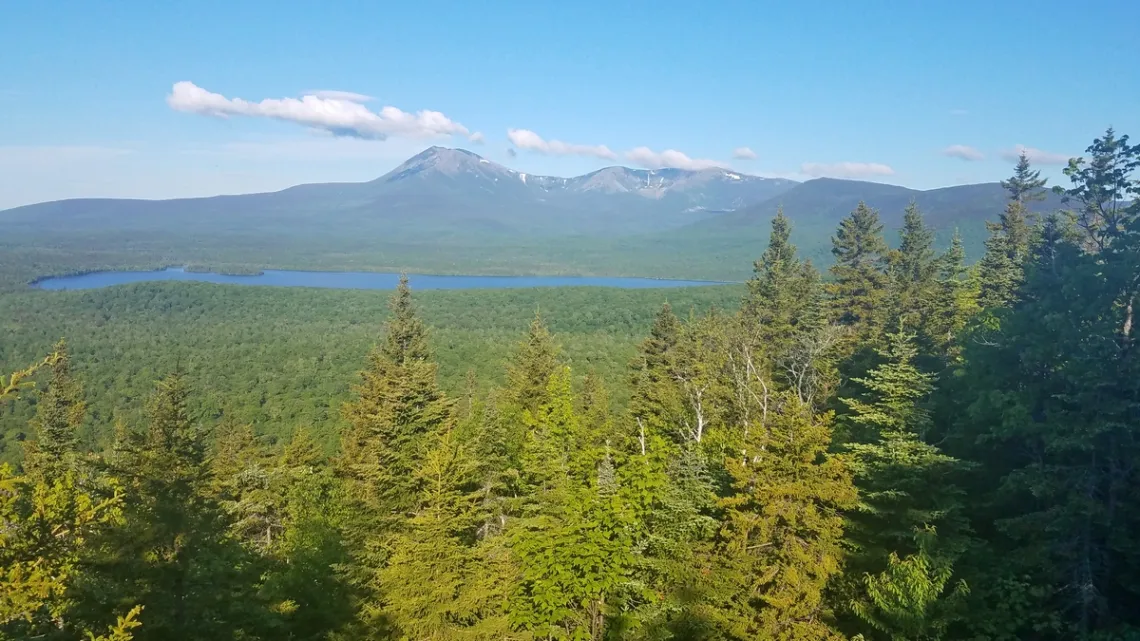
The picture above is of Mt. Katahdin, Maine, in Baxter State Park with Baxter Peak the highest summit. Baxter is the northern terminus of the American AT; for info about doing Baxter see an article in this newsletter December 2024. The picture is from Barnard Peak in Katadin Woods and Waters National Monument (KAWW). Barnard is on the IAT. The IAT page for Maine says the IAT starts in KAWW; why not have it start at Baxter Peak? A KAWW page says 29 miles of the IAT are within the monument.
I saw some SIA/IAT signs and blue trail blazes along the trail up Barnard. This is off the loop road in KAWW. Here is the National Park Service KAWW map. On this map we can see Mt. Barnard above the NW corner of the loop road. The trail to Barnard is off a road closed to vehicles but the peak is about 4 miles round trip from a parking spot, climbing only 400'. KAWW was also discussed in a October 2016 article.
The SIA/IAT: the Big Picture
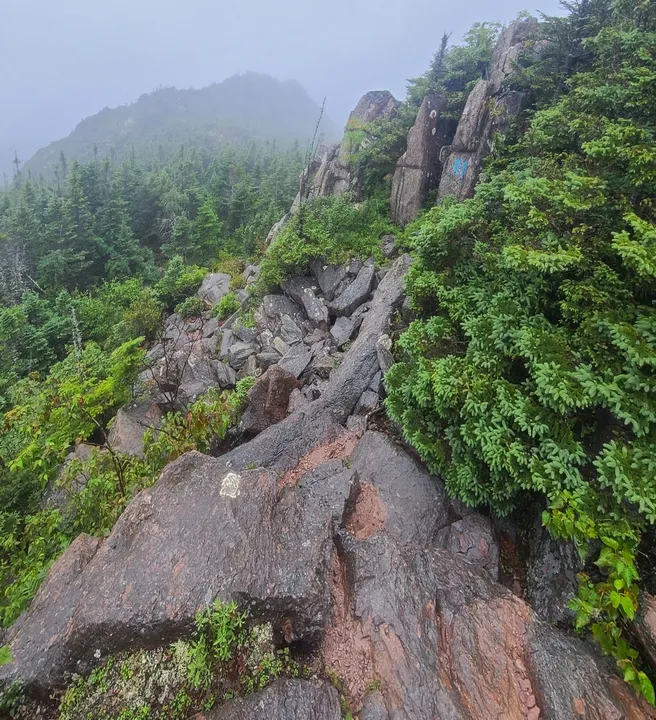
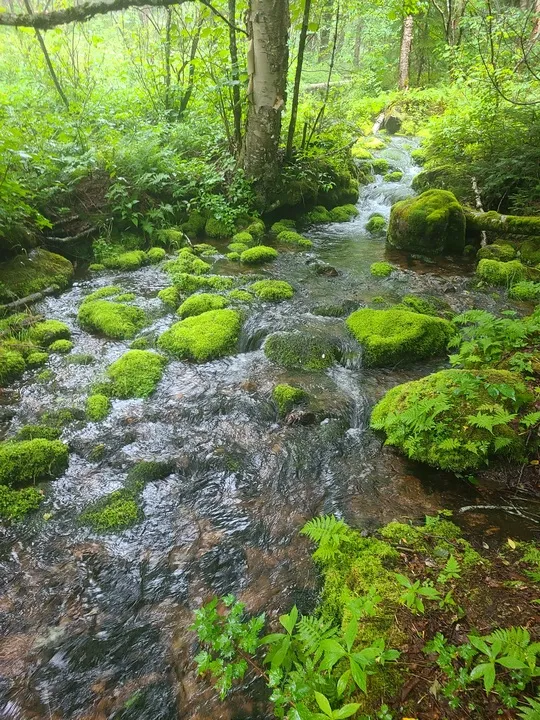
So unless we research the SIA/IAT likely assume it is an actual marked hiking trail like the AT. For a trip to eastern Quebec in August 2024 I looked briefly at the IAT maps from the website linked above, seeing that the route went through Mt. Carleton Provincial Park in north New Brunswick. And assumed that the IAT went across Mt. Carleton, the highest summit in the park. Next two pictures. Didn't see any SIA/IAT signs but it was a pleasant though challenging loop due to some rain. Now looking at the map again with zoom in (maybe now better maps, created by volunteers) we see the route follows a highway but there is a detour for the hike I did, a 6 mile loop. Carleton is certainly part of the Appalachians.
So we understand this is really about bits of the Appalachians. The IAT isn't a simple route; there are sections of the route/s in bunch of places worth a little look at with the maps on the IAT website, again zoom in. Quebec: all the way east to Cape Gaspe through Gaspesie and Forillon national parks, on the south side of Saint Laurence River. Nova Scotia: from the northeast corner of the south island northeast through Cape Breton Island, with Cape Breton Highlands National Park further north.
So if we are serious masochists might plan on doing all the bits of the IAT. Though when finished likely additional bits of the Appalachians will have been discovered and added to the trail; do we have a new plan? Certainly no reason to feel disappointed in any case, we can simply blame H. sapien's lack of understanding regards the geology.
by Kevin Hartley, Sierra Club Life Member
Super Benefits of Cultivating/Consuming Nopalito!
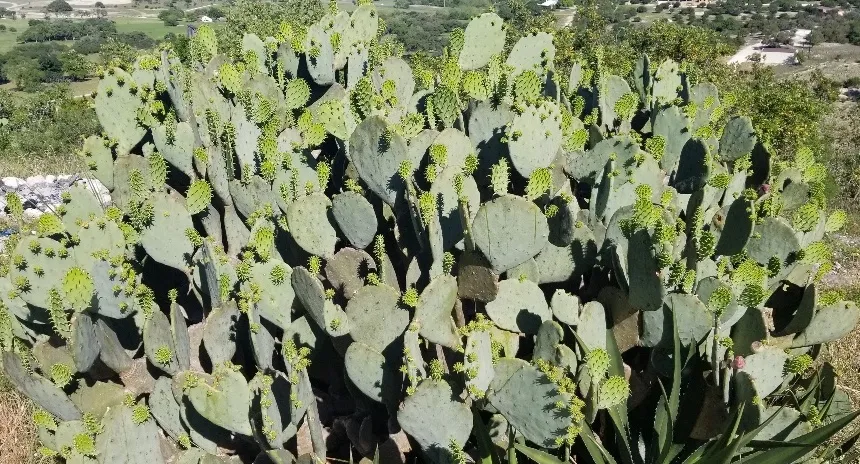
This is the young tender flat stems (pads) of prickly pear cactus (genus Opuntia, Wikipedia article). The pads in general are nopales, which are tough and fibrous when past the harvest period. There are many species of Opuntia but this is about the spineless variety we often see being grown as an ornamental and culinary plant around the southern half of Texas (2nd picture below). This originated with a hybrid developed by Luther Burbank for farm/ranch animal consumption.
This was earlier covered in this newsletter March 2022; doing again due to the serious importance of minimizing our carbon footprint along with the other advantages covered below. I had hoped that many friends would start growing and consuming this but that may not have happened.
Benefits, particularly super-sustainable!
Negative carbon footprint of cultivation and harvesting
Needs about zero attention, unlike most garden plants and sequesters CO2. Watering/fertilizing not really necessary though can be helpful. Can be fertilized with wood ashes from fire circles/stoves (reference). If we grow it ourselves there is no CO2 production as for commercial produce. The amount of greenhouse gases resulting from shipment/distribution etc of most produce we buy in supermarkets can be substantial, especially stuff coming from distant countries (CarbonBrief.com). And never a wildfire hazard as some agricultural crops can be.
Simple harvesting and preparation
We want the young tender pads; so harvest about mid-April into July. Want to know about the taste and texture? Harvest one and clean per below, cut a slice and give it a try.
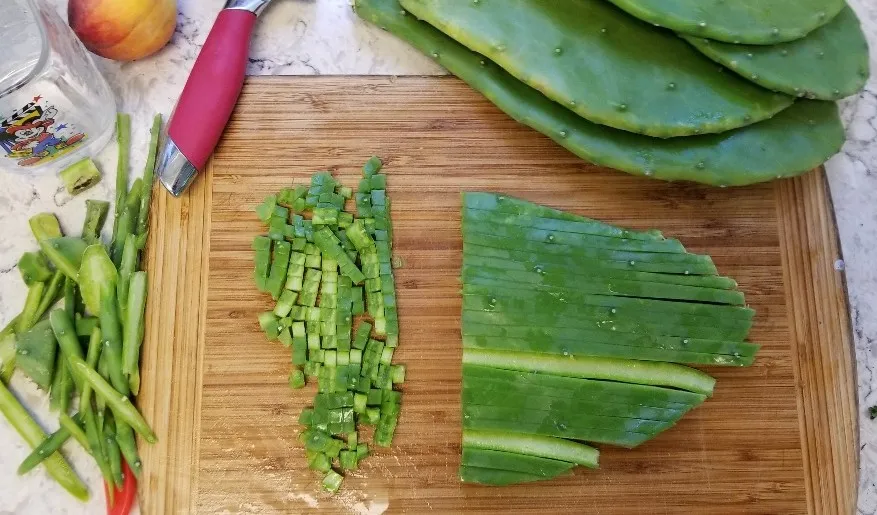
This spineless variety has tiny hairs at the eyes. But it is easily collected with gloves, twisting the pads off. In a minute we'll have 5+ lbs. We hold each pad down on a chopping board with glove or washrag and scrape the eyes with a straight-edged knife to remove the hairs (a santoku knife does well, Wikipedia). Then trim the edges, which have a few eyes left after the scraping. Then wash under running water. Picture below. Pads can take less than 30 secs. The processed pads are ready for use, distributing to friends etc. For cooking or freezing we can slice/dice; restaurants may serve slices roasted with meat.
Very nutritious
High fiber, zero fats, lots of vitamins and minerals. Just like many other green vegetables. Details easily found with a search, for example: Very Well Health and Organic Facts.
Usage ideas
Add diced to soups, stews and gumbo; very similar to okra. Cook with beans, peppers, meat and spices for tacos and serving with rice mixtures. Sliced for sauteing or roasted with other vegetables, or roasted/grilled with meat. If we have a big crop and challenged for freezer space might saute twenty pads or so at a time with spices, volume reduced by 2/3 and freeze; then use directly after thawing.
Planting
Collect some old pads and bury them like 1/3 stem end down vertically. Deer may steal these, if that is a likely problem lay horizontally with a rock on top center, hopefully protecting the pads. Plant some extra both methods a good idea, won't all propagate.
by Kevin Hartley, Sierra Club Life Member
Outings: The Call of the Wild
Visit the Alamo Sierra Club Outings page on Meetup for detailed information about all of our upcoming Sierra Club Outings.
The Alamo Sierran Newsletter
Richard Alles, Editor
Published by the Alamo Group of the Sierra Club, P.O. Box 6443, San Antonio, TX 78209, Website.
The Alamo Group is one of 13 regional groups within the Lone Star Chapter of the Sierra Club.
Changed your contact information?
If you're not sure whether the Sierra Club has your current email address, send an email to Member Services with your name and address and/or member ID (see Locating Your Member ID) so they can add your email address to your member record.
Have you moved? Let us know by sending your old address, your new address and your member ID to: address.changes@sierraclub.org.
Go online for the latest news and events
 |  |