When Does It Get Too Hot for People?
Climate change is pushing San Antonio into heat conditions that have never been experienced before. Recent heat waves are not just hotter: they are longer, more humid, and more dangerous, especially at night when bodies need relief. Planning for this new climate means asking a fundamental question: when does heat become unsafe for people?
Too often, we rely on simple air temperature, which tells only part of the story. Human heat stress depends on multiple factors: temperature, humidity, sunlight, wind, and even the heat radiating from pavement and buildings. Selecting the right measure of thermal stress is critical to make decisions about San Antonio’s future.
The Wet Bulb Globe Temperature (WBGT), developed by the U.S. military in the 1950s to reduce heat-related illness and death during training, and similar indices were designed specifically to assess when outdoor conditions become hazardous. Some of the organizations using the WBGT include Joint Base San Antonio, Northside Independent School District, Texas High School Coaches Association, Occupational Safety and Health Administration, and National Collegiate Athletic Association.
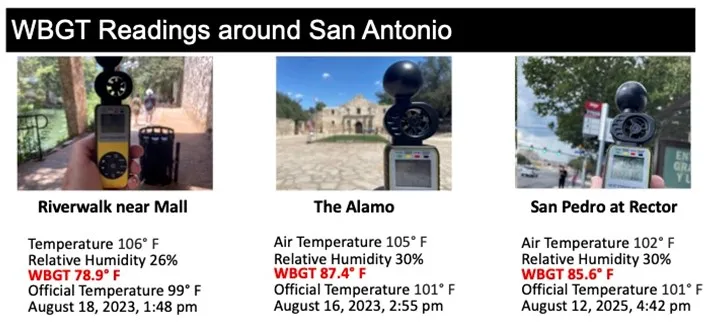
The WBGT is a single number measured in degrees that combines air temperature, humidity, wind speed, and radiated heat from the sun and other sources. Human health threat levels have been developed, and levels for San Antonio are shown here. I took some readings around San Antonio during recent summers, and you can see that I found places with elevated, moderate, and even high threat levels. | 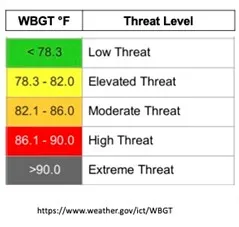
Graphic by Bill Barker |
As San Antonio adapts to a hotter future, using accurate heat-stress metrics will help guide better decisions about parks, transit stops, work schedules, and public safety. In a warming world, measuring heat correctly can save lives.
by Bill Barker, Alamo Group executive committee member
The San Antonio Extreme-Heat Challenge
Our first meeting of 2026, to be held on January 20th, features Bill Barker, FAICP, FITE, of San Antonio. He will discuss the challenges posed by increasing extreme heat, and how they can be addressed.
Tuesday, January 20th
6:00 pm
Meeting schedule
| Informal get-to-know-you | 6:00 pm to 6:15 pm |
| Announcements | 6:15 pm to 6:30 pm |
| Featured program | 6:30 pm to 8:00 pm |
| Discussion | 7:30 to 8:00 pm |
Venue
This is an in-person only meeting at:
William R. Sinkin Eco Centro, 1802 North Main Avenue
Map
Program topic
It is now hotter than it’s ever been, and it will continue to get hotter throughout our lifetimes. It is also now dangerously hot during summer months, as can be seen by increasing heat-related illness and deaths. There are also clear economic and environmental impacts. This presentation will summarize the current and projected extreme-heat situation in San Antonio and alternative technologies which can be used to address it.
About our Presenter
Bill Barker moved to San Antonio in 1997 to be Planning Director for VIA Metropolitan Transit. He has served as Executive Director of Solar San Antonio, a Project Manager in the City’s Office of Sustainability, and an Adjunct Associate Professor in the UTSA graduate urban and regional planning program. Currently, he is an advisor to the Great Springs Project and a member of the Executive Committee of the Alamo Group of the Sierra Club.
First working in mission simulation at NASA (Houston) for the Apollo lunar mission, his career then took a more terrestrial turn with the US Department of Transportation and North Central Texas Council of Governments. Bill has served as a consultant for public and private clients in seven states, Canada, and Mexico as well as the US DOE, DOT and USAID. He has been engaged in “think tank” projects with the UTSA Center for Urban and Regional Planning Research, Houston Advanced Research Center, the Environmental Defense Fund, the Gas Research Institute, the National Academy of Science Transportation Research Board, and the Center for Urban Transportation Research.
Bill is a Fellow of the Institute of Transportation Engineers and the American Institute of Certified Planners. He has a B.S. in physics and a M.A. in urban affairs.
Our general meetings are held the 3rd Tuesday of most months. They're always free and open to the public.
Reversing Falls, Pembroke Maine
Another interesting spot we might imagine visiting in Downeast Maine. For intro info about the whole area there was an article in the November 2025 issue of this newsletter. This one is set in Pembroke, which is 20 miles northwest of the eastern-most spot in the US (February 2020). An excellent area map was mentioned in the November article. Left of center at the top of the map we can see Leighton Neck in Pembroke with Cobscook Bay to the east.
At the south end of that neck we can see the little Reversing Falls Park with a parking spot labeled. Just southeast of the parking spot there is a circle of arrows around a tiny island. The map legend says about these circles: “DANGER Extreme Currents & Whirlpools”.
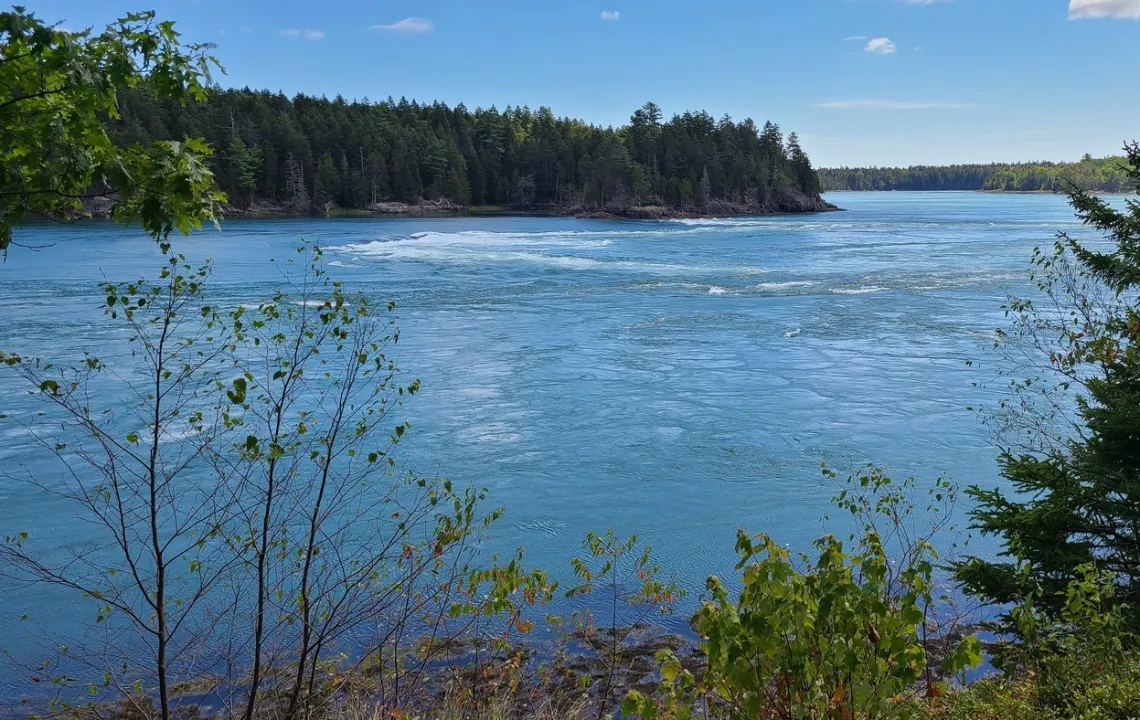
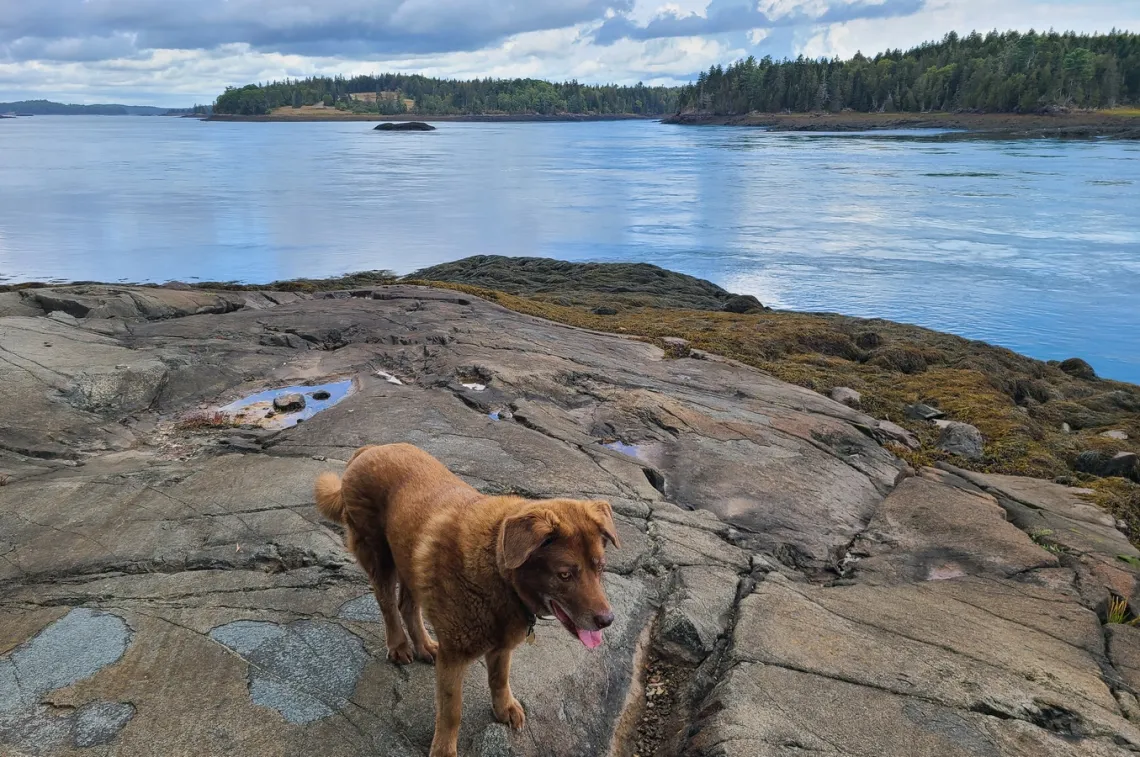
So that spot is what this park is named for; the picture above is at high tide. The island is entirely submerged, with the waves across it's top when the tide has begun moving in or out. Below are pictures at low and middle tides.
So as the map notes, extreme currents and whirlpools. We might imagine swimming out there and trying to stand on the submerged island at high tide so a buddy can take a picture. But surely don't want to approach up-current at high tide in a boat.
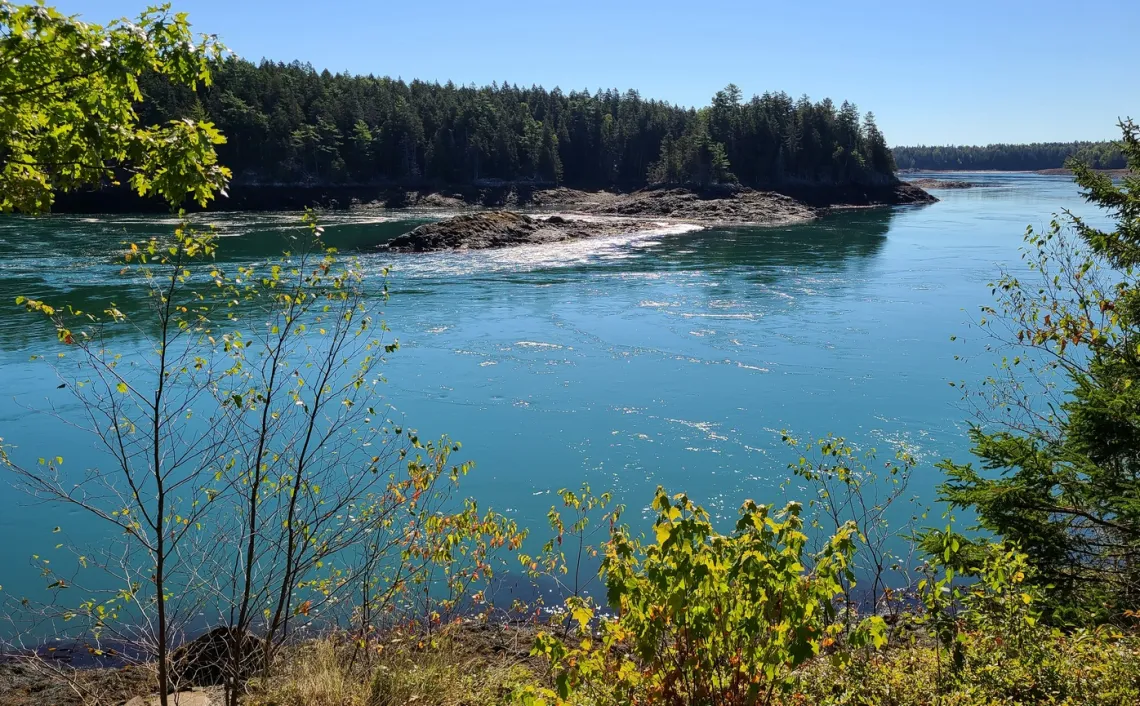
The picture below is from the northernmost spot in Race Point Preserve (again, on the map linked above a Cobscook Shores preserve, about those in the November 2025 issue), just SE of the prior pics. Taken at a spot the same distance from the island as the previous two, in exactly the opposite direction. Looking at the map we can see Race Point Preserve with Reversing Falls trail along the north shoreline.
The map shows Falls Island, which is upper left in the previous pictures and upper right in the next one. The map says it is owned by The Nature Conservancy. Looking further SE we can see Denbow Neck with Hog and Long islands on the E side, also TNC. I couldn't find a reference to Falls Island, likely few visitors, though we might imagine getting there in a boat and wandering through the thick forest.
From the TNC Where-We-Work Maine webpage, “TNC has helped protect more than 2.4 million acres in Maine, which benefit wildlife, protect unique habitats, encourage nature-based recreation and support sustainable industries.” TNC's impact is very important. I send them a donation every year.
Profound Books About Nature and Adventures by Bill Streever
We met Bill and his wife at the library in Pembroke, Maine. He is a biologist with published academic works and the list of books below. His wife is a marine biologist, they live on their sailboat and are building a house in Pembroke.
The books are personal accounts of experiences, plus extensive though basic explanations of the ecosystems and the biology, geology, geography involved and the chemistry and physics behind that. And human history. All very lucid and readable, even if we don't have much knowledge about the bits.
From the Cold preface, last in the list: “The world warms, awash in greenhouse gases, but forty below remains forty below. … Cold is part of everyday life, but we often isolate ourselves from it, hiding in overheated houses and retreating to overheated climates, all without understanding what we so eagerly avoid.... It is time to enjoy an occasional shiver as we worry about a newly emerging climate likely to melt our icecaps, devour our glaciers... It is time to embrace and understand the natural and human history of cold.”
Also about Cold: chapters by month, July to June. How the Inuit prepared for winters, the architecture of igloos and transitions of those with temperature, and essential clothing details. Cold tolerance of humans, which varies by acclimation and race. How organisms survive winters buried in the snow/ice, where it is much warmer than above. How mammals hibernate for many months there and other organisms freeze and thaw successfully. Having lived in Anchorage, lots of stories about trips around Alaska.
Finishing Cold, the final Notes chapter reviews the others, mentioning key bits and other authors' books. There are a bunch of topics we may wish to read up on. Wikipedia pages for some: Beringia, Igloos, Arctic Climate (global warming near bottom), Iceman and Frostbite (pictures), Ice Ages, Permafrost, and Greenhouse Gases. Geological Society of America for a geologic time scale chart. World Atlas about the Inuit people.
Bill's books
The SA library has four of these, including the first one, which was published in 2024.
- A Sea Full of Turtles – the Search for Optimism in an Epoch of Extinction
- In Oceans Deep – Courage, Innovation and Adventure Beneath the Waves
- And Soon I Heard a Roaring Wind – a Natural History of Moving Air
- Heat – Adventures in the World's Fiery Places
- Cold – Adventures in the World's Frozen Places
by Kevin Hartley, Sierra Club Life Member
Understanding Climate Change and its Impacts on Ecosystems
Gary Poole will be doing his annual climate change talk at Hardberger Park on Saturday Jan 24th, 2026. Our event’s purposes include understanding the science behind climate change, the global effects of climate change, and the long-term impacts of this phenomenon on specific Texas ecosystems. The audience will be encouraged to ask questions and provide their observations relevant to the topic.
Saturday, January 24th
9:00 to 10:30 am
The Urban Ecology Center, Hardberger Park West, 8400 NW Military Hwy.
Map
About this talk
Our presenter, Gary Poole, is a former middle school math and science teacher, engineer, and electronics technician. He is as well a former Texas caver, beekeeper, and is currently a Master Naturalist with Alamo Area Master Naturalists, in which organization he has served in several different capacities including as President.
Please arrive at the UEC Gathering Hall by 8:45 am SHARP to register so we can start right at 9:00 am. Minors only when accompanied by an adult parent/guardian. Dogs not appropriate because of the indoor presentation.
DIFFICULTY: Easy, definitely suitable for families. Suggested $3 individual or $5 family donations to the PHP Conservancy to support enhancements to the park.
This event's general sponsors are the Phil Hardberger Park Conservancy, the San Antonio Parks and Recreation Department's Natural Area Office, the Alamo Area Master Naturalists, The Native Plant Society of Texas- SA chapter, and the Alamo Group of the Sierra Club.
Contact Stan Drezek for additional information or questions.
Outings: The Call of the Wild
Visit the Alamo Sierra Club Outings page on Meetup for detailed information about all of our upcoming Sierra Club Outings.
The Alamo Sierran Newsletter
Richard Alles, Editor
Published by the Alamo Group of the Sierra Club, P.O. Box 6443, San Antonio, TX 78209, Website.
The Alamo Group is one of 13 regional groups within the Lone Star Chapter of the Sierra Club.
Changed your contact information?
If you're not sure whether the Sierra Club has your current email address, send an email to Member Services with your name and address and/or member ID (see Locating Your Member ID) so they can add your email address to your member record.
Have you moved? Let us know by sending your old address, your new address and your member ID to: address.changes@sierraclub.org.
Go online for the latest news and events
 |  |