Gila National Forest, Southwestern New Mexico: a Few Spots
These bits are from a trip early February 2024. The first one is just east of Silver City north of US 180. Dragonfly Loop Trail, Gila National Forest, is a very appealing short loop including markers about petroglyphs done by Apaches, including a section beside a creek, first picture below. Here is a page with pictures of the trail. And another with pictures of the petroglyphs. And a good extensive page of the larger area by a descendant of the Apaches that lived here. So we might imagine learning some stuff we didn't know much about, then doing this hike and learning more.
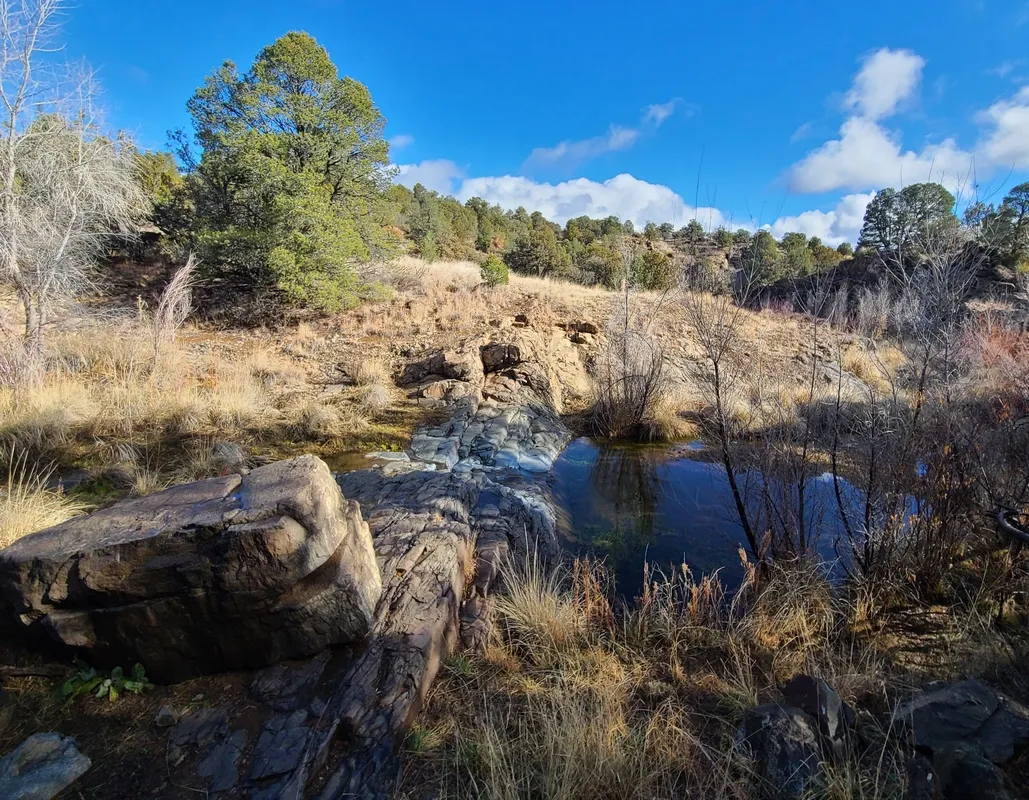
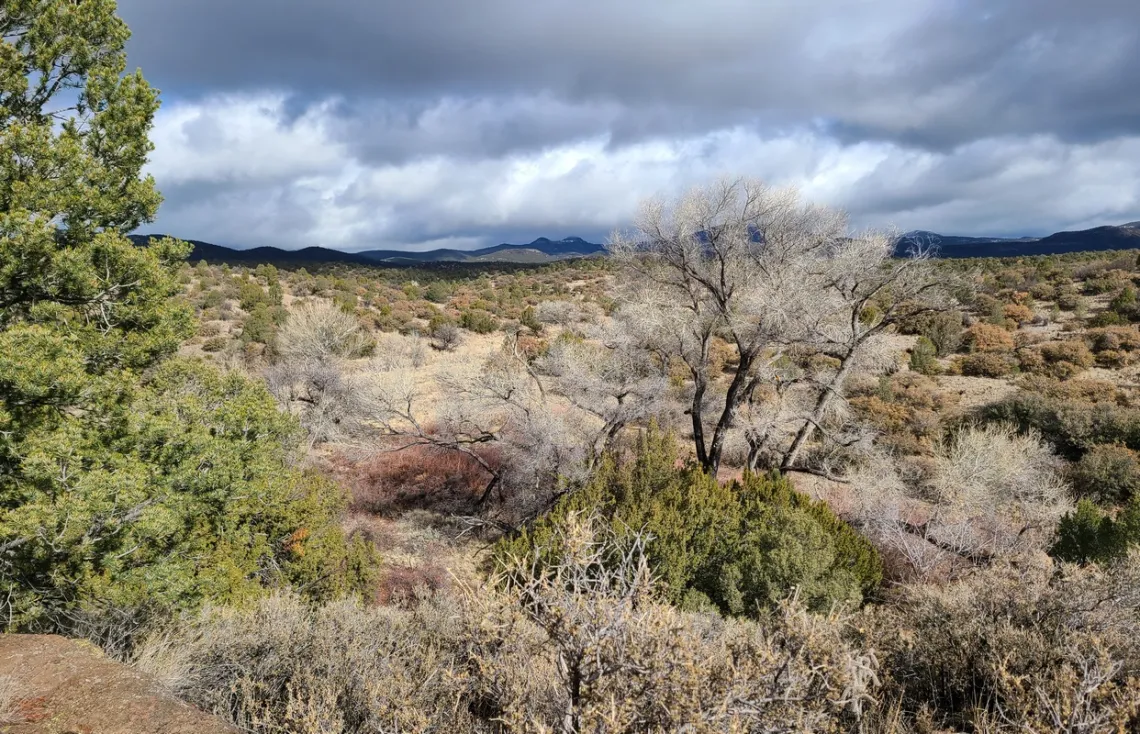
Box Recreation Area
This is just southwest of Socorro, south of US 60. Here is the BLM webpage. The website says this place is popular for technical climbing, but there are a couple easy trails visible on the Blue Canyon trail map (PDF). As the webpage says there is free camping but no water, and parking with a kiosk and restroom, though the map doesn't show whether those are at the Black Canyon or Blue Canyon trailheads, but maybe both. On an old map I can see a bunch of old mining claims and some mines marked.
Magdalena Mountains, Magdalena Fault
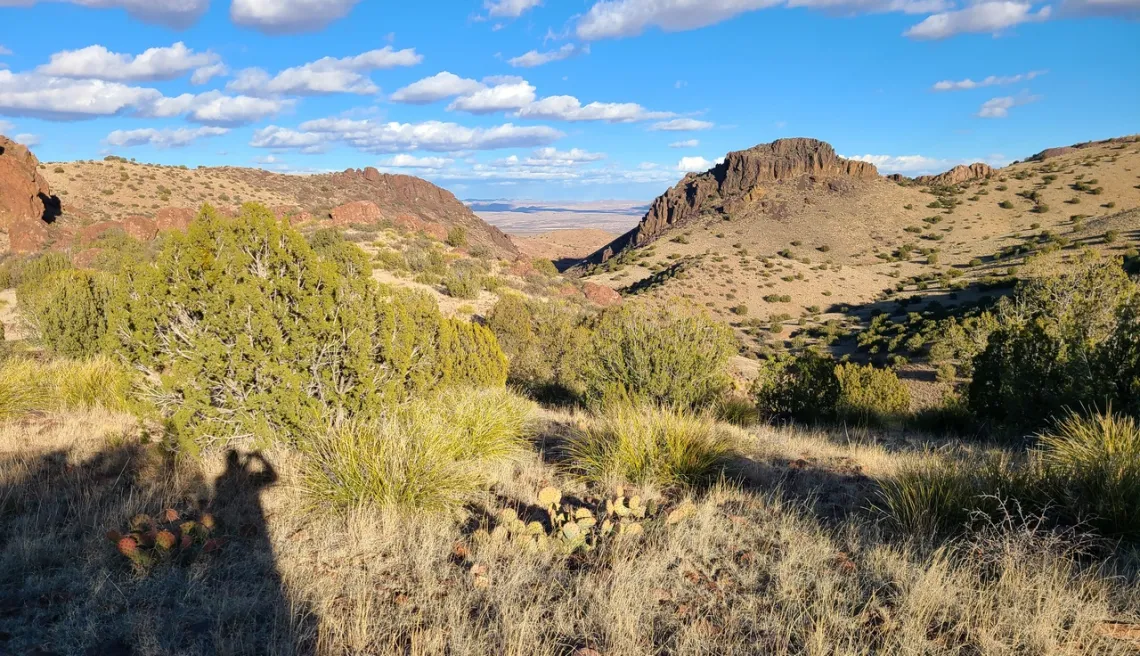
Just after doing the bit mentioned above drove just west on US 60 to Water Canyon road and then southwest to Water Canyon campground. As had seen some trails to the south on what is labeled Water Canyon Mesa, 8000', on an old map. This is in a unit of Gila National Forest/National Grasslands. Did a nice hike up to and around a bit of the mesa, next picture. Round trip 11 miles, gain 1500'. Couple more old mine ruins along the road to the campground.
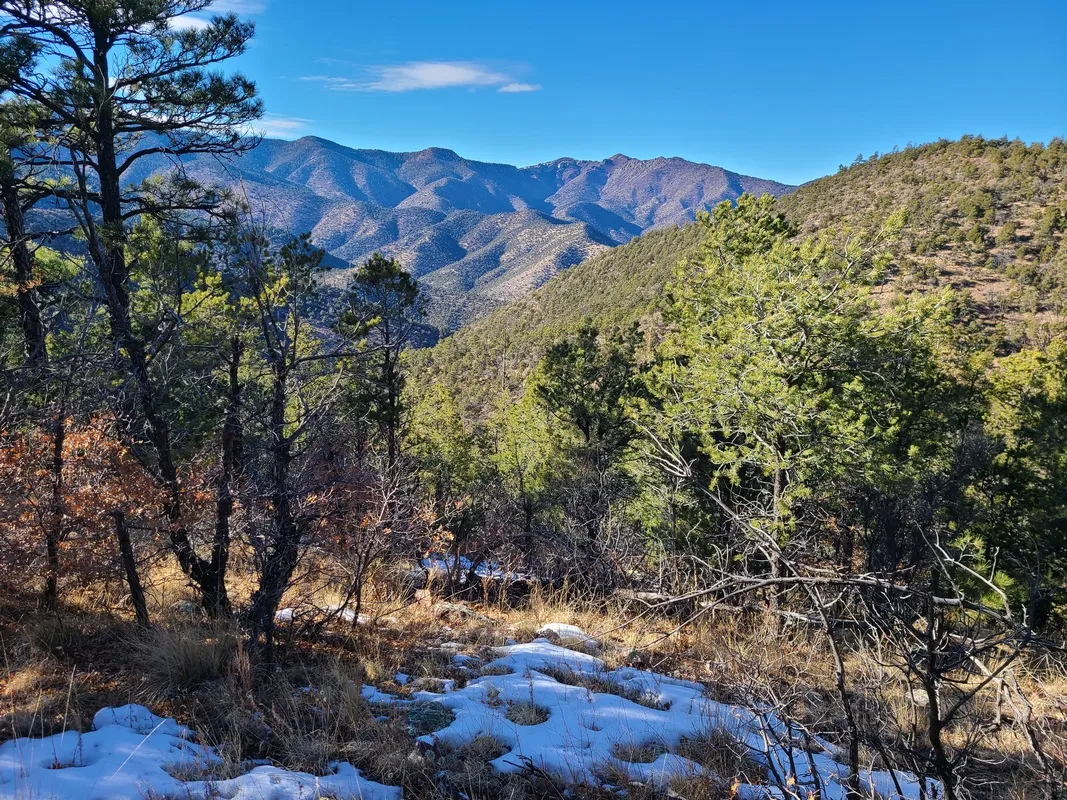
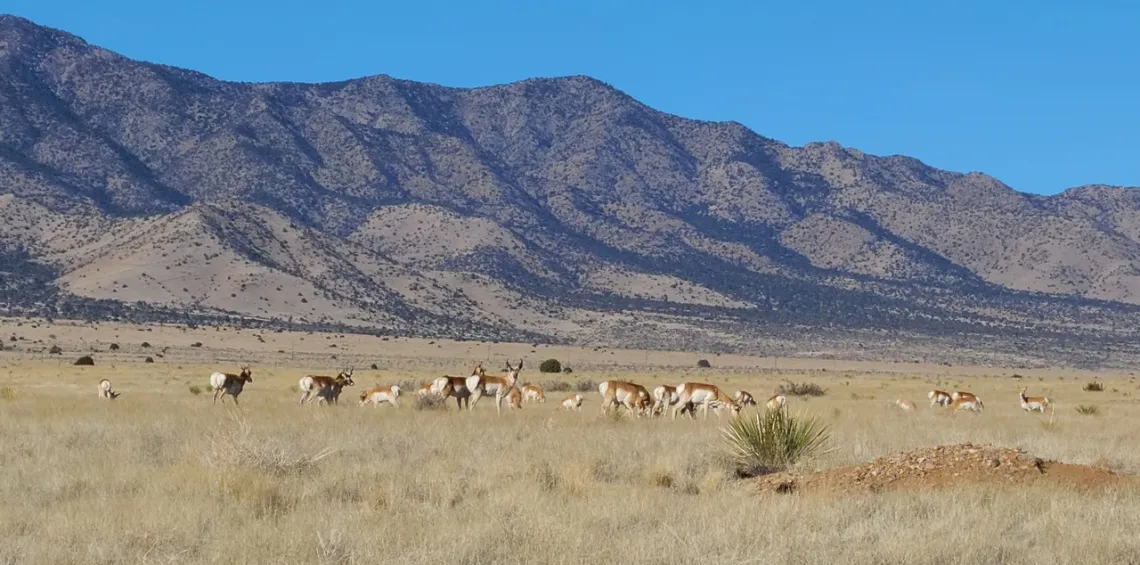
Working on this article saw an on-line map marker for a road sign about Magdalena Fault. Then found the Wikipedia page about the Magdalena Mountains, which talks about the history of the area and the people. And the USGS page about the volcanic history. Didn't know about this when I was there. The fault is the reason for the sharp divide between mountains and the prairie to the east, clearly visible in the last picture. Was very nice to see the group of pronghorns (Wikipedia), the fastest land mammal in the Americas, which cannot jump fences.
Other articles about spots in New Mexico
Cibola National Forest, New Mexico: a Few Spots, December 2025. The Doña Ana Mountains and Kilbourne Hole, June 2024. A Few More Spots in Northern New Mexico, October 2024. Across Southern New Mexico - Vistas, Geology and History, February 2023. Bisti/De-Na-Zin Wilderness, November 2019. And others linked from these.
by Kevin Hartley, Sierra Club Life Member
Tales From Antarctica
Our March 17th meeting features Stephen Ackley from UTSA. He will describe his work in Antarctica on Ice Station Weddell. His presentation will focus on expedition logistics and difficulties encountered to live and work with modern instrumentation in the polar environment, and will end with a summary of the scientific achievements of Ice Station Weddell.
Tuesday, March 17th
6:00 pm
Meeting schedule
| Informal get-to-know-you | 6:00 pm to 6:15 pm |
| Announcements | 6:15 pm to 6:30 pm |
| Featured program | 6:30 pm to 8:00 pm |
| Discussion | 7:30 to 8:00 pm |
Venue
This is an in-person only meeting at:
William R. Sinkin Eco Centro, 1802 North Main Avenue
Map
Program topic
The Antarctic sea ice station was a cooperative program between the US and Russia. It spanned the same area of the Weddell Sea in which Ernest Shackleton’s 1917 expedition aboard the vessel Endurance had been trapped and crushed in the ice. Modern efforts to access the area by vessel to conduct scientific studies of the ocean, atmosphere, sea ice and ecosystem had not been possible due to the thickness and compactness of the ice, so Ice Station Wedell provided the first measurements of these conditions in the modern era. The significance of the area is its linkages to world problems of climate, ocean circulation, and polar ecosystems, previously unmeasured.
About our presenter
Stephen Ackley has been the leader of modern Antarctic sea ice research since its inception in the 1970’s. Currently Associate Professor of Research, Earth and Planetary Sciences at UTSA, he served as sea ice geophysicist at the U.S. Army Cold Regions Research and Engineering Laboratory (CRREL) for approximately 30 years, including twelve research cruises into the Antarctic sea ice zone and on the first Antarctic sea ice drifting station, Ice Station Weddell (1992). Since his arrival at UTSA, students and faculty have participated in over 10 expeditions to the Arctic, Antarctic, and a Mexican glacier under his leadership. Prof. Ackley co-authored the monograph “The Growth, Structure, and Properties of Sea Ice” in the text “The Geophysics of Sea Ice”, which is used internationally by students of Polar Marine Sciences.
Prof. Ackley received a B.S. in Engineering Physics from Cornell University. He is a National Science Foundation Antarctic Service Medal awardee, and Ackley Point at Ross Island, Antarctica, was named by the U.S. Board on Geographic Names in honor of his outstanding sea ice research. He was awarded the 2022 Medal for International Coordination by the International Science Council Scientific Committee on Antarctic Research, for his major contributions to Antarctic sea ice research. He was elected as a Fellow of the American Geophysical Union in 2023.
For more information:
Our general meetings are held the 3rd Tuesday of most months. They're always free and open to the public.
Don’t Forget to Use Science When Planning a Cooler City and Planet
When we talk about cooling our city, or cooling the planet, it helps to start with something that cannot be debated or voted away: physics.
The law we must respect is the First Law of Thermodynamics: energy can neither be created nor destroyed. Heat is a form of energy. If we want something to become cooler, that heat energy must go somewhere or be converted into another form.
This may sound abstract, but it has enormous implications for urban planning in San Antonio, one of the fastest-warming large cities in the United States.
Cooling Means Moving or Transforming Energy
Plants offer a simple example. Through photosynthesis, they convert radiant solar energy into chemical energy stored in plant tissue. That conversion reduces the amount of energy heating nearby surfaces. Shade from trees lowers mean radiant temperature often far more than reflective coatings alone.
Solar panels convert 15-25% of the energy from the sun to electricity, thus providing more than just shade.
Conventional air conditioning works differently. It removes heat from inside a building and expels it outdoors. The building cools, but the surrounding environment becomes warmer. In a dense downtown, thousands of air-conditioning systems dump heat into the same air pedestrians must walk through.
If we truly want to cool the city, not just individual buildings, we must think more strategically about where the heat goes.
Using the Ground as a Heat Sink
One promising approach is geothermal exchange.
The Credit Human headquarters at 1703 Broadway uses underground wells to transfer building heat into the earth, where temperatures remain a relatively stable 70–75°F year-round. Instead of heating downtown air, the building stores excess heat underground.
This approach respects thermodynamics: the heat is not eliminated, but it is placed somewhere it does far less harm.
Developments like Whisper Valley in Austin show that geothermal infrastructure can be installed during initial utility construction, reducing costs. If planned early, geothermal systems can cool entire neighborhoods without intensifying the urban heat island.
Sending Heat to Deep Space
Another emerging strategy is Passive Daytime Radiative Cooling (PDRC). These specially engineered materials reflect most incoming sunlight while emitting longwave infrared radiation through an atmospheric “window” that allows heat to escape into deep space.
Unlike standard white paint, advanced PDRC materials are tuned to radiate heat at wavelengths that pass through the atmosphere into space.
Researchers estimate that widespread application of high-performance radiative cooling materials could meaningfully offset warming at scale. While not a silver bullet, it is one of the few technologies that literally sends heat off the planet.
Reflection Is Not the Same as Cooling
Simply applying light-colored or reflective coatings does not remove heat energy; it redistributes it. Reflective pavement can reduce surface temperature but may increase radiant heat experienced by pedestrians if not paired with shade.
Thermodynamics reminds us: energy must go somewhere.
If it is not absorbed into vegetation, stored underground, evaporated through water, or radiated to space, it remains in the local system.
What This Means for San Antonio
San Antonio is already experiencing longer, hotter summers and warmer nights. Planning for this new climate requires more than symbolic gestures.
It requires:
- Expanding tree canopy where water is available
- Using geothermal systems in public buildings and district cooling networks
- Exploring radiative cooling materials for roofs and transit shelters
- Designing infrastructure that reduces mean radiant temperature, not just air temperature
- Measuring thermal stress using tools such as WBGT
If we ignore thermodynamics, we risk making expensive investments that merely move heat around rather than reducing thermal stress.
Physics is not political. It does not respond to slogans. But it can guide us toward smarter design.
If San Antonio wants to lead again in cooling innovation (as it once did in early air-conditioning history), we must start by asking a simple question: Where is the heat going? And then design our city accordingly.
by Bill Barker, Alamo Group executive committee member
Say No to the Big Bend Border Wall
Thank you for getting involved in the movement against a border wall in the greater Big Bend region. You are part of a rapidly growing response. Preventing the construction of a border wall will require all of us coming together in unified & multifaceted ways.
We are a group of volunteers working diligently to create empowering resources and calls to action. We will be providing more materials in the coming days and weeks. In the meantime please:
- Call your reps daily and leave personal messages - Contacts and Call Script
- Sign the petition
- Print out, post up and share these posters and flyers created by no-al-muro.com
- Keep up to date with news and facts
- Follow and share our social media pages and website
- Keep sharing your stories with us!
- Encourage people to sign up with our contact form
- Mark your calendars for an independently-hosted screening event of The River and the Wall, March 6th, 7PM at the Crowley Theater, Marfa, TX
We are encouraging everyone in this broad community to talk with your neighbors, organize with your friends, engage with your locally elected officials, and share your love for the Big Bend far and wide.
Stronger together!
No Big Bend Border Wall
submitted by Elizabeth McGreevy, Founder & Director, Project Bedrock
Sierra Club Lone Star Chapter's Earth Month T-Shirt Design Competition
The Sierra Club Lone Star Chapter Earth Month T-Shirt Design Competition invites artists, designers, and creative advocates to submit original artwork that reflects the values and vision of the Sierra Club. Selected designs may be featured on official Sierra Club Lone Star Chapter merchandise and worn by supporters across Texas to promote environmental protection, people-powered advocacy, and environmental justice! Entrants are also eligible to win Sierra Club membership and swag!
Visit this webpage for all the details about entering this contest.

Outings: The Call of the Wild
Visit the Alamo Sierra Club Outings page on Meetup for detailed information about all of our upcoming Sierra Club Outings.
The Alamo Sierran Newsletter
Richard Alles, Editor
Published by the Alamo Group of the Sierra Club, P.O. Box 6443, San Antonio, TX 78209, Website.
The Alamo Group is one of 13 regional groups within the Lone Star Chapter of the Sierra Club.
Changed your contact information?
If you're not sure whether the Sierra Club has your current email address, send an email to Member Services with your name and address and/or member ID (see Locating Your Member ID) so they can add your email address to your member record.
Have you moved? Let us know by sending your old address, your new address and your member ID to: address.changes@sierraclub.org.
Go online for the latest news and events
 |  |