By Doug Howell
Member, Sierra Club Washington Chapter Energy Committee
Past Sierra Club Beyond Coal staffer, 2009 to 2021
With over 40% of the northwest’s electrical power, and 75% of its electrical transmission lines, the Bonneville Power Administration (BPA) is the single-most important government agency in the northwest for delivering our clean energy future. The agency has a long history of resisting necessary changes to recover endangered salmon (breaching the lower Snake River dams), but the agency is also failing to step up on energy efficiency, renewable energy, and transmission capacity expansion.
BPA and its public utility customers were tasked with providing 42% of energy efficiency savings for the region from 2016 to 2021 but only achieved 30%. Last year, BPA made an additional $500 million from its surplus sales of hydropower and had $10 billion in borrowing authority granted by Congress, yet the agency did not fill its current deficiency in energy efficiency or responsibly address a huge backlog in necessary salmon investments requested by the Columbia Basin Tribes.
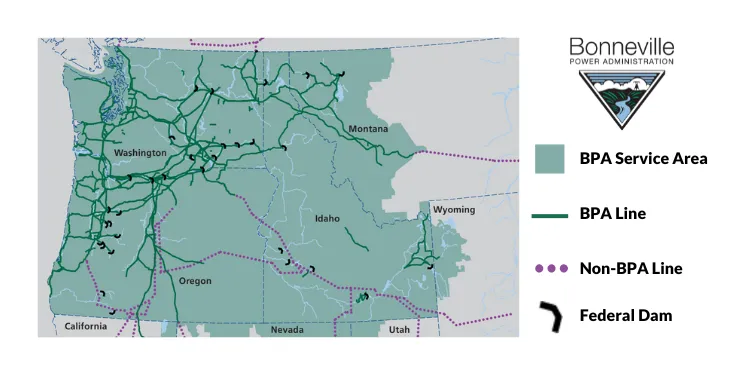
A map of the Bonville Power Association's service area.
Due to the phase out of coal and gas in electricity generation, and the tremendous growth in electricity demand from the electrification of buildings and vehicles, BPA is facing the need for a massive build out of wind, solar, and storage projects. However, it has yet to offer its public utility customers clean energy products for their renewed contracts in BPA’s draft contract: Provider of Choice – essentially ingraining fossil fuel use throughout the foreseeable future.
With this massive need for additional renewable energy, BPA needs to quickly accelerate the build out of transmission capacity by bringing clean energy supply centers such as intermountain wind, desert solar, and offshore wind to utility providers in the PNW. Northern Grid – a regional transmission planning association which includes BPA – received an “F” from American for a Clean Energy Grid for their lackluster planning methods. To address this failure, clean energy advocates are pushing for a regional forum on transmission that includes tribes, the U.S. Department of Energy, the NW Power and Conservation Council, state governments, and national labs.
Recently BPA announced $2 billion in transmission upgrades - which is a start. But it is a modest down payment on the magnitude and speed at which these investments must happen. Overall, across the PNW, stakeholders are feeling frustrated and ignored, including:
- Several labor unions (with support from most of WA Congressmembers) being stonewalled in their request for BPA to provide power to help re-establish the aluminum industry – an essential element of clean technology;
- Elected officials are raising concern BPA is not working with regional governments to take advantage of billions of dollars in federal funding for clean energy projects;
- Public utilities worry that BPA contracts won’t give them the flexibility necessary to meet climate goals, nor sufficiently incentivize energy efficiency; and
- Regional clean energy developers are losing faith in BPA to move fast enough on transmission capacity necessary to transitioning off of fossil fuels.
Please deliver a strong message to BPA by taking these actions:
- As mentioned above, contact BPA at Communications@bpa.gov to urge BPA to support a regional forum on transmission.
- Email Senators Cantwell and Murray to tell BPA to support a salmon recovery plan that restores the lower Snake River.
For questions or more information on how to get involved with BPA advocacy, contact Doug Howell at seattlehowell@gmail.com.