Snapshots of Recovery: Eaton Fire Survivors Nine Months Later
Revisiting three fire-struck families as they rebuild, reconnect, and reckon with ongoing uncertainty
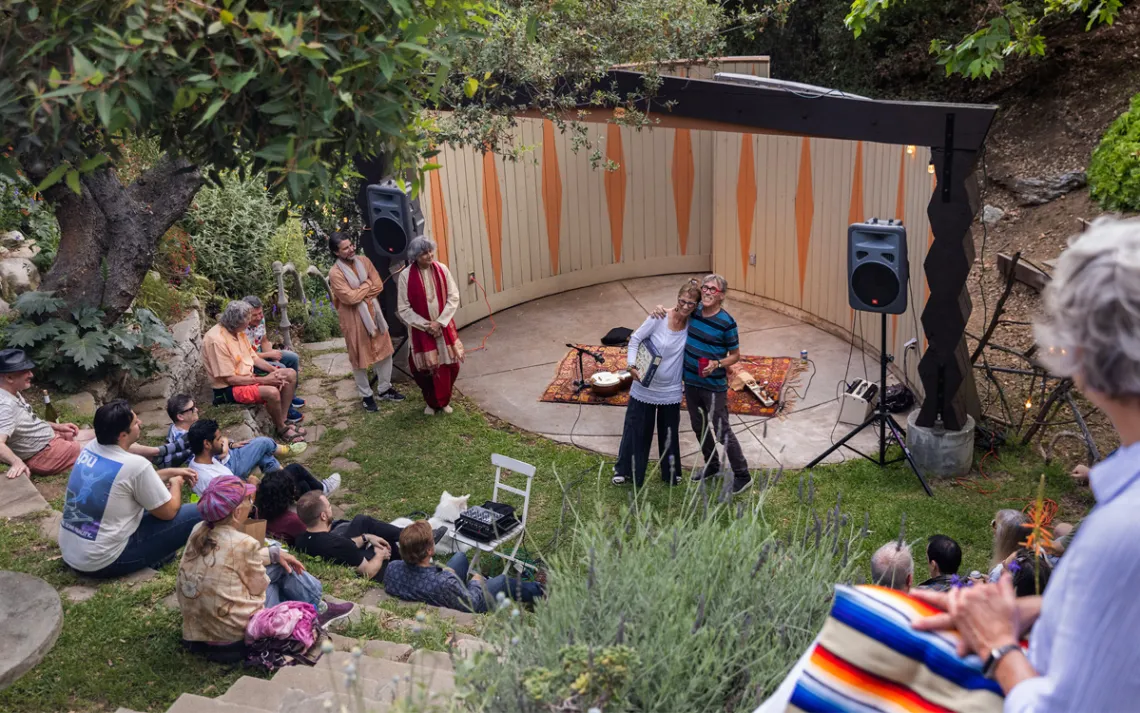
Sue Dadd and James Griffith host the first Folly Bowl of the year on June 15, 2025, after the Eaton Fire burned through Altadena. Since the fire, the couple have opened up their space for dinners and community meetings, supporting those who lost their homes. All donations from their summer music series went directly to the local musicians, many of whom lost their homes in the fire. “Thank you for coming from wherever you came,” Griffith said. “Because it may not be next door anymore.”
This is part two of a year-long project following three households impacted by the January 2025 Eaton Fire in Los Angeles. The diverse stories of these neighbors—who lived only blocks away from one another—offer an intimate glimpse into the complexities of disaster recovery and the decisions that must be made long after the breaking news. You can read the first installment here and the third and final installment here.
On an early August evening, the air still balmy but the sun fading, James Griffith and Sue Dadd’s house is a beacon in Altadena, California. There are the lights and the tall trees, green and flush with grateful birds. And then there’s the sound—a hint of music, the melody muffled under the chatter of a growing crowd.
Each of these elements have been sorely missed in the neighborhood. In January, the deadly Eaton Fire blazed through the Los Angeles community, destroying more than 9,000 homes. For months after, there was a regular thrum of construction as federal officials and contractors cleared burned lots of debris and utility companies repaired and replaced infrastructure. But now, as displaced residents navigate the costs and concerns that come with recovery, the streets are often silent. For many survivors, the quiet in Altadena is deceptive, failing to convey the often all-consuming experience of moving forward from the disaster, from the endless wait times to reach insurance providers to the hours poured into appeal aid applications, and the persistent voicemails from prospective realtors hoping to get their sale.
Nine months after the Eaton Fire, survivors have more clarity about the responsibilities that line their road to recovery, but that doesn’t mean the path is certain.
“Every performance was so beautiful and heartfelt and exquisite. And still, the most important part of everything was just the people.”
The most important part
Griffith and Dadd were unsure in the early months after the Eaton Fire if they would again hear the chatter and music that long defined their summer. The couple’s property was largely spared by the flames, save for some licks along the edges of their land, but they’ve still spent months remediating that damage. As the summer grew warmer, they took a break from this outdoor work and returned to a beloved tradition.
For six nights, Griffith and Dadd hosted concerts at the Folly Bowl, the amphitheater they built into their front yard years ago to host friends, neighbors, and musicians (and often, people who were a combination of all three). The performances spanned the musical gamut, from a duo playing the sitar and the sarod to an abstract take on the Beatles' unfinished songs. What they all had in common is that the performers had each been touched by the Eaton Fire, and the concerts were all donation-based.
An early August performance featured a jazz quintet and drew a crowd, lining the street in front of the couple’s house with cars. While Dadd took a seat in the stands, Griffith stood by the stage, gazing up at the rows. As guests filed in, they called across the yard and waved at faces that were once familiar but now haven’t been seen for months; they climbed over tucked limbs to share food from picnic baskets and updates on their housing situations. By the time Griffith took the mic to kick off the show, there wasn’t a spare seat to be seen.
“We’ve had an extraordinary season of concerts this year,” he said, beaming up at the crowd. “Every performance was so beautiful and heartfelt and exquisite. And still, the most important part of everything was just the people.”
Before pausing—“I’m going to stop; I’m choking up”—he thanked the attendees for coming. Tomorrow, their responsibilities and recovery checklists would take priority again. But for now, there was a slow sunset, swelling music, and their community, together once again if just temporarily.
“The things that I really value aren’t the bigger things or the real expensive things. [It’s the] stuff that really meant something to me when I was a kid.”

Donny Kincey leads a creative session at the Crown Me camp in Pasadena on August 13. Kincey, a teacher and artist, said he hasn’t been able to create much art since losing his home and almost all of his art inside. Doing activities like this with kids has helped get his creative energy flowing again. The camp focuses on empowering and celebrating Black children in the neighboring communities by providing creative, fun, and culturally focused activities during the summer camp program. “These are 50 LA-based kids in private schools that don’t get to often hang out with kids that look like them,” he said.
Turning trash into treasure
Donny Kincey stood in front of a table of young campers and unveiled his secret weapon: a bag of trash.
He asked the kids if they knew about the Eaton Fire and if they’d heard he had lost his home. They nodded.
“I was thinking about all the cool stuff that I've had and the stuff that I've lost, and the things that I really value aren't the bigger things or the real expensive things,” he continued. “[It's the] stuff that really meant something to me when I was a kid.”
It was a hot day halfway through the last week of the Crown Me camp in Pasadena, and Kincey was tasked with keeping a group of kids entertained before lunch. He walked them through how they could turn regularly discarded items—scraps of duct tape, crumpled-up paper—into treasured keepsakes by molding them into little figurines. As the kids ran with the idea, cutting and crumpling and taping together baseball players and musicians complete with duct-tape bats and microphones clutched in duct-tape fists, Kincey marveled at their creativity and ability to build something out of nothing without hesitation.
That mindset has been an inspiration for him outside of work too. In the wake of losing two of his family’s homes—the place where he grew up and his sister’s house, where he had been living and built his own art studio—he had felt creativity blocked for months. Lately, he’s slowly been getting back into painting.
“It's not starting to flow yet, but I'm at least collecting canvas and throwing paint at backgrounds,” he explained. “Just a step in the right direction as I'm trying to plan my next steps.”
Kincey is still in a temporary apartment, which he was offered for free after the fire while he got back on his feet, but he's having a tough time deciding where he wants to go next. The past nine months have changed his perspective, he says, and he has a hard time picturing himself paying the high rents in the area just to house himself and “a few shirts.” He wants to be comfortable, but he also wonders if he might be most comfortable staying in his truck or getting studio space to work and tossing down a mattress there.
Both of his family’s Altadena properties are among those sitting vacant while his family waits to hear back on their insurance claims. Seeing the empty lots was “worse than seeing [them] burned” for Kincey. Then, you could at least make out the chimney and see the outline of the structure.
“Now it’s just like it was never there,” he said. “Like it never happened.”
“We love Altadena, and we didn't ask for this to be taken away, so we want to put in the work to come back here.”

Freyja Lund, 10, walks in to the family’s ADU under construction in Altadena, California, on August 26. What was originally planned as a building for homeschooling Freyja and her brother behind the family home is now being completed as a 400-square-foot studio where the family can live while they build their main house.
The waiting game
Before the Eaton Fire burned down their house, Lara and Robert Lund had been saving and planning to construct an accessory dwelling unit in their backyard. They envisioned it as a schoolhouse for their kids, Freyja and Llewellyn, with books lining the walls and a table in the center. Now, the skeleton of that building looms over their empty lot. Once the ADU is completed, their plan is to live in the 400-square-foot studio until their house can be rebuilt.
Their ADU was the fifth building permit approved in all of Altadena, according to Lara. Since they received that go-ahead in early May, Robert has been working on its construction in the margins of his other contracting work. The space is now sturdy enough to walk around in and built out enough that it’s attracting attention. On their security cameras, Lara said she often sees people pulling up out front just to look at the building—maybe for inspiration, she thinks, or just to appreciate seeing progress in the neighborhood.
It’s a process that Lara knows might seem exciting from the outside but has come with fresh complications and financial anxieties. Even with Robert’s deep understanding of the construction space, they’ve been reeling from the combination of costs.
“We're just pulling out of our savings, so we're scared,” Lara said.
It’s not just the building materials, but the shipping container to hold them—there goes $2,500. A fence around the property added another $1,200. And then there’s the temporary power pole they had to pay to erect just to get the building process started.
They’re currently at a standstill with their insurance agency, waiting on payouts, which holds up their ability to access their approved loan from the Small Business Administration. Walls up and tens of thousands of dollars invested into the rebuild, the process has been trying enough that Lara and Robert still sometimes question whether they’re going to be able to rebuild for real.
“We love Altadena, and we didn't ask for this to be taken away, so we want to put in the work to come back here,” Lara said, standing in the unfinished building. “We're determined to not give up, but we have those moments—this is so hard.”
There have been some bright spots along the way. Earlier in the summer, the family took time off to travel with Llewellyn for a baseball competition. Freyja has been taking aerial silk classes from a woman who is also an Eaton Fire survivor. These breaks have proved essential for Lara, who said she’ll sometimes find herself glued to her devices—itemizing everything they lost in a spreadsheet, watching a webinar with other survivors, or on yet another call about their promised aid—and realize there’s no end in sight.
“There just has to be that time when you're like, 'I'm done. I am not going to get anything else done today,' and just be able to all hang out together [as a family],” she said. “Life's too short.”
Click here to read the first installment in this series.
The third and final installment will publish in January 2026.