Guilt, Hope, and Uncertainty: Three Eaton Fire Survivors, Three Different Journeys
Sierra will follow them for a year as they navigate displacement, loss of work, and rebuilding community
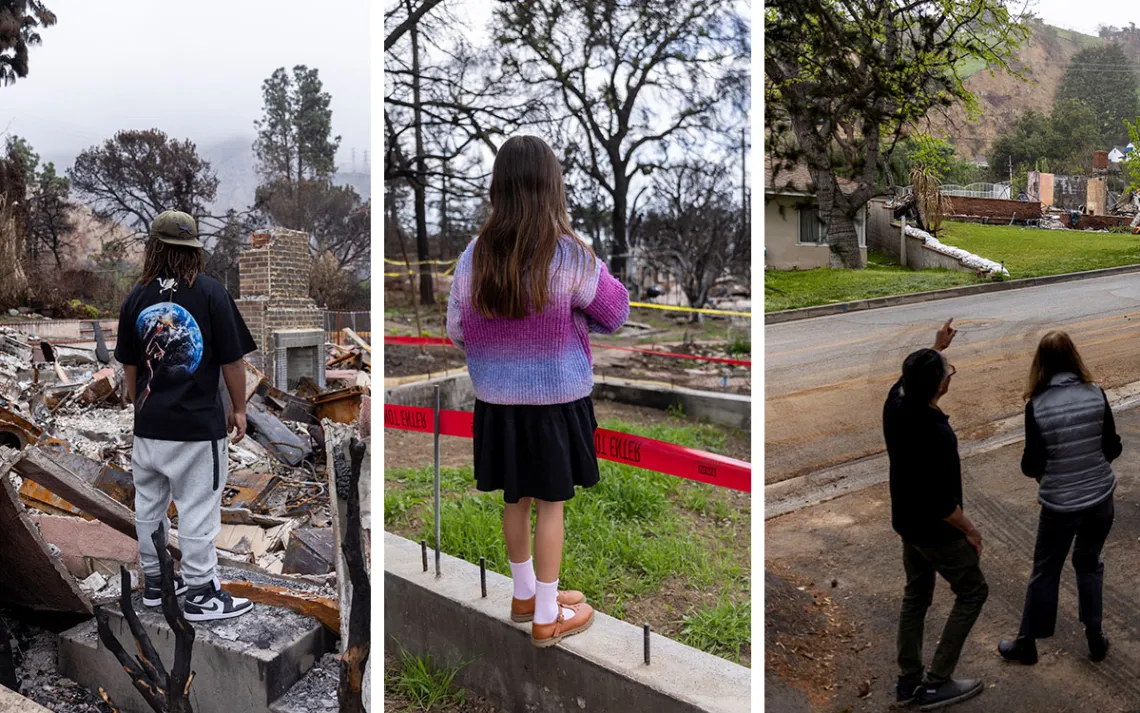
From left: Donny Kincey stands amid the rubble of his childhood home. Freyja Lund, 10, surveys the foundation of an accessory dwelling unit that was under construction when the Eaton Fire broke out, claiming her family's main house. Although James Griffith and Sue Dadd’s home miraculously survived the fire, many of their neighbors lost their homes, which they observe from their driveway.
This is part one of a year-long project following three households impacted by the January 2025 Eaton Fire in Los Angeles. The diverse stories of these neighbors—who lived only blocks away from one another—offer an intimate glimpse into the complexities of disaster recovery and the decisions that must be made long after the breaking news. You can read the second installment here and the third and final installment here.
When Donny Kincey evacuated his parents’ house in Altadena, California, flames were pouring down the mountains behind him like liquid. The sky had turned white from the incredible heat, and he could smell his hair burning. Still, he locked the door behind him as he left.
Kincey’s not sure why he did it—a reflex, maybe, mixed with disbelief that the blaze behind him could consume the house he grew up in.
“It's weird. You never really feel like you're going to lose it all,” he said weeks later, standing in the scorched remnants of the building. “There's still that hope.”
More than 100 days have already passed since the Eaton Fire set off on its course in January, becoming one of the most destructive wildfires in modern California history, leaving a trail of more than 9,000 ruined properties in its wake. For each of those houses and the families that called them home, recovery looks different. There are kids, jobs, and health issues to consider; for longtime residents, the idea of dedicating their retirement to rebuilding might feel too daunting. Even next-door neighbors find themselves operating from different starting lines depending on whether they’ve paid off their mortgage, whether they have insurance, whether their GoFundMe has taken off, and a host of other financial and personal factors.
At this stage of recovery, many residents are still trying to make sense of what was lost, of their new identities as survivors, and of the sudden slate of responsibilities that followed the flames. It’s too early to know what Altadena will look like next, but neighbors like Kincey can’t help but continue to dream, even if that dream keeps evolving.
An uncertain timeline
Kincey never imagined living anywhere besides Altadena. His ancestors had left their homes in Tulsa, Oklahoma, after the 1921 race massacre, and the quiet, canyon-side neighborhood was the first place they felt they could really put down roots again. At the time, Altadena was one of the only places in redlined Los Angeles where Black families could buy a home. Kincey’s family members ended up purchasing multiple properties in the area in the 1950s—some of them were the first homes on new blocks of buildings.
The house Kincey lived in was one of those properties, originally owned by his great-aunt and passed down to his sister. He paid his sister rent to live there, and over the course of 12 years made it his own, including converting the standalone garage into an artist’s studio. That’s where you’d find him most nights, working on his latest project, or just across the backyard in the plunge pool, relaxing after days spent running around after his second-grade students. Another perk of the property was proximity—it was just a five-minute drive from where he grew up and where his parents still lived, making it easy for Kincey to swing by to say hello or watch after the property when his parents were out of town, as they were the night the Eaton Canyon ignited.
Kincey learned at an early age how to prepare a house for this sort of “fire weather”—the windy, dry days when the air seemed to itch for an ignition. He knew to use a hose to wet it down and remove any shrubbery that might easily ignite. But this fire and the winds that carried it were different from any of the other ones he’d experienced, and Kincey soon realized it wouldn’t be safe to stay at his parents’ place.
Before leaving, Kincey called them to see if there was anything they wanted him to grab. They told him just to get out, but he still grabbed paintings off the walls as he exited, filling his trunk with the images that raised him. Then, he drove back to his house to try to get some sleep.
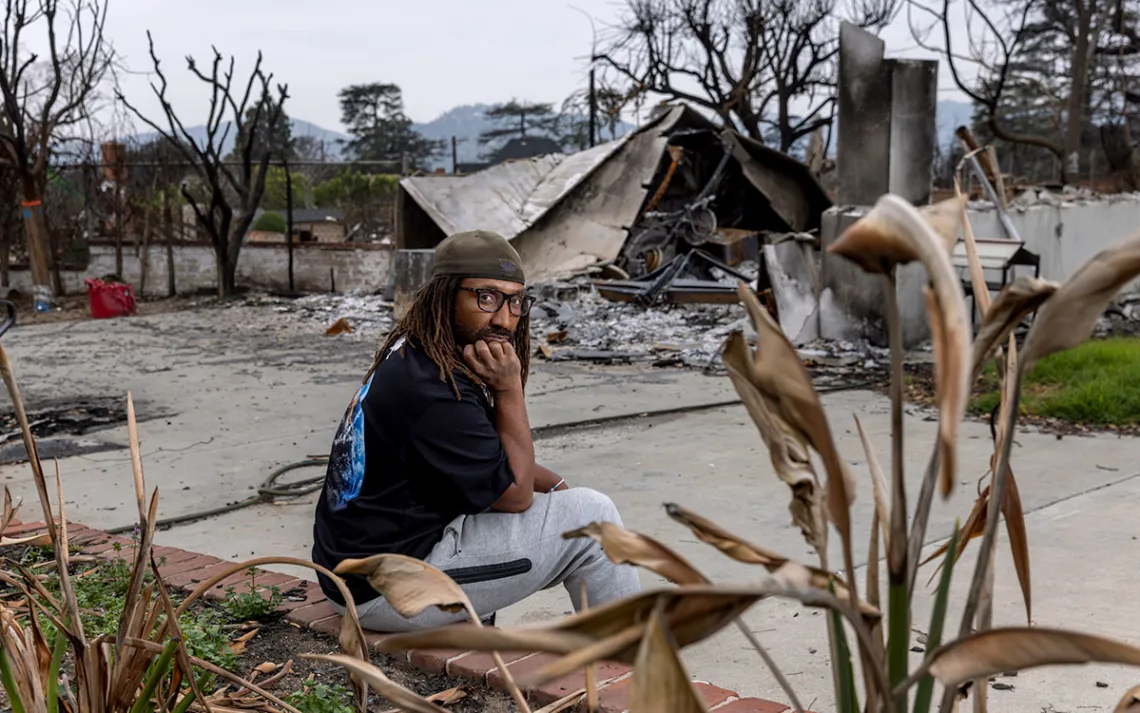
On April 16, Donny Kincey, an artist and teacher, sits in front of his burned art studio and office behind the family home where he lived in Altadena. Kincey lost his house and all the artwork he had created over the past 10 years. Below left: Kincey plays a video he took of his house burning. Below right: An unscathed mug sits in the rubble at Kincey’s childhood home—down the road from his—where his parents still lived before the fire.
A few hours later, the fire found him there.
He once again grabbed a hose and tried to soak the house, but the water stopped flowing. He watched a neighbor’s garden light up. The air was thick with the firefly lights of embers, which claimed the house next door. It erupted in an orange glow and cast swirls of smoke over his roof. Soon, his house gave in to the onslaught of heat, flames, and wind.
He stayed and watched it burn from the street until flying debris hit him in the back. Knocked to the ground, something inside of him snapped. He began to pray.
“It felt like the appropriate time, like, I get knocked to my knees in the middle of the street watching everything that I've ever known burn, after watching my childhood home burn with everything that I've ever valued,” he said.
In the days that followed, his pastor from a local church (which also burned down) invited him to speak at a press conference. Kincey broke down in tears talking about his experience and advocating for his neighbors to rebuild and maintain the historic Black community.
He’s since gotten used to talking about the fire. Three months later, standing in front of the remaining wreckage of his family’s homes, his eyes stayed dry. His perspective on preserving Altadena’s past has also shifted.


“I just know it's broken, and it's not going to be the same, so I don't hope for that anymore. It was a wish,” he said.
Kincey’s family plans to keep their properties, but the timeline of when they can return to them is murky. They opted in for the free debris removal that the Army Corps of Engineers provides, but the tradeoff is having less control over when the work will be completed. They’re also still waiting on news from their insurers about what will be covered and when they might receive any payouts.
A homeowner who learned of Kincey’s situation through one of his second-grade students generously offered him a guest house to live in for free, but temporary housing comes with the looming question of where he will go next. Since Kincey does not own either of his family’s Altadena properties, he feels an additional layer of uncertainty, relying on his relatives to make decisions that shape his next steps.
While visiting his former home, he mused that he might be able to buy one of the burned lots on the street and build a new house that would be all his. Or, he could get a trailer and park it on the family land once the toxic debris is gone. He’d even consider camping on one of the properties, except he is concerned about the bears that frequent the area. Really, it doesn’t matter to Kincey what the setup is at this point, as long as he’s back in Altadena.
“Honestly, I've never had to worry about a place to stay—I don't know how to live this way,” he said.
“Altadena is not for sale”
Lara and Robert Lund got the keys to their Altadena home the same week they found out Lara was pregnant with their first child. The 14 years they spent in that house was the longest Lara had ever lived in one place. It was the only home her son, Llewellyn, 12, and daughter, Freyja, 10, ever knew. After telling their kids the house was gone, the Lunds decided to drive back to their still-smoldering street to show their kids the loss firsthand.
“I think it was hard for them to really grasp it. I mean, I'm 47—it was hard for me,” Lara said. “What does that mean that our house burned down, that our neighborhood, our whole town burned down?”
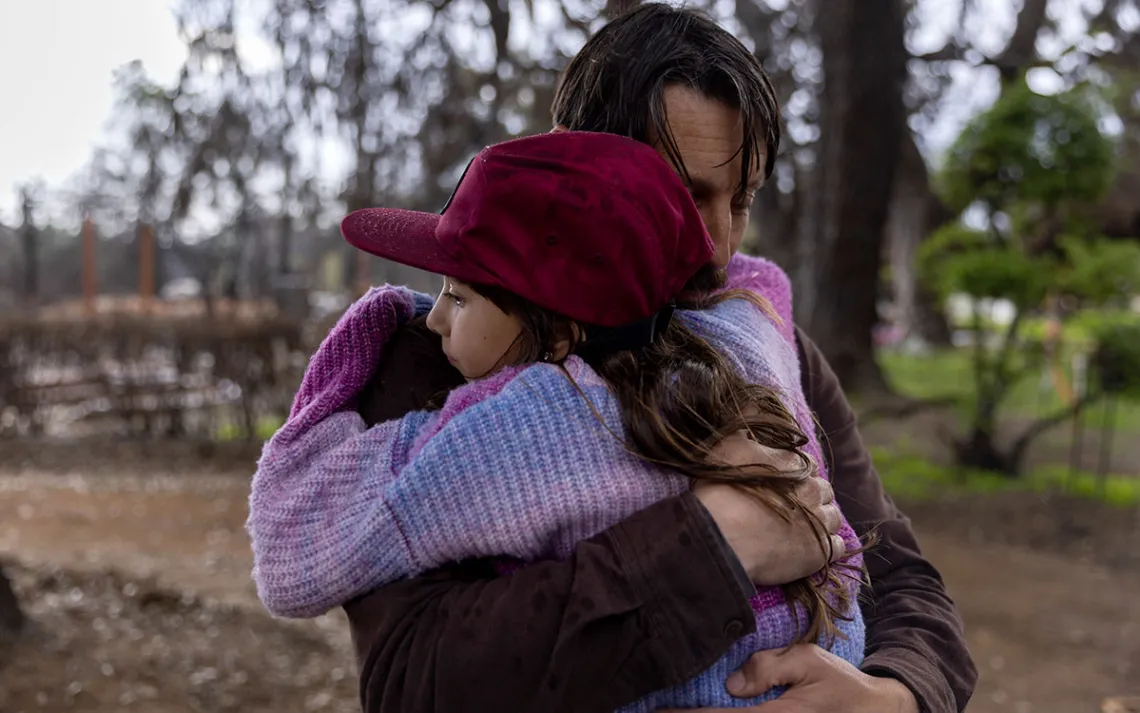
Robert Lund holds his daughter Freyja, 10, as they visit their burned home in Altadena on April 3. Robert is a general contractor, and the family plans to rebuild as soon as possible.
The Lunds fled the Eaton Fire in the middle of the night after waking up to the smell of smoke. All four family members packed into one car with their dog, Kit, and some basic necessities that Lara had hastily gathered. Then they drove about 35 miles in hurricane-force winds to her sister’s house. Once the kids were safe, Lara and Robert tried to return to their house in hopes of grabbing Robert’s truck and tools, which he used for his home contracting business. But the fire had intensified.
Around them, parked cars were igniting, and the streets were bursting with flames. Even inside their car, it was so hot.
“It’s not worth it. We’re going to die,” Robert says in a video Lara recorded during the drive. “It’s not worth it. Our house is gone.”
Their single-story house was on a dead-end street where they knew all their neighbors. Every house on the block ended up in ruins. The Lunds were the first to clear the remnants of their home from their property, opting for a private company to haul away the debris and scrape down the soil. With Robert’s expertise, they’re eager to rebuild and hope to utilize plans they had already drawn up to build a small property (an accessory dwelling unit) in their backyard.
While they await permitting approval, they’re in a temporary rental, which Lara acknowledges they were lucky to find: The competition for displaced residents to find apartments in the neighborhoods surrounding Altadena has been fierce. Despite price gouging protections, locals have reported encountering wallet-draining rates. The Lunds are currently paying a monthly rent that is double their mortgage payments, which they are still on the hook for even though their house is gone. These mounting bills are particularly concerning as they wait for guidance from their insurance company—Lara believes they were underinsured for their assets—and since Robert lost not only tools but also multiple in-progress projects in the fire.
“We're in this phase of Oh my gosh, this is going to be so expensive,” Lara said. “Yes, we're committed to rebuilding, but can we afford it? And then once we do, what is that going to look like?”
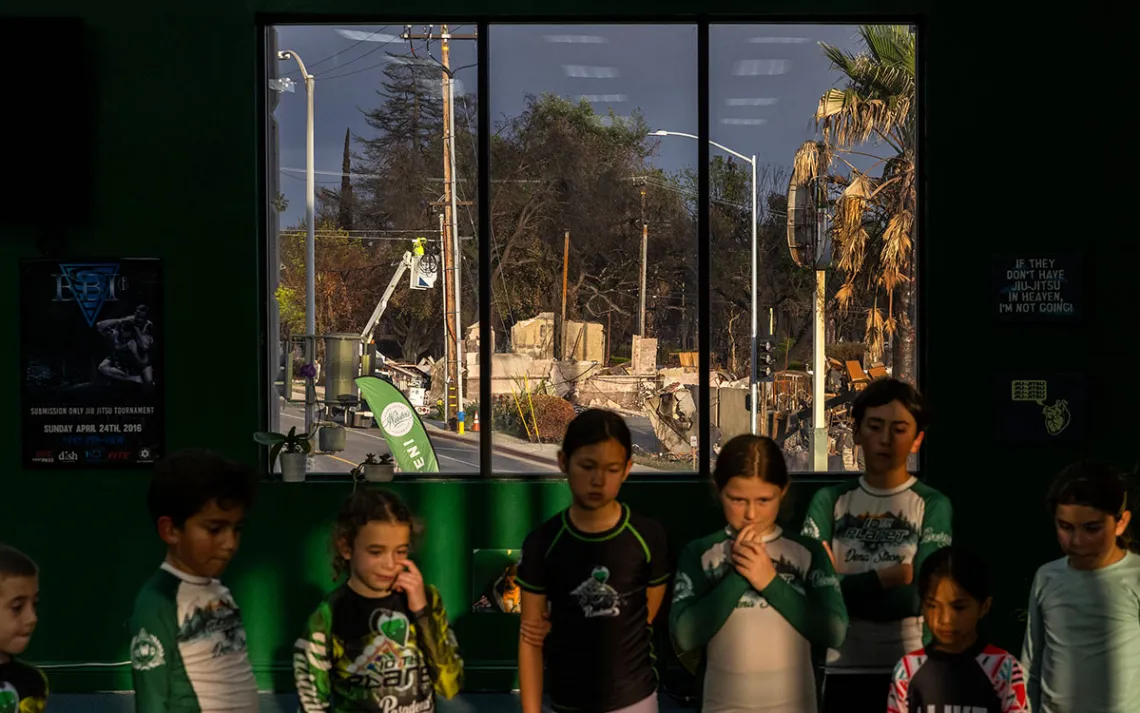
Llewellyn Lund (third from right), 12, takes his regular jujitsu class. It's a slice of normal, but out the window is a different story: the burned remnants of the neighborhood.
They’ve talked about living in a trailer on their property to cut costs, understanding that they would likely be the lone residents on their block, surrounded by construction. But being back home means Llewellyn gets to be a short bike ride away from his jujitsu class in a building that survived the fire. It means getting to follow a familiar path on their long walks with Kit, even if many of the local landmarks and neighbors are missing. And it means being part of rebuilding a community that the family says has been essential in getting through the fire so far, from donating supplies and dollars to waiving the fees for the kids’ enrichment programs.
Robert hopes their choice to return might inspire some of their neighbors to come back too, and that through his work, he can be a part of building back what was lost in more than one way. That’s the goal. For now, their property is sitting empty, with a sign stuck in the dirt proclaiming “Altadena is not for sale.”
Every single emotion
Donny Kincey and Lara Lund shared a similar thought the evening of January 7: For the fire to reach their homes, it would have to burn through the entire town. The fact that it did offers a stunning footprint of loss. Still, scattered throughout the neighborhood, some buildings appear improbably untouched next to ruins. Sometimes the juxtaposition is the sign of fire-resistant designs in action or the handiwork of firefighters, but in other cases it’s an example of sheer luck from shifting winds.
James Griffith and Sue Dadd own two such properties.
When the fire began, the couple evacuated their home of more than 25 years. Both are artists, and they own studio space about a five-minute drive away. They headed there, thinking it would be safer. But later that evening, they heard the shouts of first responders, amplified by bullhorns, telling people to leave. The scene they fled was apocalyptic—a whirl of wind and fire. They assumed their property would have been lost in the inferno, but thanks in part to the efforts of dogged neighbors who stayed behind to douse the flames—first with water and then sand when the taps cut out—it survived.
“You feel embarrassed and you feel…” Griffith said, trailing off. “There's so much tragedy that these people are going through.”
These people are their friends, like the man next door whose home Griffith had decked out with a custom mural years ago. That art was lost along with the rest of the property during the fire. Or the man Griffith met at a Home Depot recently who had lost his property but eagerly asked Griffith about the fate of his own, having recognized him as the owner of “the Folly Bowl.”
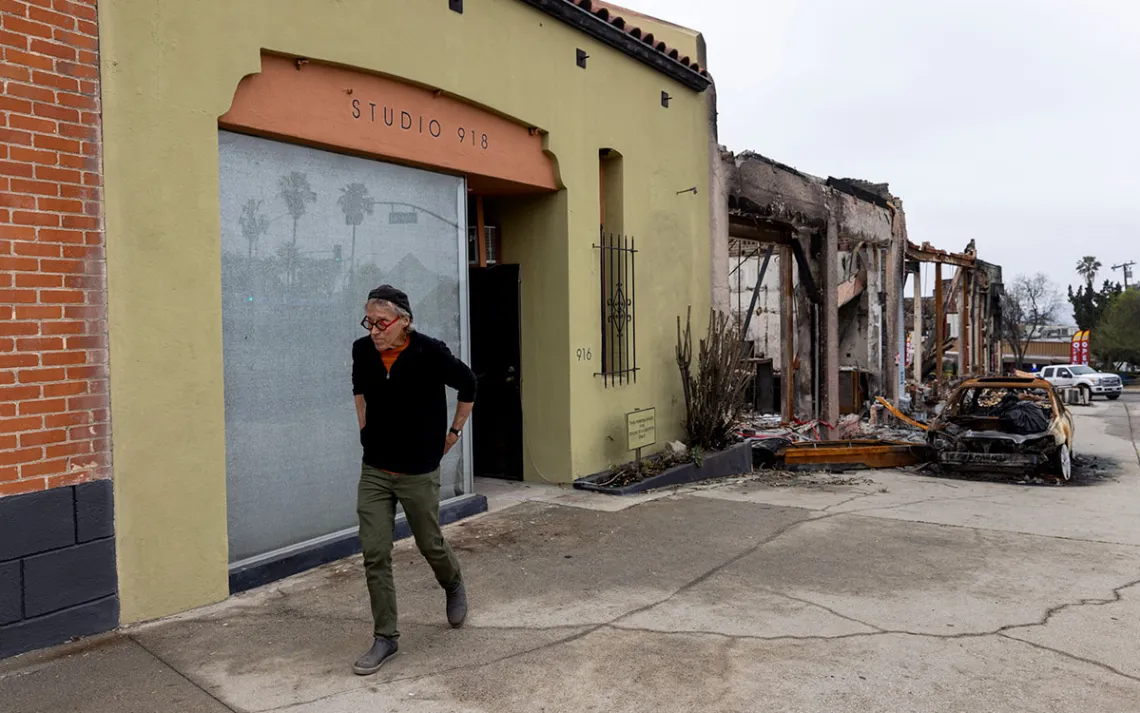
James Griffith leaves his art studio in downtown Altadena on April 16. The studio survived the fire, but the row of businesses next door burned. Below left: The Folly Bowl, an amphitheater Griffith and Sue Dadd built on their land. It hosted many community events and survived the Eaton Fire. Below right: One of many irises Griffith and Dadd are fostering for a friend who lost their home.
The couple’s crowning achievement on their property is an amphitheater they built by hand into the incline leading up to their house, personally laying the seats and building the stage over the course of four years. Dadd, a garden designer, turned the surrounding land into an oasis over the years, from the poppies that erupt in the spring to the slightly spicy Japanese mustard she says is great for sushi. In past summers, dozens of community members gathered to watch local musicians perform there. The Folly Bowl, as the couple named it, made it through the fire unscathed, along with much of their gardens, though some of their succulents boiled and irrigation pipes melted.
When Griffith and Dadd returned to their house in late January, they lived like campers. It took weeks to get back electricity. In late March, they were still waiting on internet service. Griffith and Dadd opted against making an insurance claim for fear of increasing their premiums. Instead, they threw themselves into cleaning, dedicating hours each day to laundering inside items until they lost their smoky smell and tending to the losses in the garden. The work ended up being like a sort of therapy, Griffith said.
“I felt like I was having every single emotion in the world, all at once,” he explained. “Where do you put that? Maybe that'll come out in the art one day.”


Griffith is known for using the ancient tar of LA’s La Brea Tar Pits to create startlingly realistic renderings of animals and astronomical scenes in inky and brown hues. But he hasn’t painted since the fire. For now, the couple has focused on restoring their space and trying to find ways to help their community. They’ve opened up the Folly Bowl for public meetings to discuss issues like insurance and rebuilding, and they’ve hosted dedicated dinners for those who lost their homes as well as those whose homes survived.
For weeks, they debated whether to host concerts again this summer. In April, they made the call, posting a lineup of six concerts for the summer, with an invitation to come share in their space and support Altadena artists.
“There is always a delicate dance of joy and pain for each other’s luck and losses,” Griffith said. “You feel a connection that—in no other place I’ve lived did I have that. So to have all those people not living here …”
“It’s a big loss,” Dadd finished for him.
This article has been updated to correct the spelling of Freyja and Llewellyn Lund.
Click here to read the second installment in this series.
The third and final installment will publish in January 2026.