When It Comes to Greening the Desert, Rattlesnakes May Be Prolific Gardeners
New research shows that seeds excreted by the venomous reptiles germinate at a higher rate
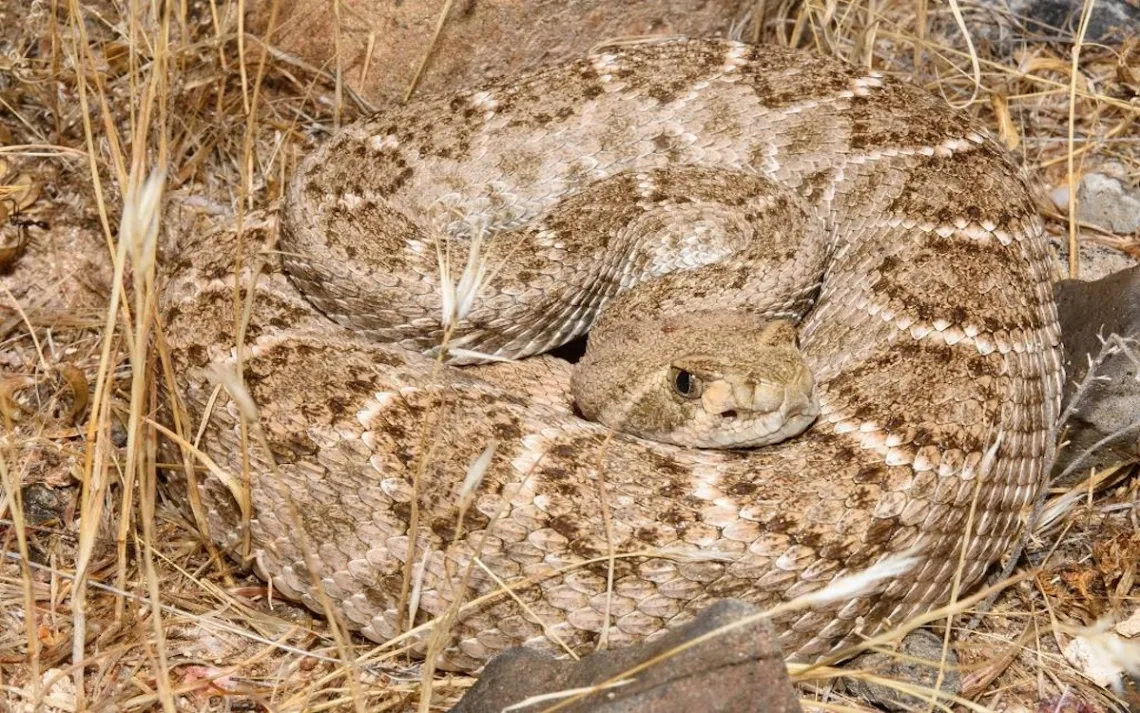
A western diamondback rattlesnake (Crotalus atrox). | Photo by William Wells
Evolutionary ecologist Gordon Schuett has been working with rattlesnakes since he was 15 years old. When the 68-year-old was in high school in Ohio, he kept somewhere between 50 to 100 snakes, many of them venomous, in his mom’s basement. Copperheads and rattlesnakes moved under heat lamps in 10- and 20-gallon aquariums sitting on racks Schuett built with two-by-fours. His mother, a nurse, understood the risks and still encouraged her son to follow his passion to study the animals. “She could see the fire in my belly to be a scientist, even at a very young age,” says Schuett. “Is it for everybody? No.”
In the 1970s, she had taken her son to see herpetologist Bill Haast extract venom from cobras at the Miami Serpentarium, and the youngster knew from that point on he wanted to be a professor. While still in high school, he started collecting data on copperheads for his master’s thesis, which included work on long-term sperm storage in females and male-to-male fighting. “I was interested not just in the fight, but the psychology of that behavior to the winner, to the loser—and also the notion of stress,” says Schuett.
Once, he was bitten by a young eastern massasauga rattlesnake that had been hiding in its cage under leaves. “And whatever harm came to me due to [that] bite, I recovered within a week or so,” he says.
After roughly half a century of studying snakes, Schuett has published more than 80 peer-reviewed journal articles and 10 peer-reviewed book chapters. Along his journey, he got a letter from Carl Sagan, which he keeps on his desk, and studied the ability of female snakes to produce offspring without the involvement of males.
But perhaps one of his most interesting lines of research focuses on the ability of snakes to rescue and disperse seeds. Roughly 4,000 species of snakes exist in the world, many of them endangered, and they may play a key role in moving seeds around damaged environments. “As habitats are being encroached in worldwide or destroyed,” says botanist Andrew Salywon of the Desert Botanical Garden in Phoenix. “There is a seed-dispersal crisis.”
Schuett’s work with snakes and seed dispersal is relatively recent. He was an author on a 2018 study in Proceedings of the Royal Society B, in which museum specimens of three species of rattlesnakes—which ate rodents that stored seeds in their cheek pouches—were examined. Scientists found seeds that had germinated in the reptiles’ large intestines. Schuett followed up on that study with another in 2022 that fed dead rodents with unchewed seeds to three species of snakes and found the seeds retained the ability to germinate after being excreted. The recovered seeds were put in petri dishes or a plastic germination box before planting. But the question remained: How would seeds fare that passed through the guts of snakes in natural conditions?
Now, Schuett, Salywon, and colleagues have an answer to that question thanks to an elegant new study they authored this January in Royal Society Open Science. The researchers fed captive-held western diamondback rattlesnakes rodents with seeds of the foothill palo verde tree and then planted the excreted seeds in natural summer conditions in Phoenix, Arizona. Not only did the seeds germinate, but seeds planted with the excrement had higher germination rates than seeds planted without excrement—and higher germination rates than control seeds that didn’t go through the snakes’ guts. The excreted seeds remained viable up to a year after rodents carrying the seeds had been consumed, which suggests dispersed seeds released at different times of year have a chance to lie in the desert until rain and ideal temperatures occur that could stimulate growth.
“It's just kind of interesting how science builds on itself,” says Salywon, a study coauthor who points out that the interdisciplinary nature of the research was important. “We just got lucky in finding a new niche to take a peek.”
Not a lot of research has been done about the value of snakes as seed dispersers, and this study might spur more research to find out how valuable the much-maligned predators are to spurring plant growth around the world. Snakes, as it turns out, may be acting as ecosystem engineers.
“There is no single serious study on the latrines of snakes.
And it's a gigantic gap.”
For example, by saving seeds stored in the cheek pouches of rodents—seeds that would often be chewed and rendered unable to germinate—and depositing them with excrement over greater distances than the seeds might otherwise spread, rattlesnakes might alter the plant makeup of their environments.
“Our study is important because it provides a link of many links to understanding the intricacies, the networking of the natural world,” says Schuett, also a study coauthor. “And it's not just reptiles; it's everything—everything is connected.”
Schuett and colleagues covered a lot of ground by picking two common species for the experiment. The western diamondback rattlesnake ranges from northern Arizona to southern Mexico, and from some islands off the coast of Baja to western Arkansas. Conjure up a cinematic image of a snake in front of a saguaro cactus and you’re probably picturing that species. The foothill palo verde is a state tree of Arizona; has large, hard seeds that are easy to study; and is a foundational plant in the Sonoran Desert. The species has an abundance of flowers, provides nesting habitat for birds, provides shade for plants that grow underneath it, and offers cover for animals fleeing raptors.
To conduct the experiment, Schuett collected five juvenile rattlesnakes from the wild and reared them to adults at Chiricahua Desert Museum in New Mexico, where he works. The reptiles were kept on plain white printer paper in cages. Since collecting and using native rodents that kept seeds in their pouches would have come with restrictions and difficulties, the researchers used a previous solution to study rodents storing seeds. They cut open the bellies of dead, lab-reared mice and gently pushed 25 seeds in, before closing the wound up with dissolvable sutures. The feedings began in September and the snakes usually defecated about a week later on the white paper. The excrement was collected, dried, and placed in a dark room. The researchers stored the seeds to see whether they could survive up to a year, as they might do in nature, since hot, wet conditions in summer might be the most likely time the seeds would germinate.
In spring, the seeds were delivered to the Desert Botanical Garden. Between June and October, two trials were conducted. Seeds were removed from the excrement and counted. The excrement came in two parts: feces and urate. The feces looked something like a Tootsie Roll, and the dry urate sat beside it. “Snakes don't pee, so the urates were like a white powder,” says botanist and lead author Mariana Acevedo Garcia. She conducted a lot of the messy work with the seeds and excrement while on a gap year between her undergraduate work at Pomona College and her current PhD studies at the University of Arizona. “It didn't smell amazing,” she adds. “But it didn't smell as bad as a human or another mammal.”
Some of the seeds were reunited with excrement and planted about a centimeter or so deep in native soil in pots, while other seeds were kept separate from excrement and planted. Also, a control group of seeds that hadn’t gone through the snakes was planted in native soil. The pots were arranged randomly in an outdoor greenhouse and watered as needed.
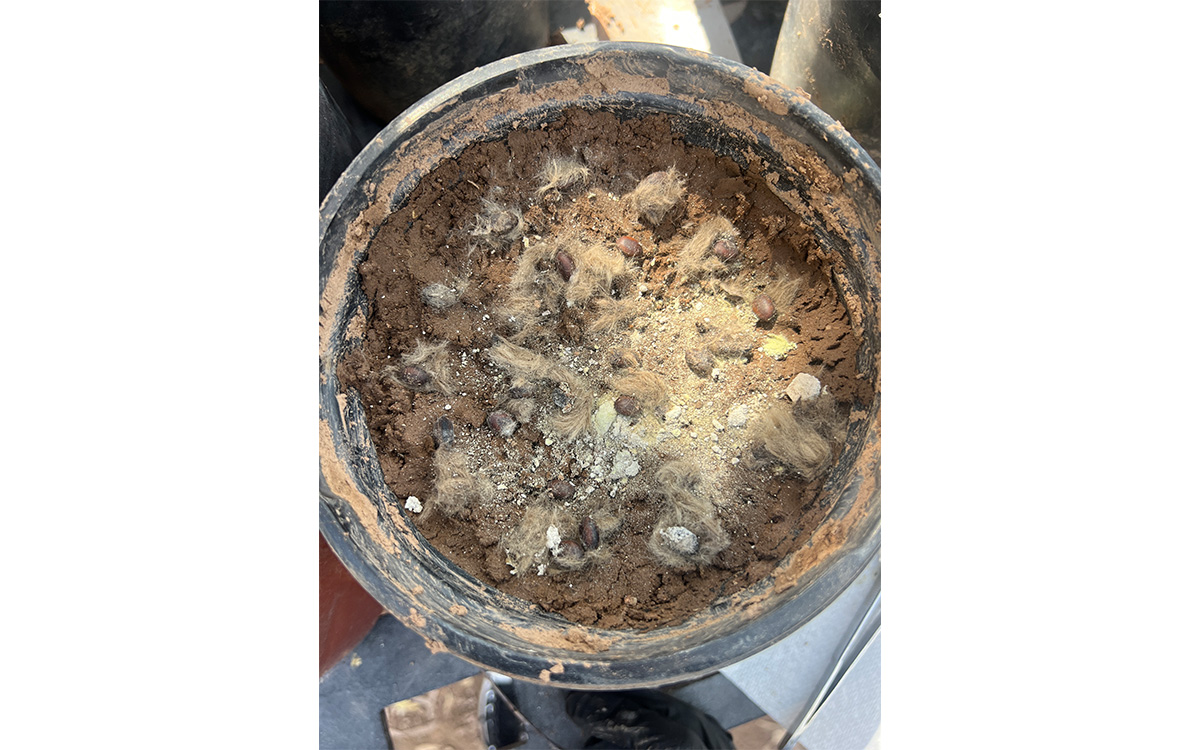
Seeds planted with snake excrement. After the photograph was taken, the seeds and excrement were covered with additional soil. | Photo by Mariana Acevedo Garcia
Schuett says he thought it was a coin flip as to whether they would get high germination. The seeds planted with the excrement had higher germination (40 percent) than seeds that went through the snake planted without excrement (29 percent) and control seeds (28 percent).
“The thing that most surprised me was that the seeds that were planted with the excrement actually had significantly greater germination rates,” says Acevedo Garcia. “So it seems that not only are snakes dispersing these seeds, but they're also kind of helping them germinate.”
Scientists know rattlesnakes provide a lot of benefits. They eat rodents, and while doing so may limit the spread of diseases the rodents or accompanying arthropods carry—including hantavirus, the plague, and Lyme disease. Emily Taylor, a herpetologist at California Polytechnic State University who was not involved with the recent study, also points to the values of rattlesnake venom, which is being studied for possibly lifesaving drugs to treat everything from blood clots to cancer. “We can be so bold as to say that in the United States, at least where we have good treatment for those people who are unfortunate enough to get bit by a rattlesnake, that rattlesnake venom is actually saving more lives than it's taking,” she says. “So people should be thanking those snakes, but from a distance.”
The Centers for Disease Control and Prevention note that about 7,000 to 8,000 people in the United States are bitten by venomous snakes each year, and about five people die.
While many people may experience a pit in their stomach at the sight of a rattlesnake, Taylor says, the reptiles are shy creatures that want nothing to do with humans. She thinks this study may change public perceptions. “If we picture that cute greeting card image of a squirrel stashing an acorn, and how adorable that is, we can now replace that with a very unloved animal, a villain, an animal that is persecuted unfairly, and very maligned by people,” she says. “And the hope is that this, at least for some people, might get them to appreciate rattlesnakes, fear them a little bit less, and just give them the respect that they deserve.”
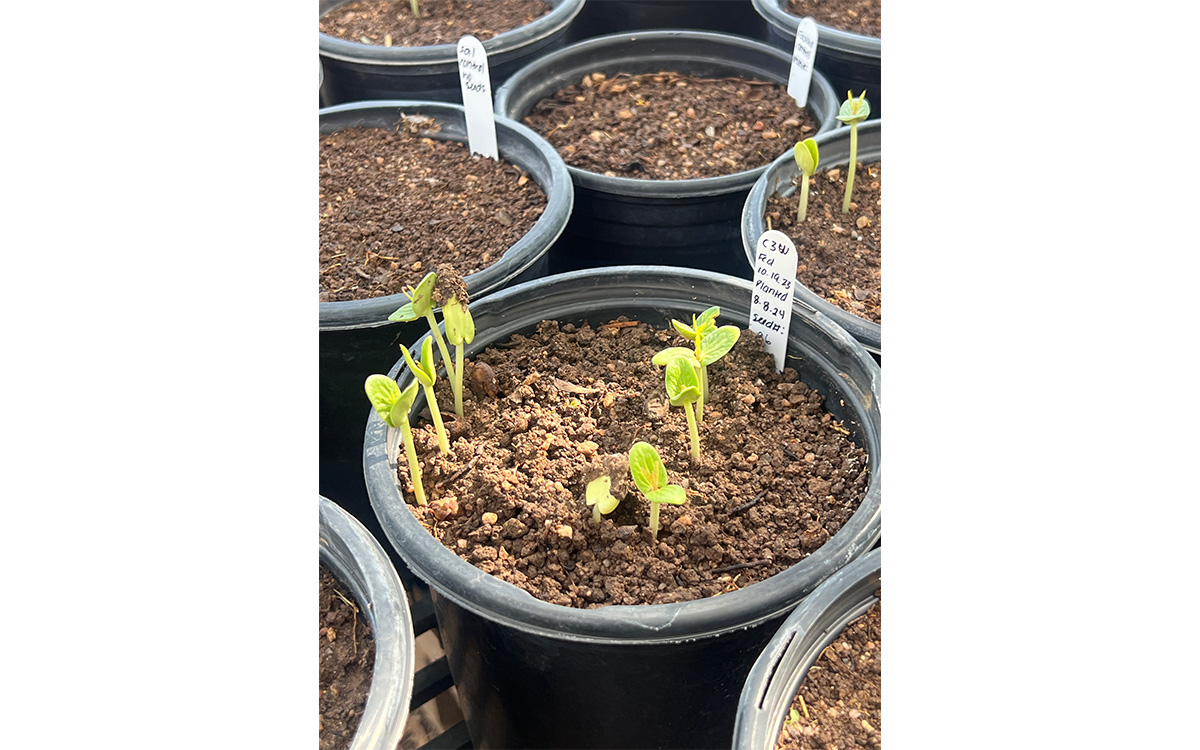
The first leaves of the foothill palo verde emerge in a pot planted without snake excrement. | Photo by Mariana Acevedo Garcia
Rodents don’t chew all the seeds they gather, as they cache some which might germinate later. But the home range for many rodents is often smaller than that of a snake. While a kangaroo rat may cover an area of hundreds of feet, Schuett notes, a western diamondback rattlesnake might cover an area of seven or eight miles over the course of days. They don’t always roam that far, but have the potential to carry seeds to distant damaged locations. “They may be important in restoration of habitats if a burn went through an area,” says Salywon, “or if it was destroyed for some reason.”
But the scientists note that not a lot is known about how snakes disperse seeds, including exactly where they go to the bathroom. “There is no single serious study on the latrines of snakes,” says Schuett. “And it's a gigantic gap.”
They may defecate in burrows, caves, or in another place of seclusion. Knowing where they go to the bathroom would help scientists understand whether the seeds they deposit have a better chance to grow.
The researchers say the next step is to conduct experiments using various types of seeds, different snake species, and other types of prey. Salywon says they have already begun experiments with saguaros, barrel cacti, prickly pears, legume trees, and grasses. In one such experiment Acevedo Garcia was working on, buffel grass seeds that passed through snakes didn’t develop after excretion. “So it was exciting,” she says, “because they are invasive species and the snake is almost acting like a filter, where they're preventing them from germinating.”
Schuett and Salywon are hoping to bring this course of study to children at places like the Chiricahua Desert Museum and the Desert Botanical Garden, so others can be involved with snakes from a young age, as Schuett was. Just as the incremental discoveries Acevedo, Schuett, Salywon, and colleagues have made may change perceptions of snakes, so might something as simple as letting a child hold or research a harmless snake at an event.
“If you like snakes as a kid, you're going to like nature and you're going to make nature-positive voting choices and so on,” says Taylor. “Of course, that last thing I said has not been studied, but it's my gut feeling that that's true.”