 The Magazine of The Sierra Club
These Tiny Moths Likely Flew to Hawai'i 20 Times. How Did They Do It?
Leaf-roller moths colonized the archipelago before evolving into a dizzying array of species
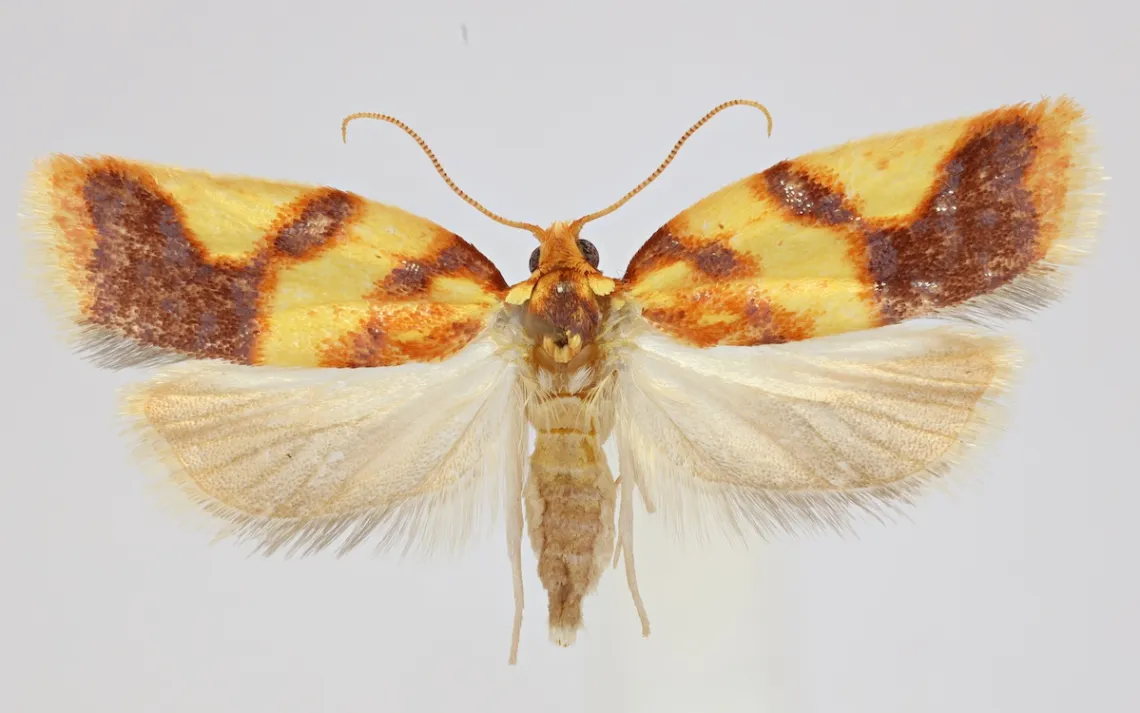
A female Iliahia flavopicta. | Photo by Kyhl Austin
The Hawaiian island chain—thousands of miles from any continent—is one of the most isolated on Earth. Long before tourists flew here for vacation, or island residents shipped goods in to fill their homes, or Polynesians arrived on voyaging canoes, animals faced a Herculean task getting here.
But a remarkable series of recent discoveries shows that a family of tiny moths may have colonized Hawai‘i at least 20 different times, millions of years before humans settled the archipelago.
Scientists working at the University of Hawai‘i at Mānoa have published a study in the journal Zootaxa describing 10 new species of leaf-roller moths in a wide array of colors and sizes. The researchers discovered seven new genera, the bigger classification bucket in which species reside. The discoveries bring the number of species of leaf-roller moths in Hawai‘i to 95, and the family’s 20 suspected natural colonizers are more than are known for any other insect family in the state.
“They each came here independently from different places in all likelihood and have completely different origin stories,” says Dan Rubinoff, the director of the University of Hawai‘i at Mānoa’s Insect Museum and an author of the recent study. “Just like a villain or a hero in a comic book.”
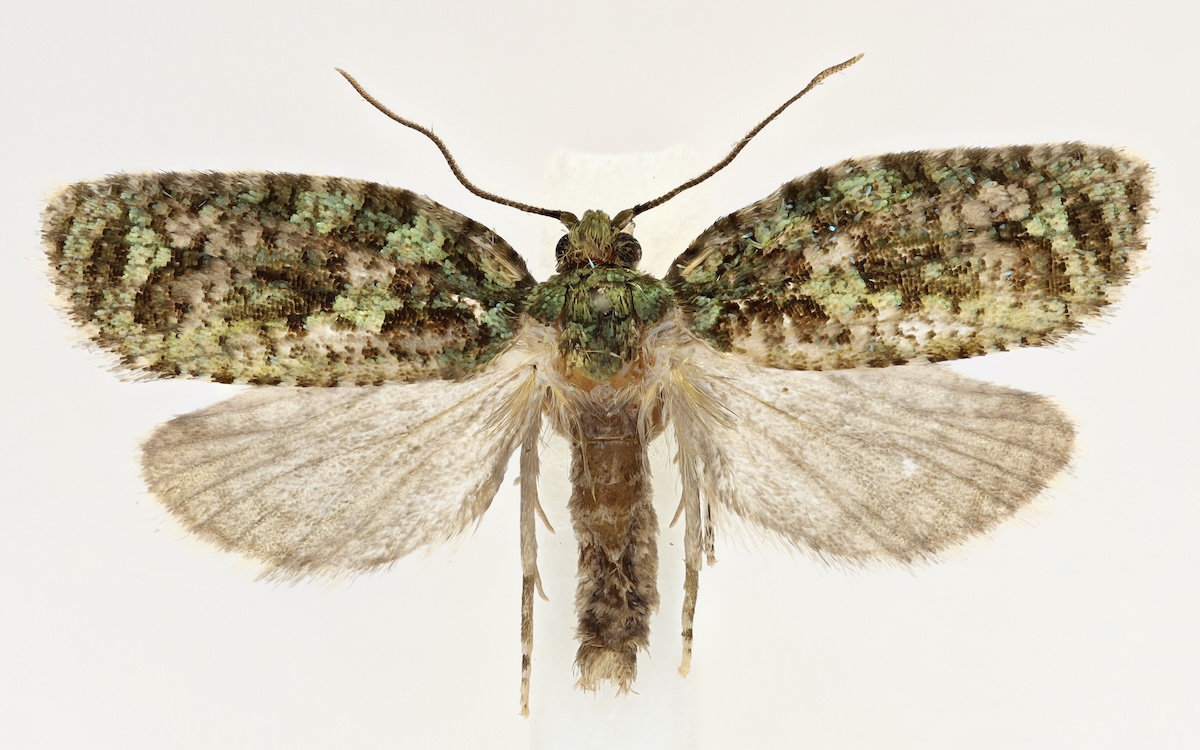
A male Limua pahole. | Photo by Kyhl Austin
Rubinoff has collected moths in Hawai‘i for roughly 20 years. When he moved to the state, no other permanent lepidopterist—a scientist who studies moths and butterflies—lived here. “This is one of the 50 United States. You'd think we'd have done the work here,” he says, “Every time we go into a group, we end up with 30 to 70 percent of the species are unknown and new to science.”
But while Rubinoff collected and restored some leaf-roller moths, he often focused on "Hawaiian fancy case caterpillars," the most famous of which may be the “bone collector.” That species lives in spider webs and decorates its silken portable case with the body parts of dead insects. To learn more about the leaf-roller moths, Rubinoff needed help from a driven and dedicated graduate student. Enter Kyhl Austin, a student who earned a master’s degree from Cornell University studying leaf-roller moths of the Caribbean.

Dan Rubinoff. | Photo by Camiel Doorenweerd
Austin enrolled as a PhD candidate at the University of Hawai‘i at Mānoa and looked at species in museums. Both he and Rubinoff also went out into the field on every main Hawaiian island to search for species.
The work was meticulous. In the lab, the entomologists described the moths’ heads, wings, abdomens, colors, sizes, shapes—and even carefully dissected each specimen’s reproductive parts. By looking closely at genitalia, the scientists could see whether male and female parts lined up for different moths. If not, that meant individuals diverged significantly and were different species, at the least. Of the moths collected in museums, the scientists found many that had been grouped together were actually different species or different genera.
To collect new species and verify whether species identified in museums still live in the wild, Austin estimates that he went on roughly 40 to 50 overnight expeditions over about five years. To get to most study sites required extensive hiking and four-wheel-drive expeditions. Rubinoff says that some of the terrain they visited was treacherous.
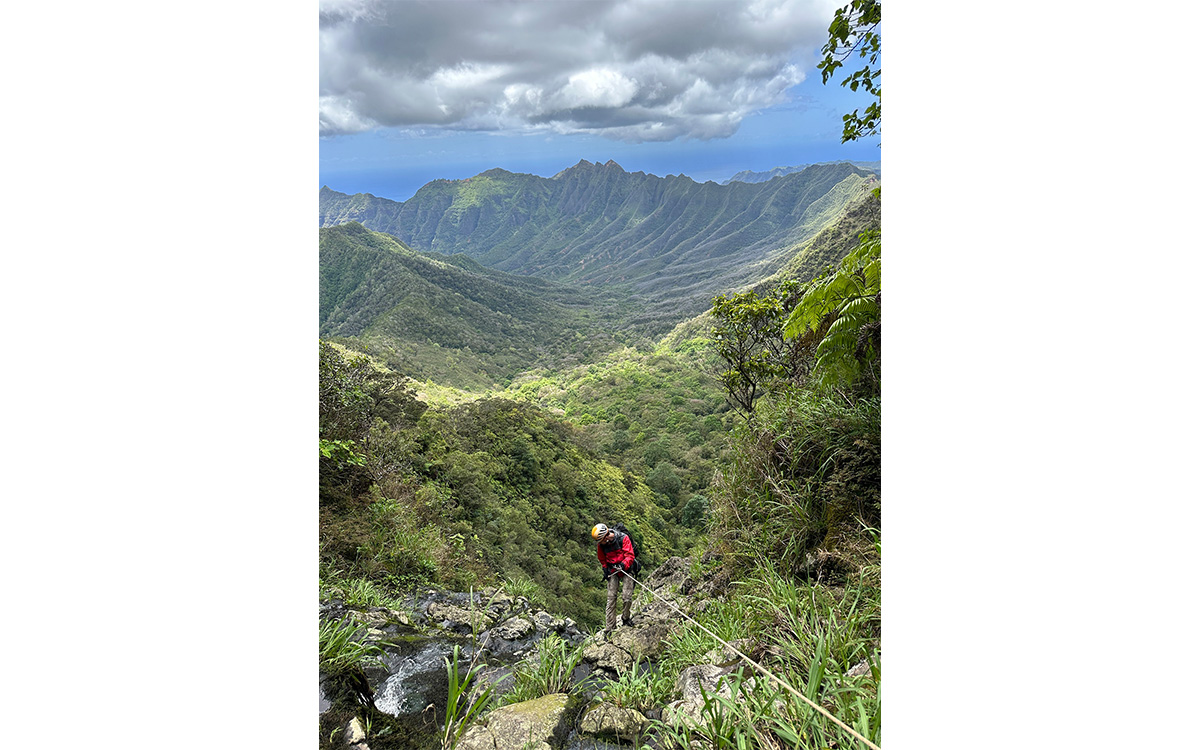
Kyhl Austin in the field. | Photo by Ryan Chang
For some remote spots on Kauai, Oahu, and Molokai, Austin joined the Hawai‘i Division of Forestry and Wildlife or the US Army on helicopter trips. During the day, he helped the other organizations with weeding, building fences, or monitoring snail populations, and then during the night, when the insects were active, he surveyed for moths. He collected them by putting up a black light next to a white sheet and then plucking them off, or by setting up special traps with black lights.
He also took a roughly 12-mile backpacking trip across the Haleakalā Crater with friends and collected moths along the way. While out on a trail hike in 2021 on Oahu, he spotted leaf damage on a plant down a steep slope, scrambled to it, and was able to grasp it while standing on his tiptoes. On closer inspection, he was rewarded with the sighting of a species, Spheterista tetraplasandra, that hadn’t been seen since 1932. The discovery garnered him the citizen science site iNaturalist's Observation of the Day.
In addition to the adult leaf-roller moths the researchers caught, they also looked for the younger caterpillars. Different species live and feed on different plants. As the insect’s name implies, many leaf-roller caterpillars roll up the leaves they are going to feed on to build a kind of shelter for themselves. Austin and Rubinoff collected these youngsters and then reared them to maturity in the lab.

A male Paalua leleole. | Photo by Kyhl Austin
The scientists described species of different sizes and colors, with some that were iridescent purple, green, and blue-green. One of Austin’s favorite species, Paalua leleole, is found on Maui and has flightless females that are partly brown and cream. Jason Dombroskie, the manager of the Cornell University Insect Collection (not an author of the study) who was Austin’s master’s adviser, was most taken with the dirty-white and light-brown speckled Paalua maunaloa. That species has a wingspan of roughly five centimeters and may be the largest leaf-roller moth in the Western Hemisphere—though it is likely critically endangered or extinct. The localities where it was found have been overtaken by invasive species.
One of Rubinoff’s favorites is Iliahia pahulu, a partly yellow and orange colored species, which is likely critically endangered and known only from two moths collected on Lānaʻi. He says that it tells a story of just how rare some of these species are.
“There's several in here that are gone before we even knew them,” says Rubinoff, “We never collected them. We found them in museums, which is reflective of the importance of museums, and these in-state museums, and us understanding not just what we have, but what we've had and lost.”
The loss of native plants and the introduction of predatory invasive ants and wasps are two of the biggest threats to leaf-rollers in Hawai‘i. Humans can help the moths by planting native species and by protecting large areas of forest from invasive pigs and goats that take out native plants.
The coolest part of the job, Austin says, is getting to name the new species. Rather than giving them Latin names, he and Rubinoff worked with an ‘ōlelo kumu, a Hawaiian language teacher, named Sam ʻOhu Gon III to dub the species. They would go to him with a story about what a moth looks like or what it feeds on, and possible options, and he would help them.
For example, the largest species, Paalua maunaloa, was known only from the slopes of Mauna Loa, the largest active volcano on Earth, and so was named after it.
Austin says the researchers came up with the number of 20 independent colonizations because 19 different genera have been found in Hawai‘i, with one genus making it to the islands twice. How exactly the initial colonizers made it to the islands is unknown. Dombroskie says they may have been helped to Hawai‘i by rafts of giant plant material, sent to sea by hurricanes, which the insects could live on for at least part of their journeys. Austin thinks they may have been the perfect size—many have wingspans of one to three centimeters—to have been swept up in storms and then flown to Hawai‘i.
Aside from just getting to Hawai‘i, Rubinoff says, it’s remarkable that the leaf-rollers were able to survive so many times once they got to the islands. The moths may have been more generalist feeders when they arrived and then evolved over time to become specialists, says Austin. The species would have been huge ecological drivers, by eating vegetation, as well as being food for birds and bats.

A male Iliahia pahulu. | Photo by Kyhl Austin
While scientists know of 95 species of Hawaiian leaf-roller moth now, Austin says he expects to find many more, possibly up to 150 species. Studying them offers an exciting window into how species diversify. When Austin first showed Dombroskie images of the moths, the Cornell entomologist wasn’t even sure they were leaf-rollers because of how weird many looked.
“That was all sort of mind blowing to me,” Dombroskie says. “It's cool what happens when you get such an isolated island chain like that and then evolution taking over.”
Aside from being an awe-inspiring way of understanding evolution, studying the leaf-rollers of Hawai‘i may have implications for learning how leaf-rollers impact economies in other areas of the world. The moths live on every continent except Antarctica and are considered pests of fruit trees, tea plants, and coffee trees, and in some years are the biggest forest pest in Canada, says Dombroskie. The discoveries Rubinoff and Austin make could lead to better options for controlling the pest species in this group.
The current description of species and genera is the first basic step of Hawaiian leaf-roller research, Rubinoff says. That work will allow researchers to understand what they are going to be working on and what they can ask questions about. For example, by studying moth DNA, the scientists might be able to find out where colonizers came from, what allowed the moths to be successful, and then better understand our relationship to the insects.
“But we have to understand the moths first before we can learn how that correlates to our own lives,” says Rubinoff. “This is setting the table, and then dessert is going to be the genomics.”