From Forest to Fireweed
The ecological upheaval of Jasper National Park
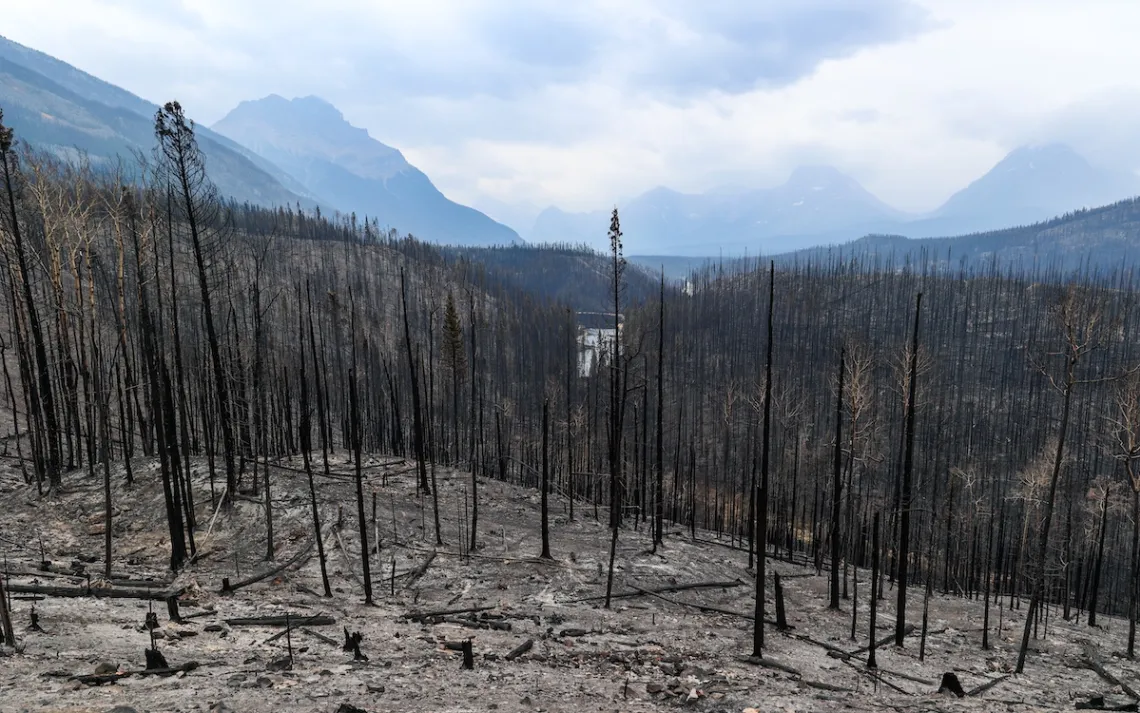
The aftermath of a wildfire at Jasper National Park, seen from the Athabasca Pass Lookout. | Photo courtesy of Luuk Wijk/Parks Canada
Between July and September of 2024, 33,000 hectares (81,544 acres) of forest burned in the Athabasca Valley of Jasper National Park, a Rocky Mountain wilderness hugging Alberta’s border with British Columbia.
For its size, the Jasper Wildfire Complex was unremarkable. The park itself is 1.1 million hectares; 28,000 burned during the wildfires of 2003. In 2023, 2.2 million hectares burned across Alberta in a wildfire season ultimately claiming 12.7 million across Canada.
If the 2024 Jasper wildfire stands out, it’s for its intensity. Ignited by lightning on July 22, the wildfire promptly generated a pyrocumulonimbus (pyroCb) storm system, in which hot air rises to the upper troposphere in a rapid column of smoke, ash, embers, and water. Not only does this column produce a relative vacuum on the ground, triggering hurricane winds to fill the void, but the injection of heat and moisture into the atmosphere breeds lightning storms, igniting more fires in turn. This phenomenon also rains embers, allowing fire to leap hundreds of meters at a time.
“PyroCbs are still an area of active research,” said Mike Flannigan, BC innovation research chair in predictive services, emergency management, and fire science, based at Thompson Rivers University in Kamloops, BC. “A colleague and I wrote about a notable one in 1986. It generated lightning, new fires, rain, hail—you name it. But we wrote about it because, at that time, they were rare.”
No longer. In 2021, the number of pyroCbs reached 102 globally, a record broken in 2023 when Canada hosted 142 of them. Jasper’s was a monster, one of the most severe ever to hit the Canadian Rockies.
There was also, probably, a fire tornado in Jasper. No one was there to see it, but the signs were clear to Aaron Lawrence Jaffe, an engineering researcher with the Northern Tornadoes Project at Western University. He was on the ground in September 2024 and saw cast-iron firepits, steel garbage bins, even shipping containers that had been flung from one side of the Athabasca River to the other. He also found huge swathes of forest debarked and flattened by 110-mile winds. Snaking through the valley were the distinct paths of vortexes.
“That’s something you see in a very intense tornado,” said Jaffe.
In order to be a bona fide “tornado,” the funnel must connect both to the clouds above and the ground below, he said, which is difficult to demonstrate after the fact. But if it wasn’t a true tornado whipping through the Jasper Wildfire Complex, then it was something we don’t have a name for. If confirmed, this will be the second fire tornado ever recorded in Canada.
Like pyroCbs, fire tornadoes remain the subject of active research, so rare a phenomenon that meteorologists aren’t sure what to make of these biblical variants—a swirling vortex of oxygen, ash, and yes, fire, usually, but not always, accompanied by a pyroCb.
Natural Resources Canada is still finalizing its report on the Jasper Wildfire Complex, with informed estimates of temperature, windspeed, updraft, among other variables, but one of its more evocative findings has escaped in the form of an analogy: This fire emitted so much radiative heat, it could have burned exposed skin a kilometer away.
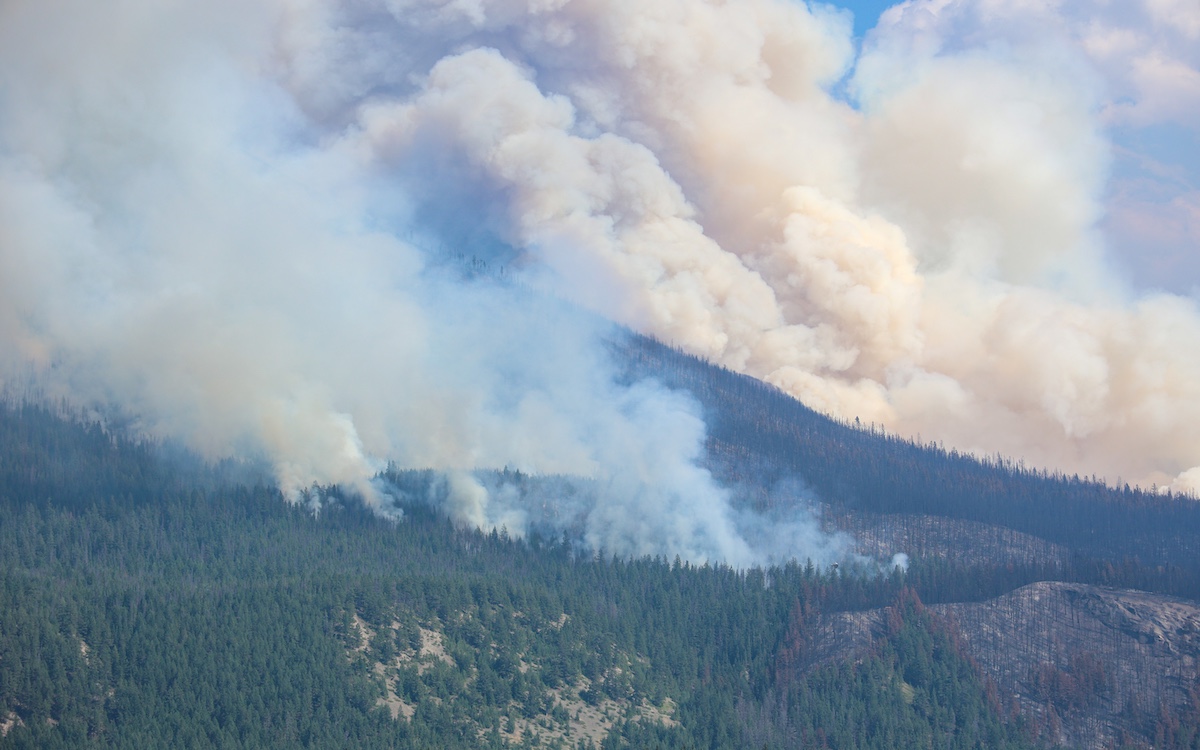
Photo courtesy of Luuk Wijk/Parks Canada
Revenge of the carbon cycle
Why Jasper burned so mightily is still the subject of research, but two factors seem beyond serious doubt: fuel load and climate change.
When 1.1 million hectares of the Canadian Rockies became Jasper National Park in 1907, the first thing to go was fire. The cultural burns undertaken by Indigenous peoples—a boon to their ungulate prey and medicinal plants—were outlawed, and natural fires were vigorously suppressed until 1996. The result was transformative.
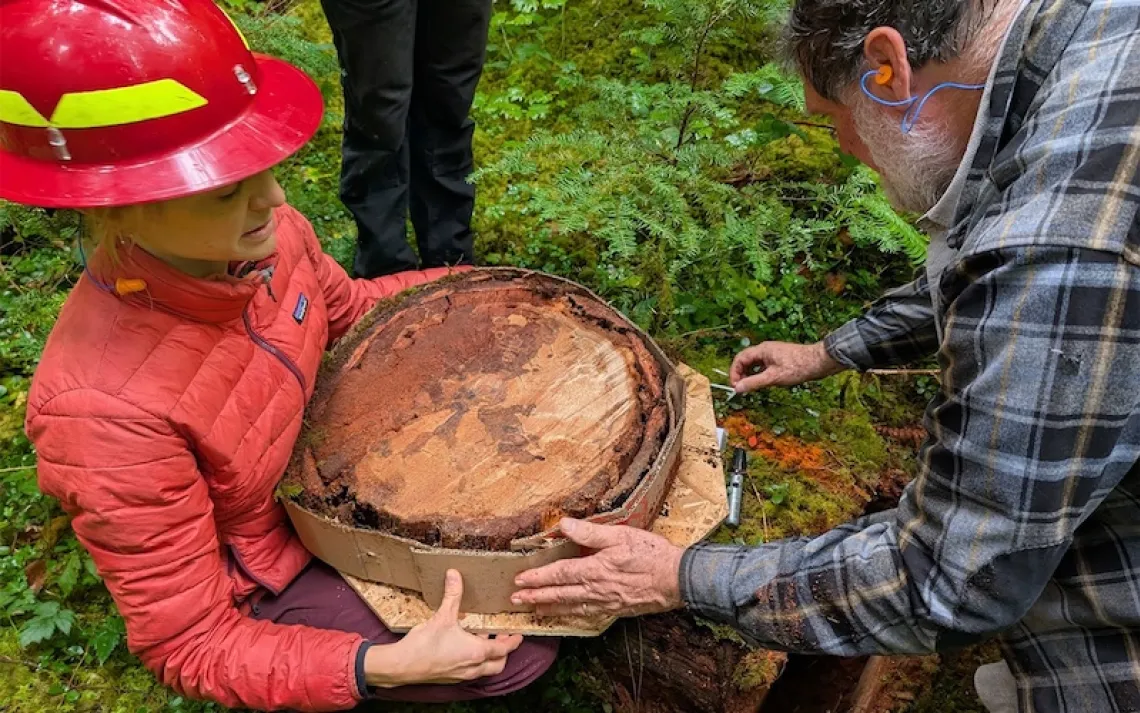
Lori Daniels, director of the UBC Tree Ring Lab, said the oldest trees in Jasper tell a surprisingly lineal story. Their rings go back 300 years, as do their fire scars. Some have survived as many as eight individual burns in that time, frequent, low-intensity wildfires between 1700 and 1900, marking trees without killing them and opening forests without eradicating them.
Then, around the time of park status, fires vanished from the record. About 70 percent of the trees in Jasper National Park today, said Daniels, germinated since 1907, many of them lodgepole pines, filling in a diverse, mosaic, largely open landscape with a closed canopy of conifers. In this way, the forests of Jasper sequestered more carbon and remained more burnable fuel than might otherwise have been possible. The loss of frequent, small, “healthy” burns primed the park for a big one. Several of the trees in Daniels’s research plots, veterans of a half dozen fires over three centuries, were incinerated in 2024.
“Charred, horizontal trees, ripped-up roots, and bare rock as far as you can see,” recounted Daniels. “It’s the most impacted patch of forest, by a wildfire, that I’ve ever seen, and I’ve seen a lot of impacted forests in Western Canada.”
Flannigan gave his first presentation on wildfire in a warming world back in 1985. It was also the subject of his first peer-reviewed paper in 1991, in which he predicted that a doubling of atmospheric CO2 (355 parts per million at the time) would result in a 47 percent increase in land burned by wildfire in Canada. We surpassed 430 parts per million in May 2025, far from a doubling, but more than enough.
“If you look at a 10-year running average,” said Flannigan, “in the '60s and '70s we were burning about a million hectares a year. Now we’re running over 4 million hectares a year, a quadrupling of area burned.”
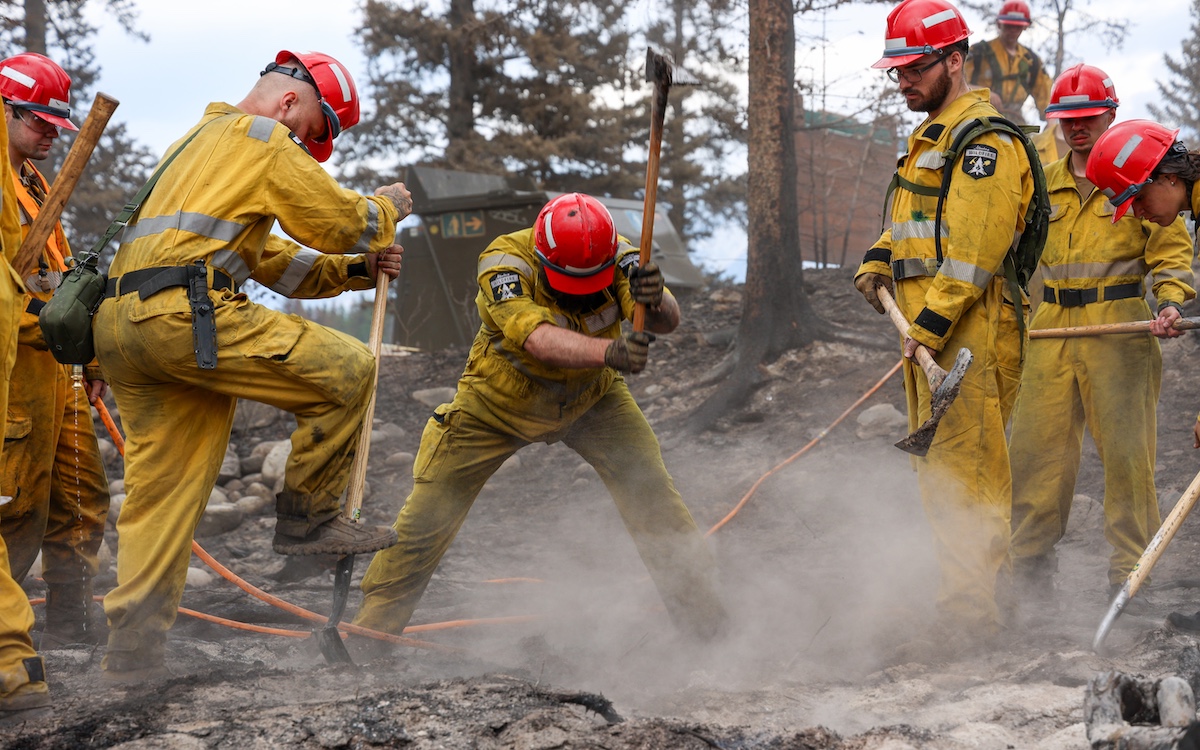
Canadian Armed Forces work near Beauvert Lake. | Photo courtesy of Luuk Wijk/Parks Canada
The fire season in Canada has lengthened by about two weeks, and in that range, hot and dry extremes have become much more pronounced. The boreal peatlands of northeastern British Columbia—wet by definition—have became so dry in recent years that wildfires ignited there in 2023 are still burning, smoldering underground through two winters and returning to the surface both springs.
“There’s a recipe for wildfire,” said Flannigan, “and it has three ingredients. The first is vegetation. Fuel. The second is ignition, which you can break down into human caused and lightning caused. The third is hot, dry, windy weather. Get all three, and you get wildfire.”
Jasper National Park had gone without rain three straight weeks before July 22, and in the days immediately prior to fire, temperatures rose over 35°C (95°F), with relative humidity in the single digits. These conditions were extraordinary for Jasper.
“It was so hot and dry,” said Daniels, “that everything, living or dead, was flammable.”
From the ashes
There were surprisingly few casualties among Jasper’s wildlife. Seven large mammals—a black bear, two elk, and five deer—were found dead in the post-burn area, and another bear, found alive, was so severely burned it was necessary to euthanize. The nests of 10 endangered black swifts (the park hosts 12 total) were flung from cliffs by the wind, and while the adults flew away in time, their chicks could not. High on the treeline, stands of endangered whitebark pine, already struggling with invasive white pine blister rust, were destroyed.
Jasper’s 33,000 burned hectares were, and remain, very strange to look at. The obsidian husks of dead trees stand rigidly straight—at least where fire tornadoes didn’t cast them down—and at the base of their trunks is mostly nothing. Exposed roots like fossilized octopi, mineralized soil like sand, and bedrock. But, shortly after the fire, these artifacts were joined by the grasses and forbs stubborn enough to make a living in ash. Hairy wild rye greened the understory before fields of clasping aster purpled it. Fireweed contributed some purple too, then came goldenrod, arnica, and black-eyed Susan with yellow. The effect was, and is, of splendid color, popping beneath dense columns of rigid charcoal.
It was enough for elk and deer, who returned to burned forests within a couple months, grazing comfortably on the ample regrowth of wildfire meadows. Plenty of food, but very little cover. When it came time to calve in spring 2025, female elk became aggressive, competing with one another for what little intact forest could shelter their young. Black bears, too, crowded forested spaces in which their cubs could escape danger up the nearest tree. Grizzlies abandoned the burn entirely, retreating to the forested subalpine, where their congested territories overlapped more than usual.
The Canada buffaloberry (Shepherdia canadensis) might well be keeping the peace. Relative to the previous year, 2025 has been mercifully wet, resulting in an explosion of this deep-red fruit, in a park where berries make up the majority of a bear’s diet. A respite, and a timely one.
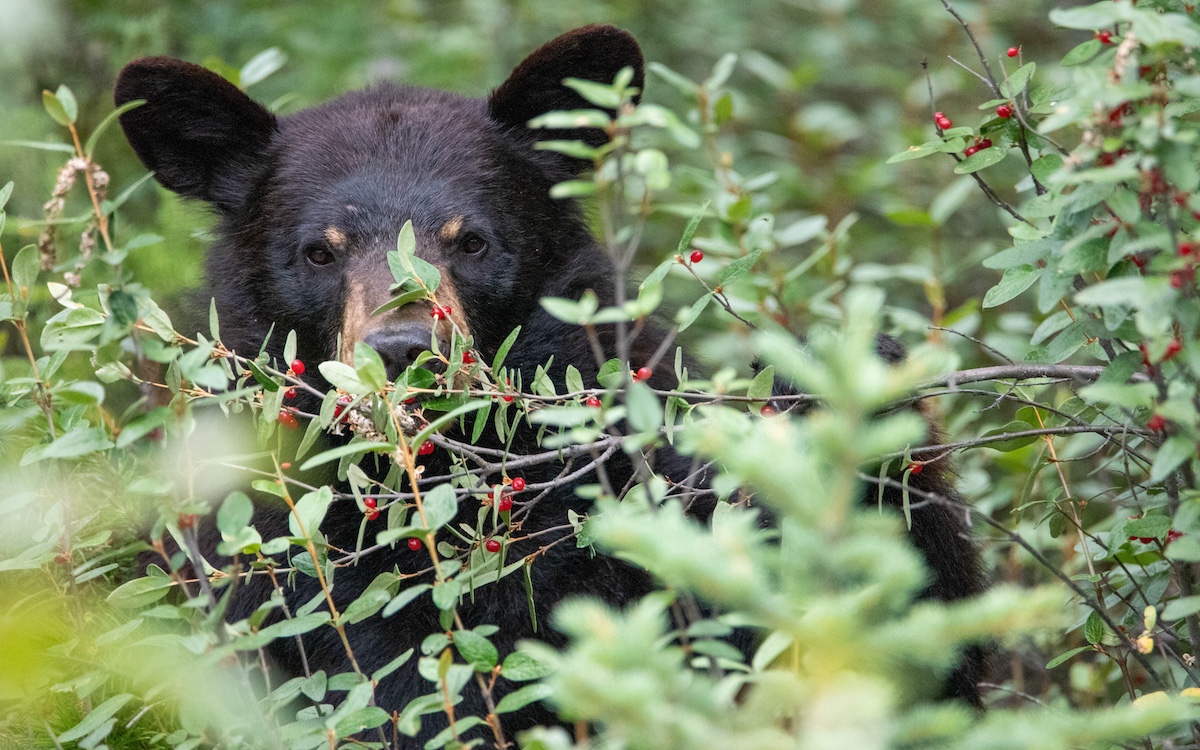
A black bear chews on Canada buffaloberry. | Photo by Zack Metcalfe
What happens next is an open question. Under normal circumstances, one might expect a fresh blanket of trees to emerge from the ash in five years or so, and this will certainly happen in places. Lodgepole pine is a serotinous species, meaning its cones will open only in the heat of a wildfire. They depend on big burns to clear the way and to liberate their seed. Flurries of fluffy white aspen seeds—“aspen snow”—have been observed floating from intact forests onto burned mountainsides. Parks Canada will be actively planting tens of thousands of whitebark pines in appropriate sites throughout the burn, seedlings specifically bred to resist white pine blister rust. There will be no shortage of pioneering trees.
But this was no normal fire. It burned so intensely in places that absolutely nothing survived, neither tree nor topsoil—not even the serotinous cones of lodgepole pine. In the words of wildlife scientist Jason Fisher, “Forests are being knocked back to the Pleistocene,” not so much reset as annihilated.
“Some of our forests will never be forests again,” said Tracy McKay, an ecologist team lead with Parks Canada, because there’s nothing left from which, or in which, to regrow. In a warming climate, these new moonscapes will probably remain too hot, and too dry, for the original ecosystem ever to recolonize. It’s a phenomenon that has been observed elsewhere, such as British Columbia’s Southern Interior, where fires from the late 1990s and 2000s were so severe that forests still haven’t returned, even where actively replanted.
“In these warm, dry ecosystems where wildfire has had a significant impact on soil,” said Daniels, “we’re seeing major shifts in species composition. I think Jasper will be another example.”
Universal fire suppression can no longer be the norm, said Daniels. If modern fires in the Rocky Mountains are to be manageable at all, the landscape will need to become a mosaic again, its fire-prone conifers blended with standings of fire-resistant broadleaves, with forested meadows, and especially with wetlands, which might be expanded with the reintroduction of beavers and the scaling back of some infrastructure. It will also be necessary to set fires of our own, thinning the woods when conditions are right.
Parks Canada has been prescribing fire to Jasper National Park since 1996, in hopes of reintroducing a more natural regime, as well as restoring a landscape mosaic. In fact, in fall 2024, Parks Canada carried out more prescribed burns in a still smoldering Jasper. Work like this will need to continue, said Daniels, and rewilding landscapes will need to be coaxed into manageable shapes, with diversity, water retention, and natural fire breaks, rather than a blanket of lodgepole pines.
“It means having our forests in a condition where they can absorb fire, and benefit from it,” she said. “Fire could again be part of the ecosystem, instead of a reset button.”
Mike Flannigan’s recommendation was more to the point: “We need to get a handle on our fossil fuel emissions.”