By Linda Pauer and Chelsea Mendoza
When Joni Mitchell wrote “Big Yellow Taxi” in 1969, she was only 26 years old. She sang, “… they paved paradise and put up a parking lot…” and it seems her words were as poignant then as they are now. The iconic environmental anthem asks, “Don't it always seem to go that you don't know what you've got 'til it's gone?” The Aliso Creek lagoon is gone!
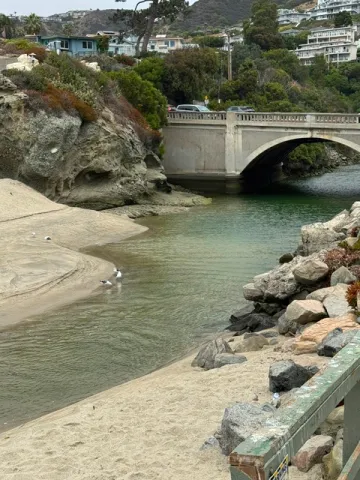
The question sits at the heart of the Aliso Creek Watershed Project: a series of multi objective restoration and urban runoff recovery initiatives spanning the creek’s 19.5 miles, along with a degraded coastal lagoon at its mouth in South Laguna Beach. It currently suffers from urban runoff impacts but is the target of a major proposed $20,000,000 restoration project aimed at returning it to a functional wildlife habitat. Just a few minutes’ walk above the PCH crossing, you’ll find a paved parking lot where the lagoon once thrived, and the tidewater gobies once swam.
Key Initiatives Across the Watershed
- Aliso Creek Estuary Restoration: Led by the Laguna Ocean Foundation and the city of Laguna Beach, this project aims to transform the degraded Aliso Creek lagoon into a functional 9-acre coastal wetland. The multi-phase plan also includes removing the artificial fill and surface parking, widening the channel to restore natural tidal flows, stabilizing the natural sand berm, building pedestrian loop trails, and improving wildlife habitats for species like Goby and the California gnatcatcher.
- Runoff Recovery & Water Recycling: Managed by the South Coast Water District (SCWD), this project captures and treats approximately 800,000 gallons of polluted urban runoff per day from Aliso Creek. It is then combined with recycled water to enhance the local water supply and support creek restoration near the Coastal Treatment Plant.
- Wilderness Park Habitat Enhancement: Organizations like the Laguna Canyon Foundation coordinate with OC Parks to remove invasive plant species, restore native riparian vegetation, and re-establish crucial wildlife corridors in the Aliso and Wood Canyons Wilderness Park.
Aliso Creek Watershed Collaboration Group: A trip to the Source
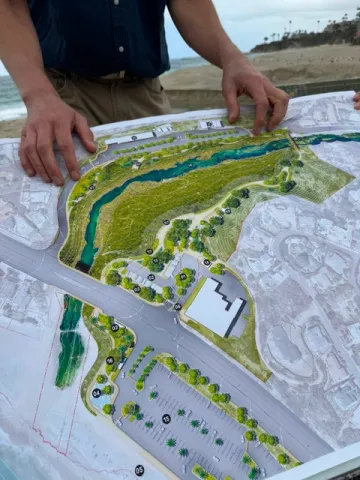
The Aliso Creek Watershed Collaboration group recently held a field visit to the creek’s mouth to see the proposed estuary restoration project firsthand and discuss opportunities for collaboration on watershed enhancement. Participants observed that today, riparian areas are largely dominated by invasive plants and contain very little water.
These initiatives focus on removing invasive species, re-establishing native ecosystems, focusing on habitat repair, water quality improvement, and reducing dry-weather flows.
The Aliso Creek Watershed Project team displayed the conceptual drawing of ecosystem restoration and urban runoff recovery initiatives spanning the creek, focusing on habitat repair, water quality improvement, and reducing dry-weather flows. (Photo: Linda Pauer)
Local Action: In Southern California, grassroots activists and Sierra Club allies have successfully pressured local governments to halt the spraying of herbicides in flood control channels and creeks.
There’s hope for the return of the estuary, its native species and eco-systems. To learn more about their active campaigns or to get involved in local restoration projects, you can check out our program on July 22nd for more information on sustainable ecological management. Our speaker, Ray Hiemstra of OC Coastkeeper, will offer his expertise on this and other topics. PLEASE RSVP
JOIN US Wednesday, July 22nd from 6:3 to 8:30 PM Norman P. Murray Community Center 24932 Veterans Way, Mission Viejo |