
On October 2nd, the Department of Energy announced that it cut 321 projects supporting American companies in advanced manufacturing, hydrogen production, grid reliability, and efficient industry, “saving” $7.56 billion - or $5.8 billion with a review of the actual data from USAspending. Unsurprisingly, Trump’s DOE targeted the cuts towards projects in districts held by Democrats - 4:1 by total dollar amount.
This week, it was revealed that the DOE is looking at another tranche of cuts - this time with Republican districts on the block. So what’s at stake here? The answer is $15.5 billion in federal government spending, another $13.3 billion in state matching funding, and an extraordinary amount of private investment that’s likely to get wiped out overnight.
We’ve pulled together the cancellations into a visualization that illustrates just how rough these cuts are going to be for nascent industries - and well established ones too. We took the reported list of awards, and pulled up their records (although as of this writing, the records from the first tranche of projects have already been expunged from USAspending).
The largest sets of cuts are from the offices of Clean Energy Demonstration ($4.44 billion) and Manufacturing Energy Supply Chain program ($4.03 billion). Clean Energy Demonstration is a program funded under the 2021 Bipartisan Infrastructure Law (BIL), and has largely spurred major US industries to look for improvements in their manufacturing processes. Programs funded under the OCED included low emissions cement manufacture, clean steel, and advanced chemical manufacturing. The Manufacturing Energy Supply Chain program was spurred through the Inflation Reduction Act, and is largely geared towards improving the supply chain of critical minerals, battery production, and parts manufacturing for electric vehicles.
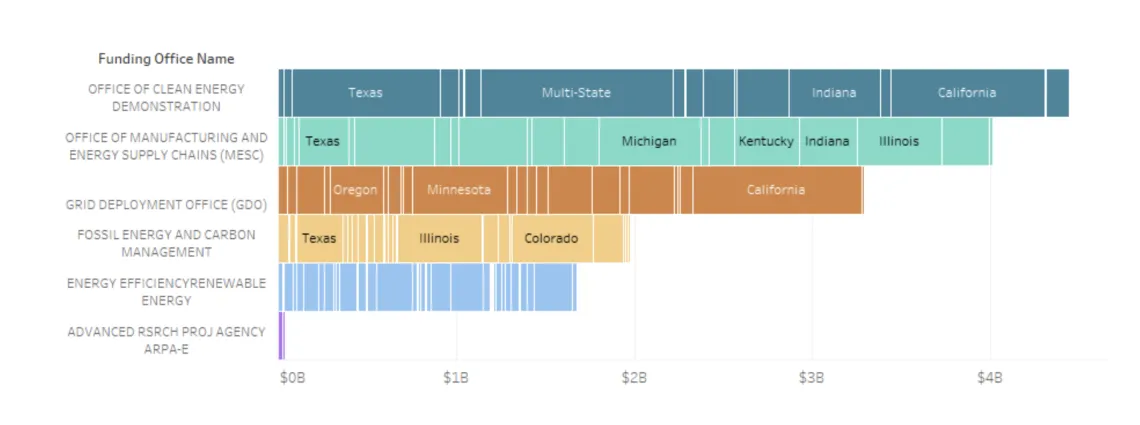
Also on the chopping block are key projects from the Grid Deployment Office ($3.29 billion), a BIL program meant to help both big utilities and state and local authorities buff up aging transmission systems through cutting edge technology improvements; and programs funded by the Office of Fossil Energy ($1.97 billion), the group in charge of the vaunted hydrogen hubs and carbon capture projects. Another $1.69 billion in cuts are being made to the office of Energy Efficiency and Renewable Energy, almost all of which are innovative projects by small and medium industries to make big steps forward in improving their own processes and reducing cost, or to state academic institutions for industrial research and development.
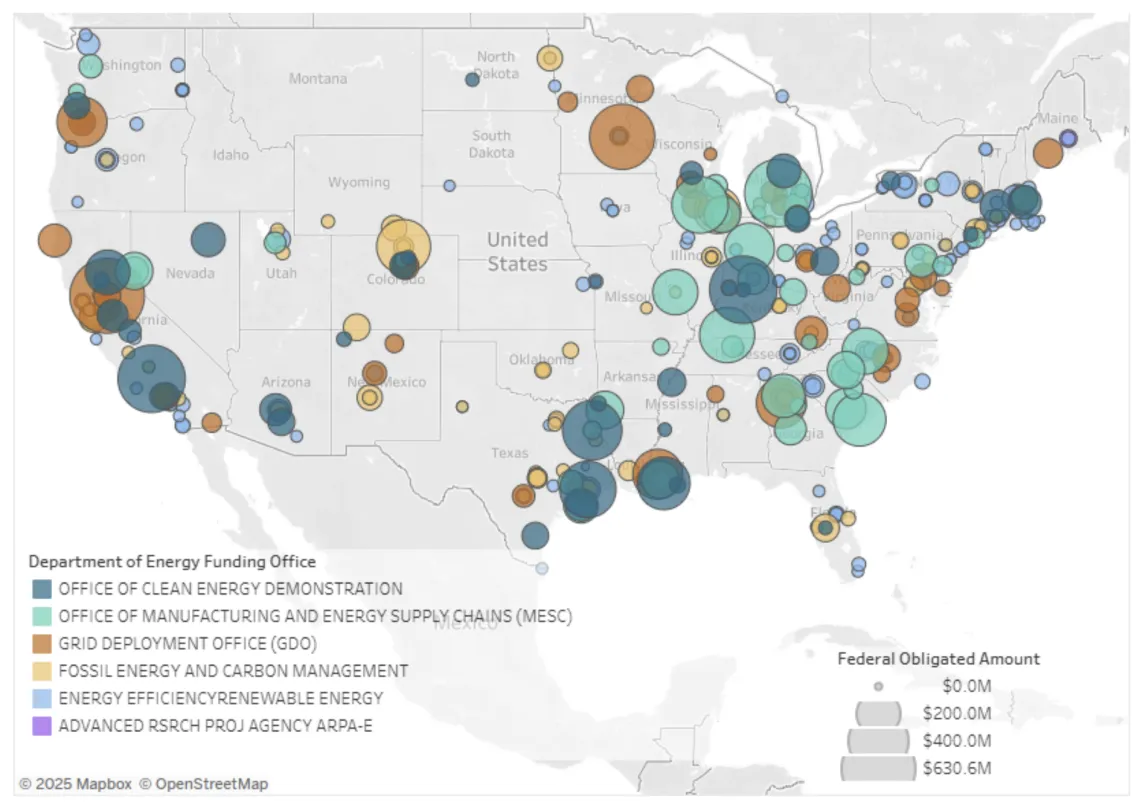
Some of the largest project cuts target electric vehicle manufacturers, battery producers, and critical minerals processing. General Motors in Michigan is losing $500 million in federal investment to spur new electric motor factories in Michigan, Kansas, and Kentucky. Fiat Chrysler Automobiles is losing $530 million in federal investment for electric vehicle factories in Illinois and Indiana. Mercedes in South Carolina ($285 million), Volvo in North Carolina ($208 million), and even Harley Davidson in Pennsylvania ($89 million) are all being slashed.
But it’s not just electric vehicles. Batteries, used in cars, industries, houses, and consumer goods - as well as by utilities - are being cut with big losses for lithium processing in Nevada ($123 million), cathode production in Kentucky ($316 million), and graphite manufacturing in South Carolina ($150 million).
Some of the most innovative manufacturing processes are also being cut. A massive investment in clean steel is on the block in Louisiana (Vale, $283 million), a brand new advanced concrete production facility in Indiana (Heidelberg, $500 million), and a solar/storage facility that would have reduced the cost of gold mining in Nevada (Nevada Gold, $95 million) are now out the window as well.
These projects are critical not only to the communities and jobs that they serve, but are core to a robust supply chain to keep prices - and emissions - low for consumers and businesses. This kind of federal funding is the stuff that actually makes things work. Investments in our economy drive new industries, drive American innovation, and keep our economy competitive. Slashing these programs is a relatively small short-term gain for a huge long-term loss.