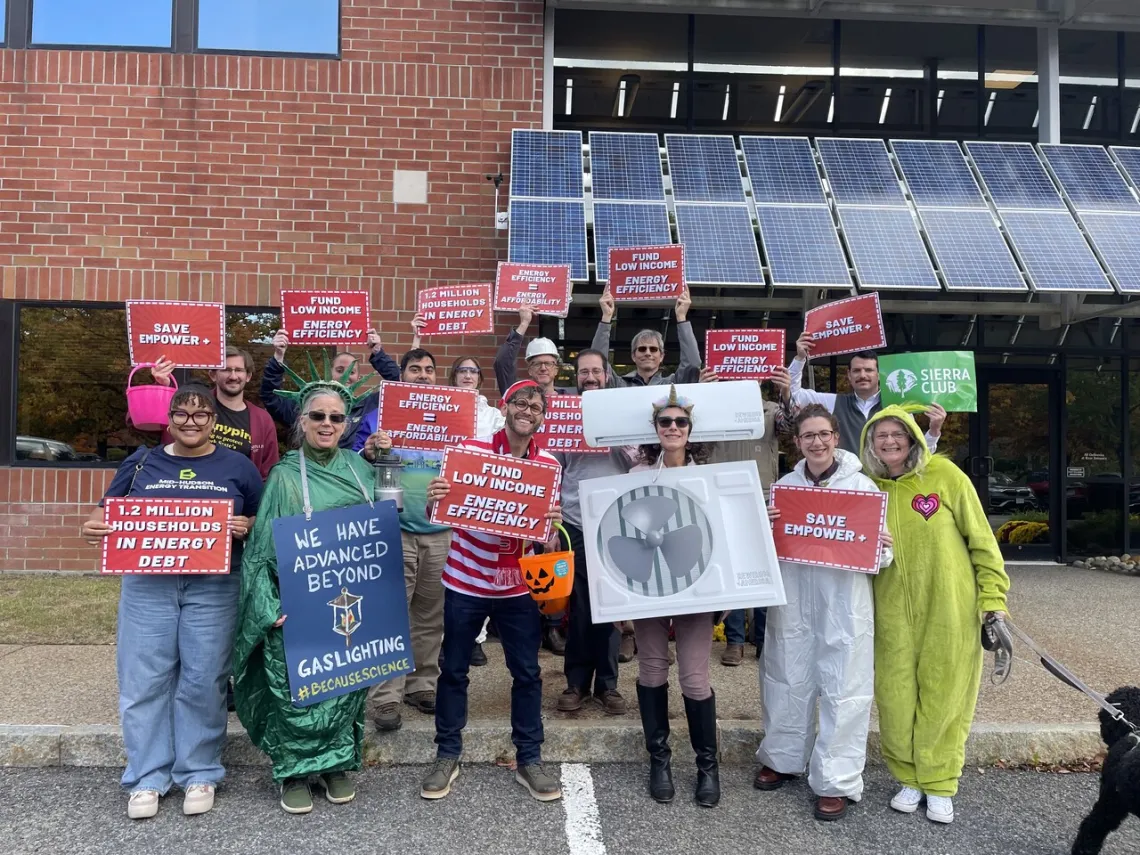
Sierra Club’s Building Electrification Campaign has worked hard over the years to ensure that people are informed and supported to make choices in their homes that reduce their exposure to pollution and lower utility bills. Energy efficient electric upgrades—like high-performance heat pumps (that offer heating and cooling), efficient water heaters, better insulation, and induction stoves, to name a few—offer a great user experience, play a huge role in lowering energy bills, and reduce dangerous indoor and outdoor air pollution.
In 2025, we focused on local, regional and state efforts to build and grow momentum towards building decarbonization and holistic upgrades that make homes safer, healthier, and more affordable to power. We also fought hard to preserve all the ground we have gained at the state and federal levels.
Despite growing public support, the Trump administration and Republicans in Congress are putting plans into motion to roll back common-sense energy efficiency standards (that are legally required to be updated) and made deep cuts to funding for clean energy investments that directly benefit American households through lower utility bills, a struggle with which most Americans are currently grappling. Trump ensured a dismantling of the ground-breaking Inflation Reduction Act that would have created lots of good-paying jobs and helped more families achieve safer, cleaner homes.
Every step of the way, and at all levels of government, we stood up for safer, healthier homes for people of all income levels and better access to more affordable, cleaner appliances.
Two efforts are particularly emblematic of our work at the federal level this year:
As soon as the Trump Administration came into office, we knew the landmark Inflation Reduction Act was on the chopping block. We got started right away in educating people and Congress about the benefits the IRA had already unlocked and the future the legislation could help achieve for regular people, businesses, and American manufacturing.
We released a series of videos across our social media platforms highlighting those benefits. We also collected thousands of signatures urging Congress to protect clean energy and preserve the Inflation Reduction Act. The videos featured:- Gloria Daniels in South Carolina who cut her energy costs by upgrading to a heat pump and solar panels—made affordable through a grant from the Sustainability Institute and federal programs from the Inflation Reduction Act;
- Chef Chris Galarza, who shared how restaurants can improve kitchen conditions, save money, and boost efficiency by switching to induction—without sacrificing temperature control; and
- American company, Copper, that makes induction stoves. Companies like Copper support stronger job security, boost domestic manufacturing, and make products for healthier, more efficient kitchens, and would have been boosted with support from the IRA.
Our efforts to protect IRA consumer rebates for energy efficient appliances have thus far been successful, though that fight is not over. And while Republicans in Congress did end tax credits for home energy upgrades, in our efforts to preserve what we could, we also raised awareness about the harms of burning fossil fuels in homes and the benefits of energy efficiency and electrification for energy security and affordability.
We have worked to make sure that consumers know that the benefits of the IRA home energy tax credits are still accessible through the end of the year by updating our home energy guide and sharing reminders on social media.
The framework for accelerating the transition to cleaner, more efficient homes and buildings may no longer exist at the federal level, but the change is underway nonetheless. And we will continue to educate people and facilitate that transformation as best we can in the coming year to meet our goals of cleaner air and more affordable energy.- Another critical program, the Low Income Home Energy Assistance Program, known as LIHEAP, was under attack throughout the year. We worked hard to protect and preserve it, and we were successful.
LIHEAP is a program that helps low-income households afford the energy they need to keep their homes safe, powered, and habitable, especially during extreme heat and cold events. Early in the year, DOGE fired all the staff responsible for the LIHEAP program, and the president proposed zeroing out LIHEAP’s budget all-together in the administration’s draft budget.
In June, we flew volunteers and staff from eight states into DC to share powerful constituent stories about the importance of LIHEAP with more than 35 Congressional offices. Sierra Club also generated more than 10,000+ digital actions and supporters drafted more than 120 letters to the editor in support of the program. Our voices were heard. LIHEAP funding was preserved in the final budget resolution that passed Congress.
However, LIHEAP faced further threats during the government shutdown. Existing staff shortages were compounded by the closure, and LIHEAP funds were not reaching states at a critical time, just as weather was beginning to turn cold in many places. We brought attention to this problem in the press and on social media, and called on utilities to take action to protect people from power shutoffs. Now, as we reach the end of the year, all LIHEAP funds have been distributed to states to deliver to people who can not afford their energy bills.
We also found ways to make significant progress at the local and state level.
- Twelve cities in California passed air conditioning to heat pump conversion building codes, accelerating the transition off of gas in homes and buildings.
- The City of Ashland, Oregon passed a novel climate pollution fee on new construction, ensuring that any new homes built with fossil fuels had to pay their fair share of the social cost of carbon.
- Just this month, the Colorado Public Utilities Commission (PUC) issued a final written order on Clean Heat targets, directing Colorado's major investor-owned gas utilities to achieve 41% reductions in emissions by 2035, compared to 2015 levels. The PUC rejected proposals for weaker targets by state agencies and utilities, siding with the arguments of the Sierra Club and Southwest Energy Efficiency Project, which were supported by local governments, state legislators, dozens of organizations across Colorado, and more than 600 members of the public.
- The Massachusetts Department of Public Utilities published final orders in proceedings addressing utility requests to charge customers for the costs of replacing aging gas infrastructure (Gas System Enhancement Plans). The orders cited the Sierra Club’s testimony and briefing dozens of times and adopted nearly all our recommendations to disincentivize the continued expansion of the gas system and prioritize safety over utility profits.
- In New York, the Atlantic Chapter generated the most public comments by far of any environmental organization on the State’s draft Energy Plan, the first plan released in a decade. Sierra Club supporters also commented in person at every hearing across the state, especially in western New York, where dozens of Sierrans effectively countered the major turnout of opposition fueled in part by the influence of the local gas utility, National Fuel, who also fracks in Pennsylvania, and who has been successfully keeping area Democrats from supporting key statewide gas transition legislation from getting passed. Another highlight was focused on legislation. The only major environmental bill passed by the legislature will end gas line allowances if the Governor signs it, and collectively Sierrans took 3,000 actions supporting the bill, in addition to having almost a hundred volunteers from across the State travel to lobby legislators in support of the bill on 3 different lobby day events.
- In Illinois, our advocacy and organizing led to Illinois Commerce Commission staff recommending an industrial electrification pilot program that would support industrial heat pump and thermal battery demonstration projects -- crucial strategies industry can use to reduce pollution, improve public health, and boost clean domestic manufacturing and jobs. Commission staff also recommended two other pilot programs based in part on Sierra Club’s advocacy: one to support electrification of agricultural activities such as grain drying and dairy production, and another to advance thermal energy networks, a form of shared energy that can provide efficient and pollution-free heating and cooling to entire neighborhoods.
- Our campaign also drove comments and submitted testimony to the Illinois EPA during the drafting process of the State Implementation Plan (SIP) to reach the standards set for safe air in the Clean Air Act. Our efforts led the state’s EPA to broaden the public input process and actively consider adopting boiler electrification as a path to reduce emissions and achieve attainment of air quality standards. Now that the state has been moved from moderate to serious nonattainment, our efforts to engage the public and give regulators tools to address harmful emissions effectively are becoming even more crucial.
Sierra Club is defending state and local building electrification efforts against industry attack in courts across the country.
This year, we secured preliminary victories in multiple cases and defended initial wins on appeal.
- Sierra Club was part of a successful lawsuit against the unconstitutional ballot initiative 2066 in Washington, which would have rolled back electrification policies across the state and increased energy costs. A state court ruled in our favor and paused implementation of the initiative. That decision has been appealed.
- Sierra Club intervened in defense of a California air district’s rule that prohibits air pollution from boilers and the federal trial court agreed with our arguments. In October, we filed a brief at the appellate court urging it to uphold the rule.
- The federal trial court in Colorado partially granted a motion by Sierra Club to dismiss an industry challenge of building code standards that would phase out gas appliances.
- A federal trial court in New York upheld the state’s All-Electric Buildings law, which requires most new buildings to be all-electric by 2028.
- Sierra Club played a vital role in coalition efforts to develop and pass the challenged law, and submitted amicus briefs at both the trial court and on appeal detailing the public health benefits of building electrification.
As we move into next year, the challenges may grow—but so will our resolve. We will continue to defend strong energy efficiency standards, support clean home upgrades, and fight misinformation that undermines consumer choice and public health. And we will expand our work as a campaign beyond residential buildings and into industrial settings, fighting to clean up industrial boilers.
In 2026, the Building Electrification campaign will have a new name: Clean Heat. Same mission, but even broader goals.
Efforts by the Trump administration and the fossil fuel industry to roll back and block our efforts doesn’t just stall progress. These attacks risk limiting consumer choice, keeping families locked into outdated technologies, lead to more pollution in overburdened communities, and worsen the affordability crisis.
The fight for consumer choice, healthy homes, and clean industrial practices isn’t over. In fact, it’s just getting started. And Sierra Club’s Clean Heat campaign is ready to meet the moment.