The U.S. has a long history of state and federal policymakers adopting achievable, science-based standards to accelerate the transition to cleaner heavy-duty vehicles. These standards have helped improve battery-electric technology, increase model availability, and expand electric truck charging infrastructure.
Sierra Club advocates and our partners have continuously pushed for timely implementation of strong standards, purchase incentives, manufacturing investments, and charging infrastructure to spur electric truck adoption. Our communities are demanding electric trucks because they help save lives, cut climate pollution, save fleets money, and drive global competitiveness.
Despite diesel truck manufacturers, oil companies, and special interests lobbying against state and federal standards, the clean truck movement was steadily growing in the U.S. Then in January 2025, opponents of clean vehicle standards started aligning themselves with the federal government’s deregulatory agenda to undermine the momentum towards cleaner trucks.
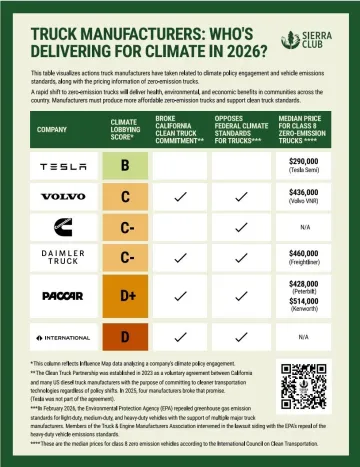
Sierra Club has developed the chart “Truck Manufacturers: Who's Delivering for Climate in 2026?” to show how some truck makers are going against their own climate commitments. This resource visualizes the actions truck manufacturers have taken related to climate policy engagement, vehicle emissions standards, and the pricing information of Class 8 electric trucks. Fleets, the trucking industry, and policymakers can use the chart to compare if truck makers are leading the market or lagging behind.
Climate Lobbying Score (Column 2)
InfluenceMap, a global research organization focused on climate and sustainability, has developed a methodology based on public information to gauge how companies are engaging on policy issues. Their Performance Band Score ranges from an A or B, which indicate strong support for science-aligned climate action—to lower grades such as C, D, and F, which reflect increasing levels of obstruction toward climate policy.
Negative lobbying by truck makers puts climate targets at risk and threatens the transition to electric trucks. Manufacturers should aim to improve their grade by supporting and defending clean truck standards, advocating for strong EV procurement targets, and advocating for EV charging infrastructure investments.
Broke California Clean Truck Commitment (Column 3)
In 2023, truck manufacturers and the Truck and Engine Manufacturers Association (EMA)—a lobbying group for the truck industry—signed the Clean Truck Partnership (CTP) with the California Air Resources Board (CARB). This agreement formalized their commitment to deliver electric trucks to California in case the regulatory landscape shifted.
In 2025, Congress unlawfully used the Congressional Review Act to revoke California’s waivers for the Advanced Clean Trucks and Omnibus Low NOx Rules. Some truck makers decided to try to use this moment to undermine their pact with California. Daimler Truck North America, Volvo North America, International Motors, and PACCAR filed a lawsuit against CARB to back out of the Clean Truck Partnership.
In response, a global coalition of 35 public health, labor, environmental, and community organizations and 50,000 individuals from 30 countries urged the truck makers to withdraw the lawsuit against California. We continue to demand that the truck makers withdraw the lawsuit, advocate for electrification standards around the world, and accelerate the transition to zero-emission trucks.
Opposes Federal Climate Standards for Trucks (Column 4)
In 2025, the Environmental Protection Agency (EPA) announced a proposal to rescind its 2009 finding that greenhouse gases endanger public welfare and to scrap the greenhouse gas emission standards for cars and trucks. The Phase 3 Greenhouse Gas (GHG) standard for heavy-duty vehicles aimed to reduce deadly diesel exhaust and climate pollution. Eliminating these truck standards would put communities in jeopardy and allow billions of metric tons of avoidable climate pollution.
Daimler emphatically commended the EPA’s reconsideration of the Phase 3 truck standard during the comment period. Its harmful comments go against science and economics given the clean truck global trends. This position was a direct contradiction to its commitment towards climate action and detrimental to achieving its own global targets for manufacturing cleaner trucks.
As soon as the EPA finalized the repeal of the Engagement Finding, a broad coalition of health and environmental groups sued the agency for ignoring its duty to protect Americans from climate pollution and illegally repealing the vehicle emission standards.
The Truck and Engine Manufacturers Association (EMA) filed an appalling motion to intervene siding with President Trump's harmful repeal of the truck standards. Volvo, Cummins, Daimler, Paccar, and International are all members of the EMA.
We demand that EMA members push the industry association to abandon its motion to intervene over the repeal of the Phase 3 GHG emissions standards, or publicly distance themselves from EMA’s litigation efforts.
Median Price for Class 8 Zero-Emission Trucks (Column 5)
New analysis from the International Council on Clean Transportation (ICCT) reveals pricing information for Class 8 battery electric tractor trucks, the large semi-trucks we see on highways delivering our goods.
ICCT had observed rising electric truck prices in the U.S., contracting the lower prices in Europe. But now the Tesla Semi has shifted the landscape by pricing the truck at an average price of $290,000. This is the lowest price among all other Class 8 battery electric tractors in the U.S.
It’s particularly important to distinguish between the cost of electric Class 8 trucks because at least nine states including California, Colorado, Massachusetts, and New Jersey, offer incentive funding to help improve the total cost of ownership for fleets.
Legacy truck makers should take into account that they will soon be losing market share in the U.S. and globally. Manufacturers must produce more affordable zero-emission trucks and support clean truck standards.
Why Clean Trucks Matter
President Trump’s plan to roll back vehicle standards gave manufacturers and the oil industry the green light to keep polluting vehicles on our roads for decades. Prioritizing polluters over people and delaying climate action is inexcusable. Americans are reeling from the deadly impacts of climate change across the country, including worsening wildfires, flooding, and hurricanes that are devastating communities and incurring billions of dollars in damage.
Exhaust from diesel trucks is also a leading source of harmful air pollution that sends countless Americans to the hospital every year. Communities located near major roads, highways, railyards, and ports suffer disproportionate burdens from traffic and transportation pollution. These neighborhoods, often Brown and Black communities, bear the burden of higher respiratory illnesses, and relentless noise pollution.
Over 152 million people in the U.S. live in counties with harmful levels of air pollution according to the American Lung Association. Truck makers cannot sit idle taking short-sighted positions each time the political tides change. Instead, manufacturers need to take responsibility for urgently reducing climate emissions by producing electric trucks for the U.S. market and ensuring their actions are aligned with their climate commitments.