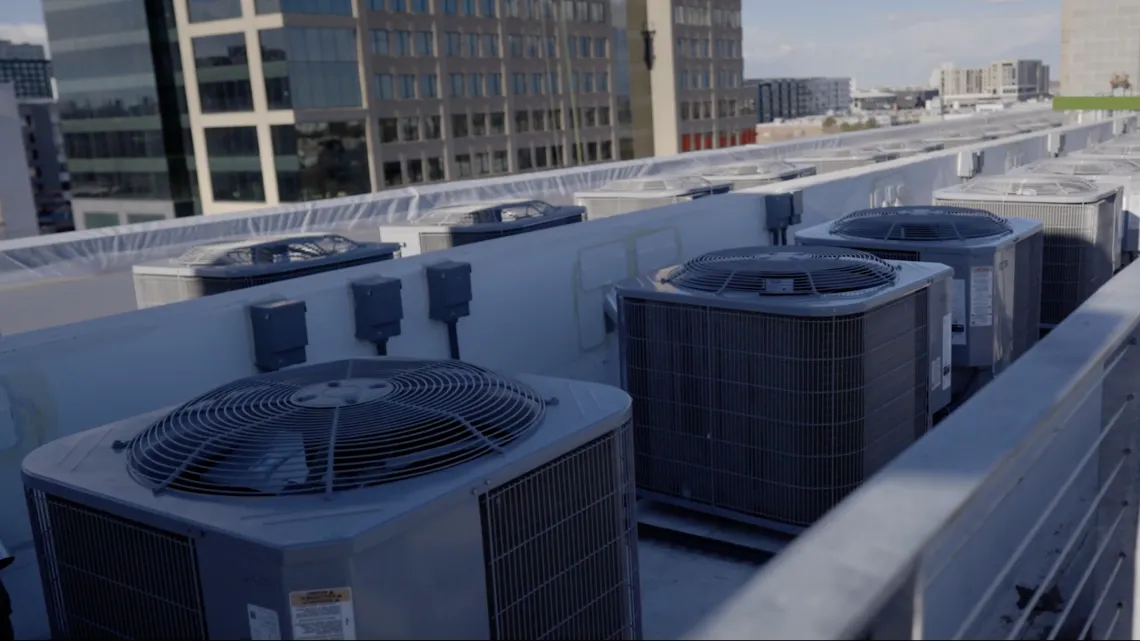
Buildings are major sources of air and climate pollution, making up 21% of Colorado's total carbon emissions. Methane (natural) gas burned to cook food, heat up water, and warm our homes and businesses is expensive and creates indoor and outdoor air pollutants that harm public health. Meanwhile, inefficient air conditioners use enormous amounts of energy, raising energy bills and wasting electricity.
Experts agree: We must move to an energy system that phases out methane gas, replacing outdated technologies with more affordable and advanced alternatives like electric heat pumps. Coloradans deserve cleaner heating and cooling systems in our buildings.
Colorado passed legislation that sets goals to cut climate pollution by 50% of 2005 levels by 2030 and reach net zero emissions by 2050. Passing these targets was a major victory, but to make them a reality, the state recognized that planning needs to start now in order to effectively and equitably transition away from methane gas in homes and buildings.
Below you can read more about how Sierra Club is working to keep Colorado on track to meet its goals and ensure families and businesses save on their electric bills and benefit from the transition to clean, renewable energy.
Clean Heat Plans: Requiring Utilities to Cut Pollution
In 2021, SB21-264 established new rules for Colorado utilities to utilize “Clean Heat” metrics to reduce emissions. Future goals are set by the Colorado Public Utilities Commission (PUC) and utilities, like Xcel Energy, must file Clean Heat Plans every four years proposing programs to meet the targets set by the PUC. These proceedings determine how hundreds of millions of dollars will be spent toward reducing gas and investing in electrification.
In the fall of 2025, the PUC held a rulemaking to establish Clean Heat targets for 2035, deciding upon a 41% emissions reduction goal. Commissioners emphasized that plans needed to be in line with the State’s goal to reach net zero emissions by 2050.
To state it plainly, Colorado utilities that sell methane gas to customers are required to take climate action and public health seriously and invest in an energy system for the state that is powered by clean energy, not dirty fossil fuels.
Sierra Club Role and Victories:
- 2024: Sierra Club intervened with a goal of making Xcel Energy's first Clean Heat Plan as ambitious as possible. Our legal expertise and grassroots advocacy led the PUC to approve $430 million to support electrification and energy efficiency upgrades for its customers. This is one of the largest utility investments into building decarbonization in the United States to date. The plan also established some of the most generous heat pump incentives in the nation. This would lead, in part, to Colorado's heat pump installation rate doubling in 2025.
- 2025: Sierra Club and partners won big in a rulemaking to establish emissions reduction targets under the Clean Heat Act. The PUC adopted targets to reduce gas utility emissions 41% by 2035, consistent with Colorado’s statewide decarbonization goals We also received an acknowledgement from the PUC that the state’s statutory commitment to net zero emissions by 2050 applied to this rule.
- 2026: This July, Xcel will be filing their next proposed Clean Heat Plan at the PUC. Sierra Club will engage with our partners and volunteers in order to make the case that the utility must be acting rapidly to proactively and equitably transition its system in order to ensure the strongest plan possible.
Gas Infrastructure Plans: Winding Down Gas Investments for Longterm Savings
Gas Infrastructure Plans (GIPs) are submitted by gas utilities to the PUC to determine investment and maintenance plans for methane gas systems. This includes pipelines, aging infrastructure, and connections to newly-built homes and buildings. Under PUC rules, GIPs should align with Colorado’s decarbonization goals and consider non-pipeline alternatives (NPAs) like electrification. This is important because when new buildings are hooked to gas by default, customers are locked into paying for gas investments long into the future, even if it’s expensive, unwanted, or derails climate goals.
Conservation groups like Sierra Club advocate that the PUC require utilities to explore NPAs, which are options that will help them avoid unnecessary investment and infrastructure buildout. Due to utilities earning money based on how much they spend on their gas systems, they have an incentive to lock in more polluting methane gas pipeline spending than may be in the public interest.
Sierra Club Role and Victories:
- 2025: Sierra Club negotiated a settlement that led to approval of a $48.7 million NPA project on Xcel Energy’s system - the largest NPA ever approved in the United States.
- 2026: Sierra Club intervened in Xcel Energy's GIP, helping secure a strong PUC decision that did not approve many of Xcel's expensive gas expansion plans. The PUC also directed Xcel to better consider NPAs and incorporate policy and market momentum toward electrification when planning its gas system. Critically, regulators also sided with groups like Sierra Club calling into question Xcel Energy's profit incentive for investing in gas, which runs counter to the state's climate goals.
Gas Rate Cases: Preventing Unnecessary Cost Spikes
Rate cases are regulatory proceedings where utilities ask the PUC to review their spending on the methane gas system and approve the amount of money their customers can be charged. Utilities often ask for large sums of money, including for projects that run over budget or are harmful to the environment and public health. When you see news articles that say something like, "Xcel Energy wants to raise gas rates 10%," or "Black Hills wants to raise customer rates by $15 per month," that's often part of a rate case.
Public interest groups like Sierra Club can intervene, arguing to keep unwise fossil fuel spending out of customers’ rates and arguing for better, cleaner solutions to our energy needs. Just because these companies are monopolies doesn't mean they should be allowed to run a bad business and force customers to pay for it.
Rate cases are also the space where investor-owned utilities like Xcel Energy request their Return on Equity (ROE), which determines how much utility shareholders profit from gas system spending, sending Colorado customers’ dollars off to Wall Street. Utilities often ask for higher profit margins, which means customers have to pay more in their bills.
Sierra Club Role and Victories:
- Sierra Club engages in rate cases across the country calling on gas utilities to reduce investments in dirty fossil fuels and to seek affordable solutions that don't burden ratepayers, including here in Colorado.
- In 2026, Sierra Club is engaging in Xcel Energy's gas rate case. In initial comments sent over on June 5, Sierra Club continued to testify that customers should not be charged for Xcel Energy's attempts to charge customers for the gas system investments that could have been better replaced by NPAs and continued pushing back against Xcel's profit incentive to overbuild new gas infrastructure.
Achieving Clean Heat for Everyone
Colorado’s transition away from gas is already well underway, and Sierra Club is working to ensure that it equitably benefits all Coloradans, especially people who are burdened by high energy bills and pollution. These folks, whether low- or moderate-income individuals, renters, or people living in hard-to-improve buildings, may not be able to voluntarily switch from gas to electric appliances without policy and funding support. As wealthier individuals are able to upgrade to more efficient technologies, like heat pumps and induction stoves, there is a risk of other communities being left stranded and having to pay to maintain the gas system if the transition is not planned well and carried out thoughtfully.
Sierra Club is working with partners to ensure that electrification is equitable and affordable for all:
- Prioritizing low- and moderate-income (LMI) households for no-cost energy retrofits, ensuring these communities are not the last left on the gas system.
- Advocating for non-pipe alternatives (NPAs) at the PUC. By reducing spending on the gas system, NPAs both reduce pollution and save money for all gas customers.
- Holding private utilities accountable to their customers by advocating against rising costs, specifically opposing higher rates of return on equity” (ROE).
TAKE ACTION!
If you want to advocate for yourself, your neighbors and your community or, if you want to hold big polluters like Xcel Energy accountable for their attempts to expand dangerous fossil fuels, then you can join our Youtilities Campaign. Sign up today! Click here.