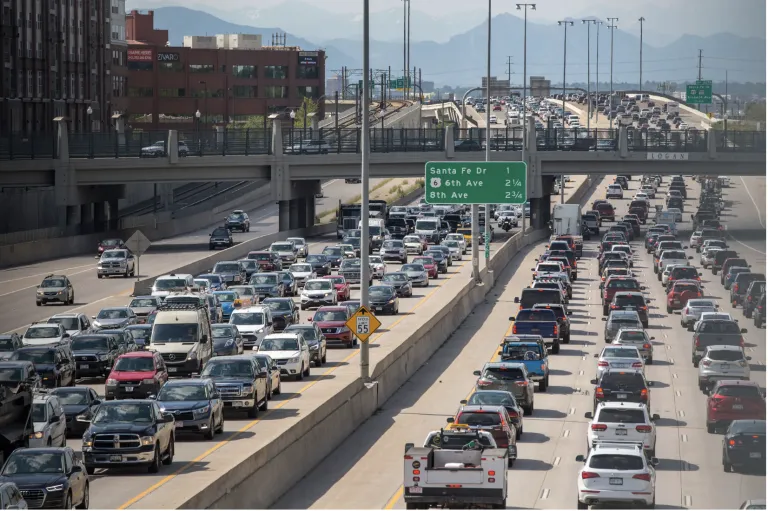
Traffic on Interstate 25 in Denver, August 2019; Hart Van Deburg/CPR News
The Colorado Department of Transportation’s (CDOT) new ten-year plan dramatically favors highway expansions over transit and multimodal improvements. This failure to address traffic congestion, the economy, government finances, climate emissions and local air pollution, and transportation affordability forces Coloradans into further car dependence instead of giving them more affordable and sustainable alternatives. It MUST be adapted to shift funding away from the 1900s-era car infrastructure and toward transit and multimodal options that more modern economies are adopting.
The problems with the current plan can be mostly framed around a simple physical truth: car-dependent systems need much more energy to move around the same number of people as systems giving travelers more freedom of choice. These energy requirements are then reflected in greater system-wide costs for fuel, construction materials, land-use needs, and overall environmental costs. This has been understood for a half-century or more. Worse, the extremely expensive highway widenings planned by CDOT have been shown to not even durably reduce traffic congestion.
Climate change is real and imposes monumental costs on Coloradans' health and economy. This will only worsen if CDOT implements its current plan. Projections from a MIT study indicate that air pollution kills roughly 3,000 Coloradans in the Front Range alone. Approximately half of those deaths are attributable to cars and car-related infrastructure with additional deaths from forest-fire pollution driven, in large part, by climate change. The state's recreation industry is dependent on addressing climate change's impacts on snowfall and increased forest fires. Climate-related costs in Colorado are expected to exceed $30 billion over the next 25 years.
CDOT's plan is out of step with the state's goals for the environment and public health. Colorado is already years behind its emissions-reduction targets recommended by the best available science. For these reasons, Sierra Club Colorado encourages its members to write to CDOT and urge that this plan either be re-written or overridden to focus more on public transit, walking, and biking, and less on failed strategies that harm human well-being and the natural world.