Restoring Fire in the Northeast
These fire-dependent forests could thrive if foresters burned them
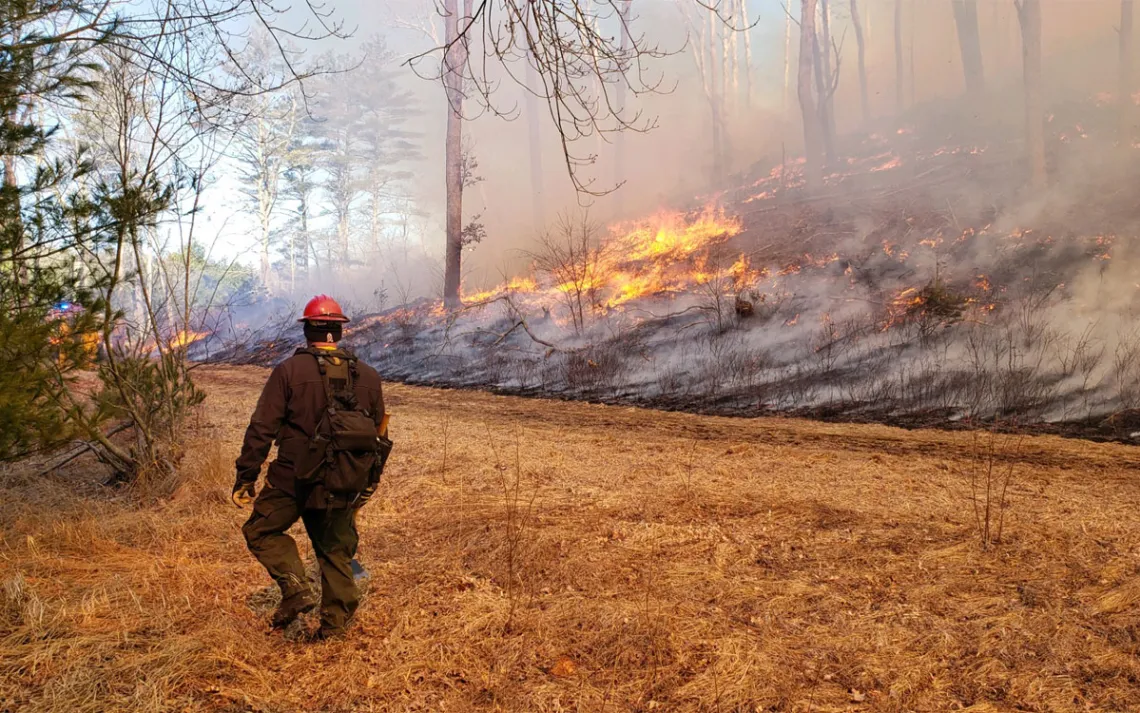
A prescribed fire at the Norcross Wildlife Foundation. | Photo courtesy of Dan Wilder
In parts of the Northeast, ecologists are discovering that a relatively common forest type holds a potential secret. They’re called “cryptic barrens,” and while they are often overgrown, they include the elements needed to conserve globally rare pine barrens habitat. All they need, researchers say, is fire.
Precolonization, frequent fires enabled pine barrens—natural communities of dense shrubs, scattered trees, and sandy soils—to emerge from New Jersey to New England. The Long Island Pine Barrens Society reports that these biodiverse ecosystems once made up roughly a quarter of Long Island. With development and fire suppression, just a handful exist today.
“When we talk about cryptic barrens, what we’re talking about are barrens that have not seen fire in 80 to 100 years,” said Chris Buelow, senior restoration ecologist with the Massachusetts environmental agency MassWildlife. Nearly half of the endangered terrestrial species in Massachusetts depend on fire-influenced habitat. With work, cryptic barrens could once again support species that don’t live anywhere else.
The opportunity has scientists, state and local officials, nonprofit organizations, and tribal partners collaborating to expand prescribed fires. But in regions that have gone decades without a burn, what does it take to restore fire to the landscape? Experts say more fire and more public engagement around the value of barrens.
As forest managers grow to recognize the importance of sustainable fires, especially in the western United States, ecologists like Buelow are exploring whether resurrecting burn cycles can restore barrens in the Northeast and bring back imperiled species. “A lot of that biological legacy is still there,” Buelow said. “It’s just really obscured.”
What makes barrens?
Found along the North Atlantic coast, fire-adapted pine barrens emerged over thousands of years from sand and gravel deposits left behind by glaciers. The most famous is the New Jersey Pine Barrens, home to the cryptid Jersey Devil. Small pockets of pitch pine-scrub oak barrens also appear inland. The Albany Pine Bush Preserve in upstate New York, Montague Plains in western Massachusetts, and Waterboro Barrens Preserve in southwestern Maine are among the few remaining.
Healthy barrens require disturbance. Regular fire opens up the canopy, exposes mineral soil, and creates ideal conditions for plants with specialized adaptations. For instance, pitch pines produce waxy cones that release seeds with heat. Scrub oak vigorously resprouts after fire. Wild lupine seeds germinate when softened by a burn. The Karner blue butterfly, frosted elfin, and orange swallow moth produce larvae that depend on specific fire-adapted plants.
Keeping fire out of barrens causes these ecosystems to break down, Buelow explained. The canopy closes as a crush of generalist species overwhelms the landscape.
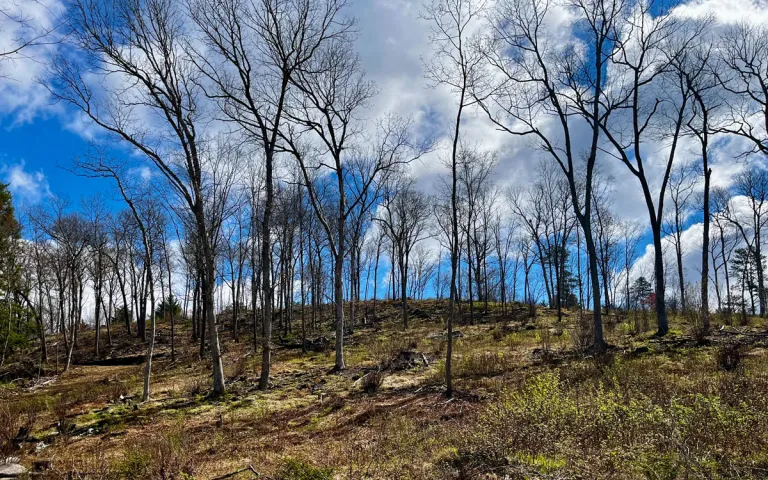
A Norcross site one year after a prescribed fire. | Photo by Liz Mirabelli Nye
Trial by fire
On a brisk morning in early May, I traveled to Wales, Massachusetts, and met Dan Wilder, the director of applied ecology at Norcross Wildlife Foundation. He strapped tick gaiters over his field pants and led us across an open, hilly landscape. With few trees, the sky stretched overhead.
“The diversity really comes in the understory,” Wilder said. Low-bush blueberry blanketed the ground, interrupted by sedges and the charred remains of branches and stumps. Norcross manages roughly 8,000 acres and held its first burn last spring on a 28-acre section of its land.
“These ecosystems are extremely resilient,” Wilder said. “As long as we don’t put a parking lot on them.” As we walked, uncommon, fire-adapted plants demonstrated his point. We found bird’s foot violet, a delicate perennial with dark-green foliage shaped like the splayed foot of a sparrow. Soon, we stumbled across something that made Wilder stop. It was a rare honeysuckle he’d only seen once before—not at Norcross but at a large-scale barrens restoration site that serves as his inspiration for restoring the ecosystems.
About 30 miles north is the Muddy Brook Wildlife Management Area. In 2004, Buelow and the MassWildlife team identified parts of Muddy Brook as cryptic barrens. It had the right soil and indicator species, including pitch pine. Muddy Brook’s evolution in the decades since demonstrates the power of regular fire to re-engage dormant seed banks and revive pine-oak barren communities.
Researchers spent 10 years cataloging Muddy Brook’s plants and animals before the first burn in 2015. They recorded seven state-listed endangered species. Last year, Buelow reported 20. MassWildlife’s recent surveys also documented the return of 50 disturbance-adapted plant species, a whopping 1,500 species of moths, and 179 different native bees, including the Macropis cuckoo bee, a species so rare it was thought to be globally extinct. Much to the delight of local birders, the Muddy Brook barrens also saw the return of eastern whippoorwill after a 30-year absence.
“It's a species that we joke follows me around,” Buelow said. “Every project I do now has whippoorwill in it.”
Restoring Indigenous knowledge in modern New England
Despite the proven payoff, resurrecting prescribed fires in New England is no easy task. Indigenous people have worked with fire for millennia, rejuvenating and managing landscapes. While prescribed fires are relatively commonplace in the western United States, Northeast practitioners are still building the trust needed to get the work done. In populous states, such as Massachusetts, permits, smoke plans, and liability insurance mitigate risk, but until neighbors experience a safe burn, they’re often skeptical.
Another big barrier to expanding prescribed fire is not enough people power. Most organizations don’t have trained practitioners in-house, so burn crews are assembled collaboratively. It’s not unheard of that fires get delayed if skilled staff become unavailable on burn day. Prescribed fire is not a new technique, but as Wilder explains, “It’s new for many people, and it’s not one you can pick up in a day.”
MassWildlife has 45 staff trained for prescribed burns. A typical burn crew consists of up to two dozen people, as well as staff from other organizations, trainees, and volunteers. The agency currently works with the National Park Service, US Fish and Wildlife Service, Mashpee Wampanoag Tribe, Hassanamisco Band of Nipmuc, private fire management companies, and numerous other conservation organizations, as well as wildland fire partners across state boundaries.
“Managing fire-influenced ecosystems at landscape scale requires collaboration, partnership, outreach, and innovative funding strategies,” said Caren Caljouw, MassWildlife’s prescribed fire program manager.
Turning science into practice
Last year, MassWildlife and its partner organizations conducted 62 burns across 2,500 acres in the state. Caljouw expects these numbers to grow over time, especially as partners continue to collaborate. At Norcross, Wilder is planning for the next burn, a roughly 200-acre site intended for 2028. Meanwhile, he hopes to build a fire consortium in the Northeast, a network he envisions for smaller organizations working with similar landscapes, challenges, and opportunities.
At the state level, Buelow is formalizing a conservation plan for these imperiled ecosystems. When he started in the field over two decades ago, he and his colleagues had no reference community to build from. With each fire and each restoration project, capacities grow. So does the comfort of neighbors and communities. People near burn sites used to call Buelow only with complaints or concerns. Now he gets people asking why he isn’t burning more, a sign that public perception of fire is changing.
Next, experts hope the wider public will come to realize that restoration is not just about individual barrens—or even individual species. It’s about creating a constellation of sustainable, healthy habitats that support vulnerable plants and animals and promote resilience across the region.
“We're maintaining these nodes of biodiversity now,” Buelow said, “so future generations have something to work with.”