Zombie Fires Are Taking Over the North
How overwintering fires are changing the landscape in boreal Alaska and the Northwest Territories of Canada
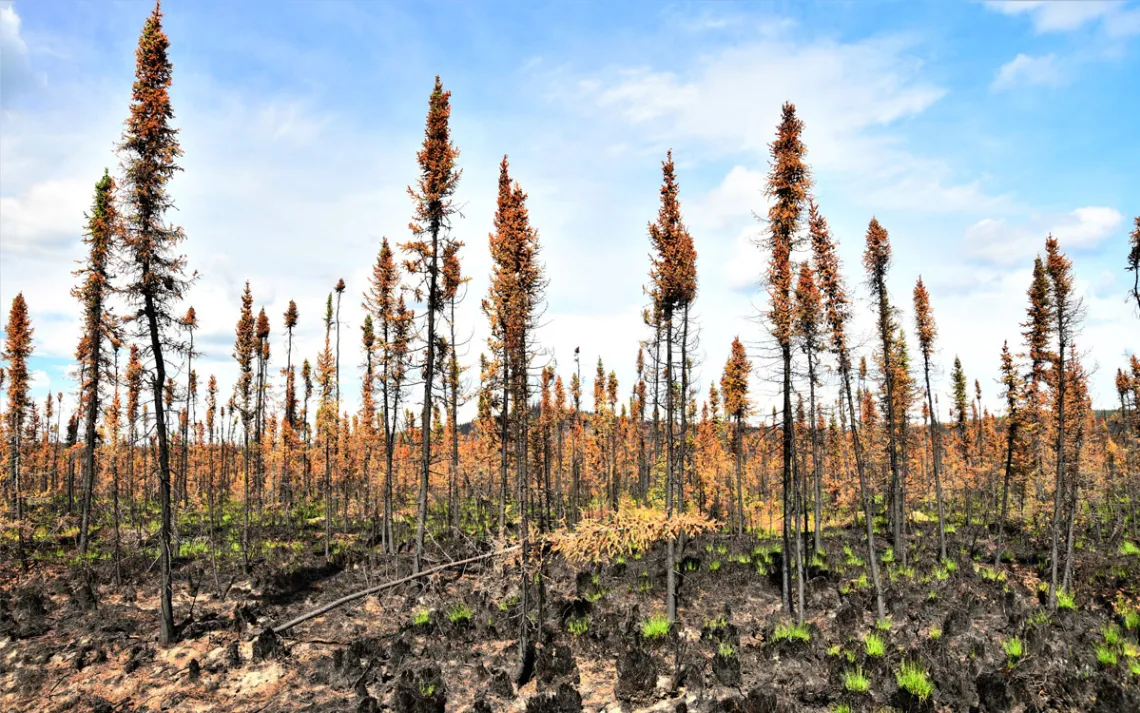
Lush green grass grows among damaged spruce and other trees along the Trans-Canada Highway, Canada. | Photo courtesy of jtstewartphoto/iStockphoto
Winter usually offers a reprieve from the fire season. However, scientists have noted an uptick in a very specific type of fire as climate change alters the northern reaches of our planet in unrecognizable ways. Zombie fires are not a new phenomenon, but researchers in Alaska and the Northwest Territories of Canada have found that with hotter summers and blazing wildfires, fire has the potential to lie dormant in dry undergrowth, even under snow. When the next summer rolls around, with dry conditions, those fires can reemerge.
Jennifer Baltzer is a Canada Research Chair, a prestigious title given to professors at Canadian universities, in Forests and Global Change. And her team originally thought that only peatlands, with their deep peat soil ideal for combustion, could harbor zombie fires. But, when the team visited 20 sites across the boreal forests, they found that overwintering fires could be supported across the boreal landscape, creeping into upland forests. In the aftermath of the 2014 fire season, Baltzer's research created the first-ever field study of overwintering fires.
In 2023, over 17 million hectares (over 40 million acres) burned across Canada, four times the area burned in 2014. After this record fire year, Western Canada also had the highest frequency of overwintering fires it had ever seen—around 150 zombie fires across the country. In the past, the majority of fires were caused by humans or lightning strikes. Now, overwintering fires have become a larger part of the equation.
“All three of these ignition sources are projected to increase in the coming decades. Zombie fires have always been a part of the system, but not as a frequent ignition source,” Merritt Turetsky, an ecosystem ecologist at the University of Colorado Boulder, said. “That's my concern for the future—that we are going to have all three types of ignitions cranking up to a higher frequency than we’ve ever seen before.”
The increase in overwintering fires has a huge impact on already vulnerable communities. In 2024, more than 3,000 residents in and around Fort Nelson, British Columbia, were evacuated as wildfires approached the town. That fire was spurred by what some believe were zombie fires from 2023. At least two major fires from that year, the Nogah Creek and Patry Creek Fires, are believed to have gone dormant, as some of the residents reported seeing smoke coming up from the snow throughout the winter.
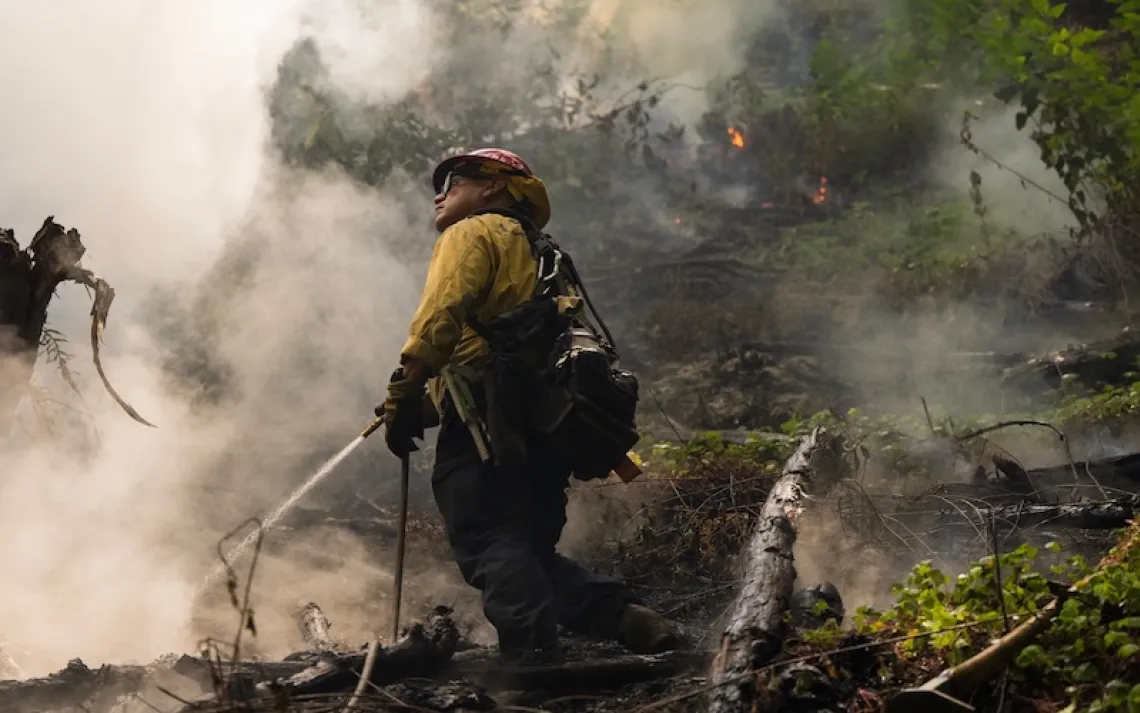
Along with being a heavy mental burden for community members, zombie fires, also called “sleeper fires,” are a logistical nightmare for fire managers. These fires can create incredibly unsafe terrain for fire managers to work in, while also extending the fire season, leaving areas vulnerable at a time when fire crews are just starting to assemble for the upcoming season.
Turetsky says that the sites of zombie fires in Alaska and the Northwest Territories of Canada were never difficult to find from the birds-eye view of the fire management helicopter. Zombie fires burn through the root systems, destabilizing the trees and leaving few standing. “We were basically flying over a sea of downed trees, like a big tsunami came and knocked every tree over,” Turetsky said.
However, the burned areas can be a hazard to work in. At some of her research sites, it wasn’t safe for the helicopter to land. Instead, Turetsky, Baltzer, and Sander Veraverbeke, an earth systems scientist, had to jump from the helicopter as it hovered above the slash pile.
“We were supposed to land, get out, and scramble over these downed trees for our research,” Turetsky said. “It was crazy.”
A new study published in the International Journal of Wildland Fire found that the vast majority of these zombie fires are within 500 meters of the perimeter of the fire from the previous season. This could lead the overwintering fires to spread into new territory, creating the chance for more large-scale wildfires that firefighters in Canada and Alaska are already struggling to contain.
“That means there is probably adjacent unburned fuel for these fires to grab onto,” Baltzer said.
Knowing where zombie fires are happening is vital for fire managers, but the researchers also aimed to understand how zombie fires impact soil carbon losses in peatlands and the regeneration of the forests they burn. Peatlands are one of the most effective ways the biosphere locks away carbon. When peatlands burn, hundreds of years of carbon is lost, turning into carbon dioxide. Even worse, when peatlands smolder, they release carbon monoxide and methane along with carbon dioxide.
Researchers also worry that an area burning two years in a row, first from the wildfire and then again from the zombie fire, could lead to forest regeneration failure. But in her research, not a single site ended up having regeneration failure. “We’re not seeing complete loss of forest resilience in the face of these overwintering fires,” Baltzer said. Instead, most sites saw a shift from conifer trees, like jack pine and black spruce, to broadleaf trees like aspen and birch.
Some scientists believe this is a climate “win” because deciduous species grow faster than conifers, allowing photosynthesis to lock up carbon in the foliage and trunks of deciduous trees more quickly than they could if conifers regrew in the burned areas. Turetsky isn’t convinced.
“From my perspective, as the bog lady, I wonder where all the legacy carbon will be stored. Not the one-to-five-to-ten-year carbon, but the legacy carbon that has survived for decades, centuries, millennia in the peatlands,” she said. “It is not in deciduous forests. It is in conifer forests and bogs.”