What Is a Forest For?
California’s demonstration state forest system may be moving toward a future of climate research and tribal stewardship
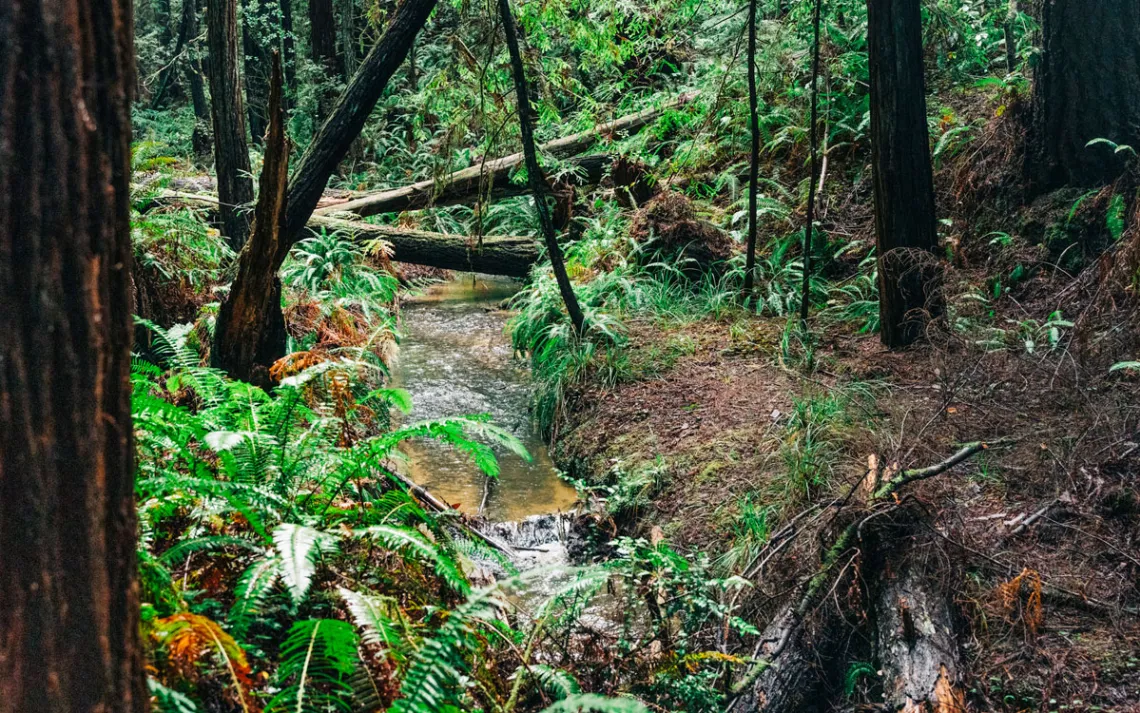
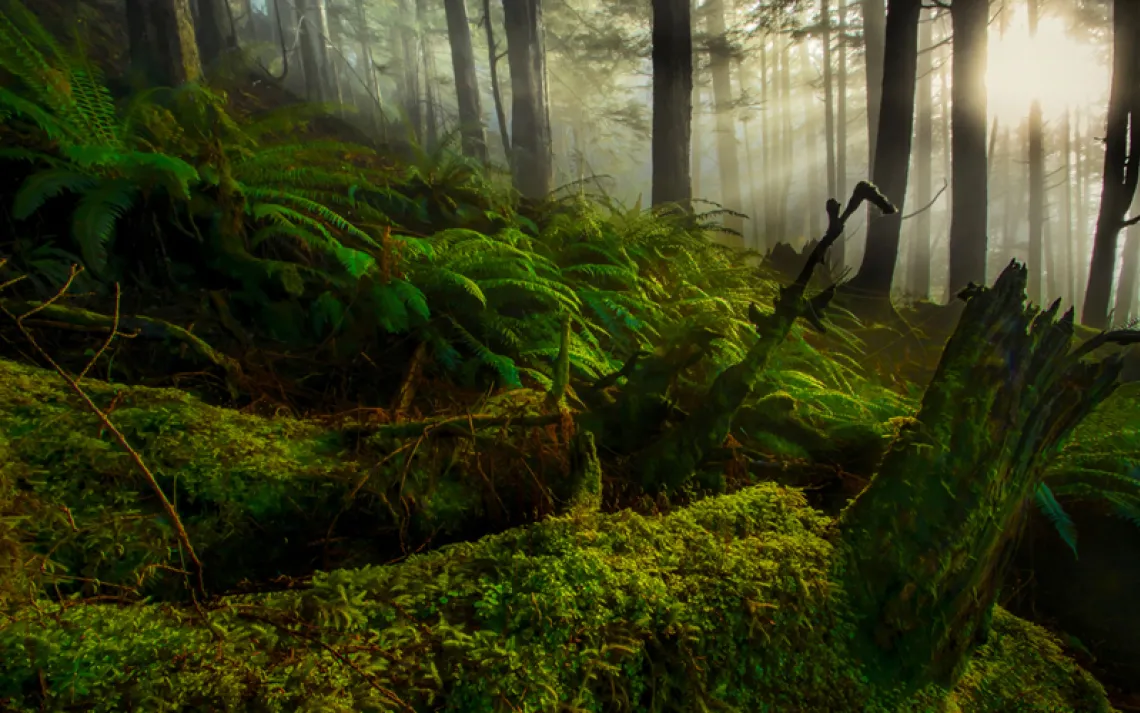
A creek in the Jackson Demonstration State Forest. | Photo courtesy of Visit Mendocino County
Buffie Campbell loves when her work takes her out among redwood trees. As a tribal citizen of the Sherwood Valley Rancheria of Pomo Indians, she is the current executive director of the Intertribal Sinkyone Wilderness Council, a coalition of tribes united to conserve Northern California’s forests. In the forest, Campbell’s thoughts turn to just how much the region’s towering redwood trees have in common with humans. People share a need for clean air, water, and networks of support with these trees, she points out. We also share resilience. “If allowed, we both can exist to be ancient and wise elders that have offspring,” she reflected.
The forest Campbell’s ancestors stewarded, which colonizers wrested from the tribes in the gold-and-lumber rush of the mid-1800s, is today known as Jackson Demonstration State Forest. Jackson’s 48,652 acres of redwoods in Mendocino County make up around half of California’s demonstration state forest system, which the state established as a kind of living laboratory in the 1940s.
Since its start, research on the forests has been historically industry oriented. In these groves of ponderosa pines, manzanitas, redwoods, and sequoias, scientists have tested how to keep forest lands thriving, at least enough to achieve maximum sustained timber production. For decades, the demonstration state forests’ prime directive has been turning cutover lands productive again by testing which types of logging practices would foster the growth of more trees to cut.
“Now we’re at a time where we have other big questions that need to be answered,” remarked Will Russell, a professor of environmental studies at San Jose State University, who focuses on how forest ecosystems respond to human and natural disturbances.
A new bill in the California State Assembly would reorder the demonstration state forest system’s priorities for the first time in 50 years. Under AB 2494, plans to log and sell timber, currently the forests’ primary purpose, would only be approved when felling trees supported research into climate change, wildfire prevention, and the growth of the forest’s wider ecosystem. Public access, recreation, education, and community use would also be elevated as core purposes of the system, in hopes that these lands could model how an economy driven by ecological restoration and community recreation might replace one fueled by extractive industry.
Chris Rogers, an assembly member who took office in 2024, authored the bill—but he isn’t the first legislator to try to modernize the law governing the demonstration state forest system. Former assembly member Wesley Chesbro nearly got a bill across the finish line 20 years ago, before it was vetoed by then-Governor Arnold Schwarzenegger.
The new bill is permissive by comparison, reflected Melodie Meyer, a conservation attorney with the Environmental Protection Information Center, who wrote the legislation with Rogers. As scientists learn more about how forests sequester carbon and survive wildfire, Meyer appreciates the evolving understanding that “a hands-off approach isn’t entirely appropriate.” She sees the new bill as opening a door for compromise between the timber industry and the environmental movement, through management methods, including thinning small trees, prescribed burning, and studying the water quality impacts of forest restoration.
“It’s not a stepping-stone to stop things like logging,” said Mark Mondragon, a retired Cal Fire firefighter for more than 30 years and vice chair of the Amah Mutsun Tribal Band, whose native lands in Santa Cruz County include the Soquel Demonstration State Forest. “It’s a stepping-stone to help us learn and educate.”
The 85,000 acres and 14 demonstration state forests the bill impacts represent only 1 percent of forested land in the state. Still, logging and forestry associations have opposed AB 2494.
For Chris Blencowe, a registered professional forester who advises people who own small parcels of forest land, it’s clear that the demonstration state forests need some kind of change. He’s a member of the Jackson Demonstration State Forest Advisory Group, known as the JAG, which guides and votes on forest plans. At public JAG meetings—sometimes, in clearings ringed by redwoods—foresters, loggers, mountain bikers, and people from the surrounding community go in circles about the forest’s future.
“There’s moments every meeting where we’re sort of bogged down,” Blencowe reflected.
That passion has a long history. Environmental uprising has run in parallel to the logging industry’s decline in Mendocino County. Many vividly remember the Redwood Summer of 1990, and residents took to tree-sitting again in 2021. That year, tensions reached a fever pitch over Caspar 500, a timber harvest plan that would have disturbed a sacred site and included felling second-growth redwoods up to four feet in diameter.
Jackson’s management has changed since the outcry. After the 2021 protests, the JAG declared that it would only review timber harvest plans that included research into climate change or wildfire prevention—even though these are technically secondary purposes under the current law. Cal Fire began revisiting Jackson’s management plan several years ahead of its 10-year-schedule. The agency also established a Tribal Advisory Council in 2023, which meets about monthly to both review timber harvest plans in development and consult on tribal goals in Jackson. (Campbell sat on the TAC when she was a member of the Sherwood Valley Rancheria Tribal Council.)
“We like a lot of the things that they have done,” Rogers said. “But it is also based on the personalities that exist in Cal Fire right now.”
Amy Wynn, a coastal planner and the current JAG chair, personally hopes that the forests can still model ways forward for private industry, should the legislation change.
“I think that it's essential that the demonstration state forest system test and figure out and show how other timberland owners, small and large, can make ends meet in a restoration economy,” she said. She joined the JAG after trying to establish a guided mountain biking service in Jackson, a venture that turned out to be prohibited under the current law.
But Jackson hasn’t modeled that financial sustainability over the past few years. Typically, the demonstration state forests are funded only by the revenue they generate from timber harvest plans—but where Jackson had been the economic heart of the system, just one timber harvest plan has been implemented in the forest since 2021. While the costs of staffing and maintaining the demonstration state forests’ operations, campgrounds, and fire safety hover around $4 million, the system as a whole has only brought in about $1 million annually in recent years.
Beginning in 2022, the California Natural Resources Agency diverted some funding to temporarily alleviate pressure to approve new timber harvest plans in Jackson. That bought several years to work out some of the growing pains of introducing tribal input and shifting operations to prioritize climate, but it’s not a long-term solution.
Advocates for AB 2494 hope the bill could be one. As originally written, the bill would have funded forest operations using some money from an existing 1 percent tax on California’s private timber sales. The bill has been referred to a Senate committee. And if it moves forward, Governor Gavin Newsom could sign or veto it by September.
“We will continue to negotiate with the industry on possible funding models,” Rogers said. “And I am optimistic that we can strike a deal that locals, environmentalists, and the timber industry can get behind.”
Meyer hopes for the chance to prove how an economy centered on climate goals, wildfire prevention, and ecotourism efforts could provide more long-term stability—including for those who’ve made a living logging.
“I'm really hopeful that this … will be a lesson for the whole world, being able to transition away from these types of industries,” she said.
Meanwhile, Campbell and the intertribal council are optimistic about establishing a tribal guardianship program. “Just like redwood trees are, we are highly adaptable too,” she said. By training youths to both steward their lands and educate about the forest’s history and ecology, she hopes the forests might demonstrate what other work could be possible.