Key takeaways
- Fossil fuel debt remains embedded in public pension portfolios, with more than $19 billion in disclosed bond holdings across the 40 U.S. public pensions included in the dataset.
- Available bondholding data are significantly incomplete, with Urgewald identifying disclosed fossil fuel bond holdings for 15 of 40 pensions.
- Disclosed exposure varies substantially across funds and is not simply a function of portfolio size, but uneven data coverage means those differences may reflect some combination of actual holdings, investment practices, and data availability. The identified holdings represent a floor, rather than a complete picture of total holdings.
- Holdings underscore the need to assess whether climate commitments translate into fixed-income investment practices, particularly around financing companies pursuing fossil fuel expansion.
- Fixed income warrants greater attention in climate-risk strategies, including restrictions on new bond purchases from companies pursuing fossil fuel expansion
Bonds help finance fossil fuel expansion
Fossil fuel expansion depends on continued access to capital. Companies finance drilling, production, and infrastructure through a combination of retained earnings and external financing, including loans, revolving credit facilities, and bonds. For investors concerned with the systemic risks posed by climate change, the relevant question is therefore not simply whether or not to own fossil fuel companies, but whether their investments are helping to sustain business models that depend on continued expansion of fossil fuel assets and infrastructure.
Bonds are particularly important because they are a direct and significant source of corporate financing. When an investor purchases a newly issued bond, the proceeds go to the issuer, providing capital that can support its broader business strategy. Most corporate bonds are issued for general corporate purposes rather than tied to a specific project, meaning that purchasing them provides financing for the company’s overall business strategy, including expansion where that remains part of the strategy. Even when proceeds are earmarked for a particular purpose, such as through a green bond, capital is fungible: financing one part of a company’s balance sheet can free up resources elsewhere, including for fossil fuel expansion where that remains part of the strategy.
Therefore, as long as a company’s business strategy continues to rely on or include new fossil fuel expansion or development, providing it with new financing, regardless of the vehicle, can support that expansion either directly or indirectly, contributing to the development of long-lived high-emitting fossil fuel assets that drive carbon lock-in and exacerbate systemic climate risks.
This matters for climate risk because new fossil fuel expansion creates long-lived assets and infrastructure that can lock in emissions, increase transition risk, and make economy-wide decarbonization more difficult. For diversified, long-term investors, those consequences extend beyond any individual issuer; their portfolios are broadly exposed across the economy, making systemic climate risk impossible to avoid through diversification alone. The relevant question is therefore not simply whether to reduce exposure to fossil fuel companies, but how investment decisions can help reduce the flow of new capital supporting continued expansion—and, in turn, the accumulation of assets that deepen economy-wide climate risk.
Why targeting new capital matters most
Debt financing presents a different – and more immediately consequential – lever than traditional equity divestment. Selling an equity holding generally occurs in the secondary market: the investor transfers ownership to another market participant, while the company receives no new capital from the transaction. Divestment can have signaling, governance, and indirect market effects, including on investor demand and potentially a company’s cost of capital. But it does not, by itself, withdraw the capital the company needs to finance its next project.
New debt financing works differently. A purchase of a newly issued bond provides fresh capital directly to the issuer, linking the investment decision to the company’s capacity to finance future investment. Restricting such purchases therefore addresses a specific component of capital access: the ability to raise new debt. For investors seeking to manage systemic climate risk through capital allocation, restrictions on new financing to companies pursuing fossil fuel expansion provide a more direct mechanism for influencing future capital formation than selling existing holdings in the secondary market.
In public markets, the most direct application is to restrict purchases of newly issued bonds from fossil fuel companies that continue to pursue fossil fuel expansion. This approach targets the financing of future activity rather than simply changing who owns existing securities.
The distinction between primary and secondary markets remains important. While buying a bond in the secondary market does not provide new capital directly to the issuer, continued demand for its bonds supports a liquid market and can make it easier for the company to issue and refinance debt in the future.
Taken together, a broader restriction on new bond purchases can combine the core restriction on newly issued debt with a complementary restriction on new secondary-market purchases, while recognizing that secondary-market purchases do not themselves provide new capital to issuers. A primary-market-only restriction would still permit investors to make new secondary-market purchases of bonds issued by companies pursuing fossil fuel expansion, maintaining demand and liquidity for those securities.
Similarly, the structure of modern investment markets also means that investors need to consider both active and passive strategies when implementing these financing restrictions. The significant growth of passive investment strategies in recent decades, including in fixed income, has made index-based vehicles an important channel through which capital is allocated. Index construction can therefore have significant implications for how these policies are implemented. The new BCam Indices provide one example of how fossil-fuel-expansion criteria can be incorporated into investment-grade corporate bond benchmarks. A comprehensive approach to fossil fuel financing, therefore, also needs to account for how exposure is generated across both active and passive strategies.
What the latest data show
Our latest analysis draws on data from Urgewald’s Investing in Climate Chaos 2026, which identifies institutional investor holdings in companies on the Global Coal Exit List (GCEL), 2026 Metallurgical Coal Exit List (MCEL), and 2025 Global Oil & Gas Exit List (GOGEL). We examined 40 U.S. public pension funds, and found that both disclosed holdings and data coverage vary substantially across funds.
For the full dataset and pension-by-pension results, see the accompanying dashboard.
Available data significantly understate fossil fuel bond holdings
Of the 40 pensions analyzed, disclosed fossil fuel bond holdings were identified for 15, and bondholding data are incomplete and uneven across funds. Coverage is incomplete on two levels: no bond holdings are identified in the available data for many pensions, and even where bond holdings are identified, the available data may capture only a portion of a fund’s actual holdings. There is no way to verify from public data whether the available holdings data for any fund are complete.
Urgewald, which published the underlying data, estimates that available data may capture only 20–30% of total bond holdings. The figures should therefore be understood as a floor rather than a complete accounting of exposure. The absence of identified bond holdings does not necessarily indicate an absence of exposure; without more comprehensive data, it is difficult to distinguish funds with lower exposure from funds for which less complete data are available.
Concentration among disclosed bond holdings
Across the 40 funds, Urgewald captured $19.4 billion in disclosed fossil fuel bond holdings. The disclosed bond exposure is highly concentrated: the California Public Employees' Retirement System (CalPERS) accounts for approximately 49% of all disclosed fossil fuel bond holdings, while the five funds with the largest disclosed bond holdings in the dataset – CalPERS, the State of Wisconsin Investment Board, the New York State Common Retirement Fund, the Florida State Board of Administration, and the California State Teachers' Retirement System (CalSTRS) – account for approximately 81% of the total.
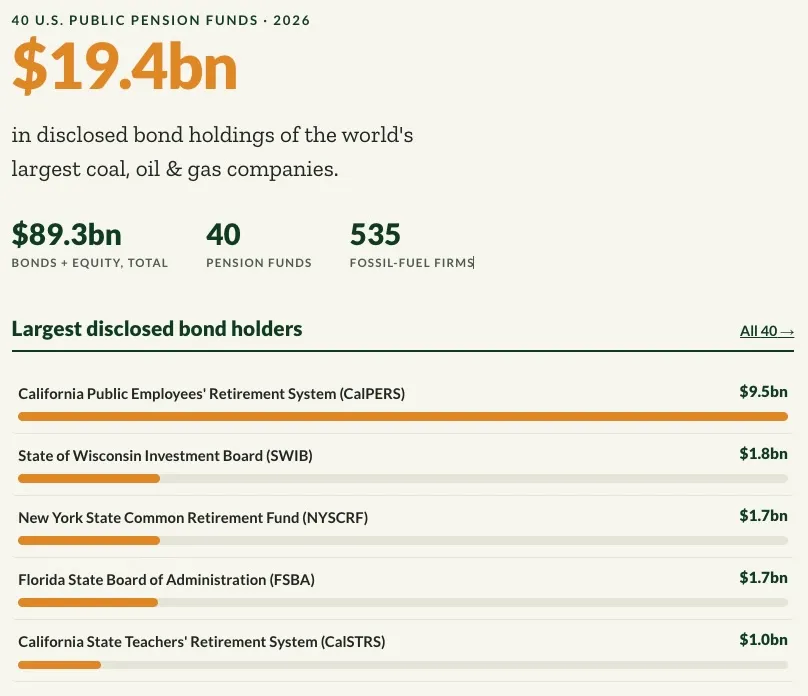
These figures should be interpreted alongside the significant gaps in bondholding data. Because coverage is incomplete and uneven, the funds appearing as the largest bondholders may reflect some combination of larger underlying exposure and more complete data coverage. The available data cannot disentangle the two. The concentration is notable, but should not be interpreted as evidence that the largest disclosed holders necessarily have the largest total fossil fuel bond exposure.
Exposure intensity varies across funds
Looking at disclosed fossil fuel exposure relative to the size of each portfolio reveals a different picture than the absolute dollar figures. The largest funds are not necessarily the most intensely exposed. Across the 40 funds, disclosed total fossil fuel holdings (combined equities and bonds) amount to approximately 2% of aggregate AUM, but disclosed exposure is considerably higher at several individual funds.
The Minnesota State Board of Investment has the highest disclosed exposure relative to AUM, at 4.41%, despite ranking only seventh by total dollars. CalPERS is unusual in standing out on both measures: it has the largest disclosed exposure, at $22.0 billion, with disclosed exposure equivalent to 3.81% of AUM. Maryland State Retirement & Pension System (3.69%), Pennsylvania Public School Employees Retirement System (3.45%), and New York State Teachers’ Retirement System (2.96%) also sit well above the aggregate ratio.
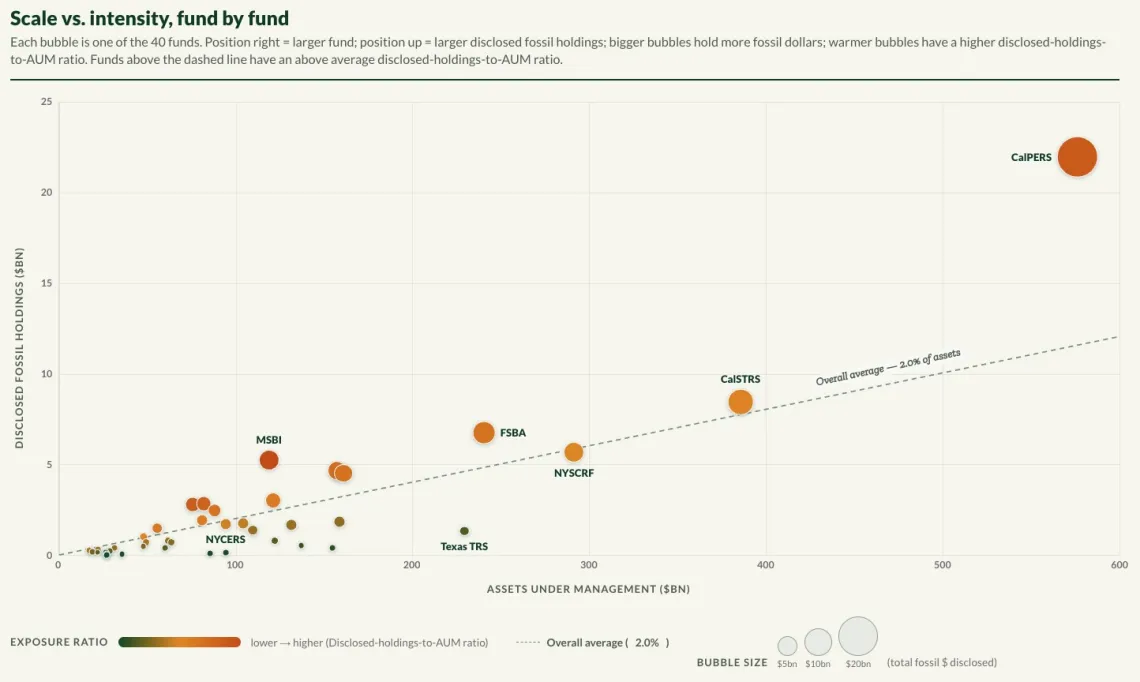
The other end of the spectrum is equally revealing. Several very large funds sit well below the aggregate ratio. The New York City Employees’ Retirement System (0.13%), Teacher Retirement System of Texas (0.58%), and University of California Retirement Plan (0.25%) all show comparatively low disclosed fossil fuel exposure relative to their portfolio size.
For The New York City Retirement Systems and the University of California funds, this lower disclosed exposure is consistent with their existing fossil fuel divestment policies, providing important context for interpreting the results. Texas TRS presents a different policy context: state law has imposed restrictions on TRS investment activity involving financial companies deemed to boycott energy companies, so its comparatively low disclosed exposure should not be interpreted as evidence of a deliberate reduction in fossil fuel investments. The holdings data alone cannot determine the reasons for these differences, which may reflect some combination of investment practices, portfolio composition, and data coverage.
This makes the exposure-intensity measure useful, but also reinforces the limits of the underlying data. A large portfolio can have relatively little disclosed fossil fuel exposure as a share of AUM, while a smaller fund can have substantially higher disclosed exposure relative to AUM. At the same time, incomplete data coverage could make some funds appear less exposed than they actually are. The variation across funds is meaningful, but the ratios should be read as a picture of disclosed exposure—not as a complete measure of actual fossil fuel exposure or climate-policy performance.
What bond holdings show about pension climate action
Investor climate frameworks increasingly recognize that climate change presents material risks to long-term portfolios. Yet not enough attention is paid to how investment decisions themselves can influence the underlying drivers of those risks. This is particularly relevant in fixed income, where purchases of newly issued debt directly provide capital to high-emitting businesses. Fossil fuel production is not the only source of this dynamic, but it is a particularly clear example given the scientific consensus that new fossil fuel expansion is inconsistent with limiting warming to global climate goals.
The holdings data do not establish whether a particular bond was purchased at issuance, when it provided new capital directly to the company, or subsequently in the secondary market. They nevertheless show that fossil fuel debt remains embedded in public pension portfolios.
That matters for climate-risk management. Primary market purchases directly provide new financing, while continued demand for outstanding debt supports liquidity and the broader market for that financing, with potential implications for companies’ ability to refinance and access debt markets over time. Where investment policies do not distinguish between, or place restrictions on, these forms of exposure, investors may continue to participate in fossil fuel debt markets even where their broader climate policies seek to reduce climate-related financial risks.
The data are not sufficient to determine whether individual pensions have a gap between their stated climate commitments and their fixed-income investments. Data coverage varies too widely, and the holdings data do not capture the underlying investment decision or the terms under which securities were purchased.
What they do demonstrate is the importance of looking beyond high-level climate commitments to how those commitments are implemented across asset classes. A pension may have a climate policy, portfolio emissions target, or other risk-management framework while still maintaining substantial exposure to the debt of companies pursuing activities that contribute to systemic climate risk.
This points to a broader consideration for investors: managing climate risk may require more asset-class-specific approaches to capital allocation. Fixed income presents distinct mechanisms through which investment decisions can affect corporate financing, and therefore may require tools and expectations that differ from those applied to equities. More complete and consistent disclosure of fixed-income holdings is an important first step in understanding where these exposures exist and assessing whether investment practices are aligned with a pension’s broader approach to climate-risk management.
Recommendations for pensions to mitigate climate risk through fixed-income strategy
As the climate crisis intensifies, so do the financial risks it poses to long-term investors. For fiduciaries like public pension funds that manage intergenerational retirement savings, it is increasingly important to consider not only the near-term risk and return characteristics of individual investments, but also how investment decisions contribute to the systemic conditions that will shape portfolio performance over the long term. Investment decisions made today help shape both the economy and the financial risks of tomorrow.
Public pension funds should therefore consider how their capital allocation decisions can both help mitigate systemic climate risk and avoid reinforcing the activities that drive those risks. To manage these risks, public pension funds should:
- Restrict new bond purchases: Prohibit new purchases of bonds from companies expanding fossil fuel production or infrastructure, in both primary and secondary markets, and incorporate these criteria into fixed-income investment guidelines and manager mandates.
- Phase down existing exposure: Establish a plan to reduce existing bond holdings in companies continuing fossil fuel expansion, taking into account maturities, liquidity, and portfolio constraints. This should complement, not substitute for, restrictions on new primary-market financing.
- Address indirect exposure: Apply these expectations to external managers and assess fossil fuel bond exposure through index funds, commingled funds, and other pooled vehicles. Where existing vehicles cannot meet the financing restrictions, consider allocating a portion of fixed-income assets to strategies or indices that incorporate fossil-fuel-expansion exclusions, such as the BCam Indices. Where suitable options are not yet available, work with managers and index providers to develop additional suitable strategies that can meet the restrictions.
- Increase transparency: Publicly disclose fossil fuel bond holdings, including indirect exposure, and report on implementation of the pension’s fossil fuel financing restrictions.
- Integrate into climate-risk management: Incorporate fossil fuel bond exposure and financing into the pension’s broader framework for managing climate-related financial risks. Ensure that resulting restrictions and eligibility rules govern fixed-income investment and manager decisions.