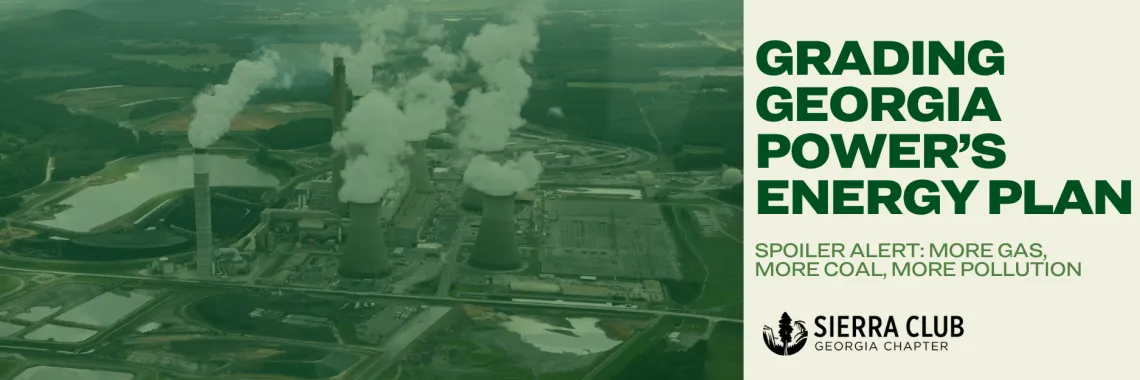
Every three years, Georgia Power revises its plan for how it will provide power to its 2.7 million-plus customers over the next 20 years. It’s called an “Integrated Resource Plan,” or IRP for short. The plan forecasts how much electricity Georgia Power will need over the next two decades and where it plans to get it. It’s an important document because it determines whether Georgia will be powered by clean, renewable sources or from dirty fossil fuels like coal and fracked gas.
Before Georgia Power can move forward with its plan, it must be approved by the Georgia Public Service Commission (PSC), a group of five elected officials responsible for regulating utilities in Georgia, including electric, gas, and telecommunications services. Georgia Power’s IRP was due for an update this year, and the PSC unanimously approved a final version of the plan in July after months of public hearings.
Toplines of the 2025 IRP
Over the next two decades, Georgia Power is forecasting a massive increase in demand for electricity, about 8,500 MW. For context, Georgia Power’s current total capacity is about 14,000 MW. Nearly all of this demand, about 90%, is coming from new power-intensive data centers.
To meet the demand, Georgia Power plans to expand its use of fossil fuels. Coal plants that were planned to retire will instead keep operating. New gas turbines will be built at multiple plants in Georgia. The plan calls for no new solar power infrastructure in Georgia while also imposing arbitrary caps on clean energy. For context, Georgia Power’s energy mix in 2023 was made up of 46% gas/oil, 25% nuclear, 16% coal, 7% renewables.
The Sierra Club evaluated Georgia Power’s initial IRP filing in March (check out our initial grades here) and determined it was insufficient to meet the moment. Several other consumer and environmental groups spoke out against the IRP for its failure to help Georgia ratepayers struggling to pay their bills. Unfortunately, the final version approved by the PSC is nearly identical to the initial filing with a few small differences, which we discuss below.
Commitment to Climate Action
Final Grade: F
What’s in the plan:
- If Georgia Power follows through on all the proposals in the PSC-approved IRP, the utility would be one of the top greenhouse gas emitters in the U.S. The approved IRP includes plans to build more methane-gas burning turbines at multiple power plants in Georgia. It extends the life of coal burning plants that were planned to be retired. Georgia Power’s plan does not include building any clean energy infrastructure in the state.
Why it matters:
- This plan moves us backwards in our fight against climate change. From wildfires due to drought to more powerful hurricanes, the impacts of climate change are already being felt in Georgia. The IRP was a chance for Georgia Power to address climate change, and it failed to do so.
Ditch Coal
Final Grade: F
What’s in the plan:
- Despite previously planning to retire them because they were no longer economical, Plant Bowen, near Cartersville, and Plant Scherer, just outside Macon, will now continue operation well into the 2030s. Georgia Power will also import fossil-fuel generated electricity from Alabama and Mississippi. This “power purchase agreement” will also keep these plants in our neighboring states online longer than previously planned.
Why it matters:
- Keeping these plants operational pollutes our environment and our communities. Air pollution from these plants can cause asthma, strokes, and heart attacks. Toxic coal ash, left behind after burning coal, is stored in large pits that lead to dangerous substances seeping into our water. Georgia Power also admits that keeping coal plants online is expensive and not in the best interests of Georgians. Keeping these plants burning for another decade (or more!) will harm Georgians’ health and contribute to climate change.
No Methane Gas
Final Grade: F
What’s in the plan:
- Georgia Power is looking to invest in new methane gas infrastructure at Plants McIntosh, Bowen, and Scherer. The utility also wants to extend the life of Plant Gaston in Alabama, which primarily burns methane gas, and transmit the electricity to Georgia. Since the IRP was approved, Georgia Power announced that the results of its “all-source” request for new electricity will be met with new gas infrastructure:
- 2 new combined cycle turbines at Plant Bowen near Cartersville (1,482 MW)
- 2 new combined cycle turbines at Plant Wansley near Newnan (1,453 MW),
- 1 new combined cycle turbine at Plant McIntosh near Rincon (757 MW).
Why it matters:
- Methane gas is a powerful greenhouse gas with a more significant impact on climate change than carbon dioxide. To feed these new gas plants, expensive and dangerous pipelines, with their associated infrastructure like compression stations, will likely need to be built, further disrupting our communities. Additionally, since Georgia Power’s customers pay 100% of fuel costs, they will be vulnerable to the fluctuations in prices, leading to even higher power bills.
Clean, Renewable Energy
Final Grade: D-
What’s in the plan:
- Georgia Power’s approved IRP does not include plans to build any new solar infrastructure in the state. It simultaneously puts arbitrary caps in place to limit the growth of solar power. While the IRP includes plans to seek 1,000 MWs of clean energy through a “request for proposals” process, this represents less than 13% of the 8,000 MWs of new energy Georgia Power claims it will need over the next six years. Much of the remaining power the utility says it needs will come from fossil fuels.
Why it matters:
- The IRP presented Georgia Power with an opportunity to go big on clean energy to power our state. Solar power is the cheapest source of energy on the planet, and Georgia has a growing clean energy economy, including the largest solar panel manufacturer in the country. Despite these obvious benefits, Georgia Power plans to increase our reliance on fossil fuels. Is Georgia Power unconcerned about the impacts of climate change because it makes more money when temperatures are higher than average? Given Georgia Power’s decision making, it's a valid question that needs to be asked.
Energy Burden and Equity
Final Grade: F
What’s in the plan:
- Energy burden is the percentage of a household’s income that is spent on electricity, methane gas, and other household fuels. Georgia residents face some of the highest bills in the nation, and Black households face disproportionately high energy burdens. Georgia Power’s approved IRP does not address or even acknowledge these facts.
Why it matters:
- Residential power bills in Georgia have gone up dramatically in recent years. Georgia Power customers have seen six bill increases, about $500 more a year, since 2023. Some of those increases are due to higher than anticipated fuel costs, and since Georgia Power plans to increase our fossil fuel use, we’re likely to see additional increases for fuel costs in the coming years. Meanwhile, Southern Company brought in $4.4 billion in profit last year.
Pollution
Final Grade: F
What’s in the plan:
- Georgia Power has decided to cancel planned retirements of coal plants that were scheduled to be shut down. It plans to expand operations at multiple methane gas burning plants. The end result of these actions will be poor air quality and more dangerous coal ash waste.
Why it matters:
- There is close to 100 million tons of toxic coal ash stored in pits across Georgia, most of them near major rivers or other bodies of water. Coal ash’s impact can be particularly felt in communities like Juliette, where residents recently settled multiple lawsuits with Georgia Power over whether this pollution was harming their health. Coal ash has been found to contain substances that can increase the risks for cancer, heart disease, and stroke, and can inflict permanent brain damage on children. Air pollution near these coal and gas plants will get worse and harm the health of nearby communities.
More Information
Q: How does this compare to previous IRPs?
It's worse. The Sierra Club identified many areas of concern in Georgia Power’s 2022 IRP and graded it accordingly. There were some bright spots in the 2022 IRP, including plans to retire multiple coal plants. Unfortunately, this year’s IRP breaks those retirement commitments, proposes building more fossil fuel infrastructure, and contains shockingly little clean energy, which is why this year’s grades are so much lower compared to 2022.
Q: Why is the IRP so important?
Georgia Power’s IRP is the blueprint and roadmap for our state’s energy future and how we’ll get there. The IRP process is one of the few ways the public can interact with and impact that roadmap.
Q: What do data centers have to do with the IRP?
Data centers are causing a boom for energy providers across the nation because of the massive amounts of energy they require. Atlanta is one of the top data center markets in the U.S., and Georgia Power is making several bad choices in the name of powering these data centers, including keeping coal plants online past their planned retirement.
Q: What is “energy burden?”
Energy burden is the percentage of a household’s income that is spent on electricity, methane gas, and other household fuels.