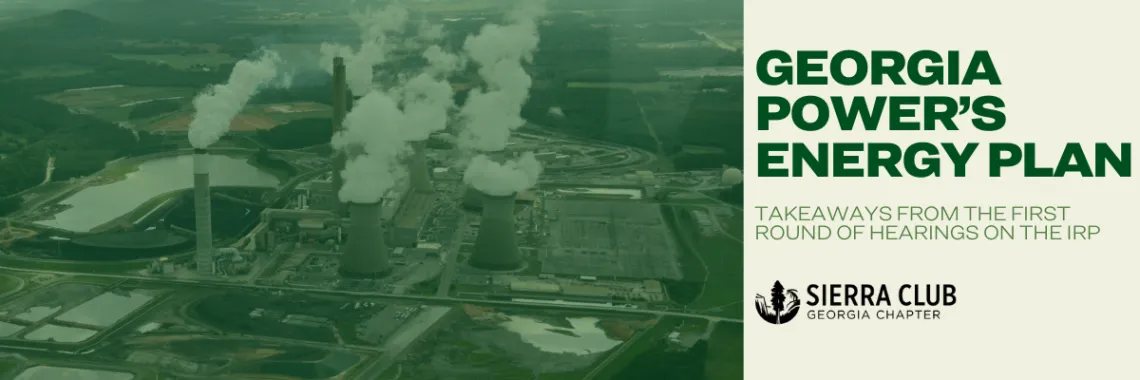
At the end of March, the Georgia Public Service Commission (PSC) held its first round of hearings about Georgia Power’s long-term energy plan, also known as its integrated resource plan or IRP.
The IRP outlines how Georgia Power will generate the electricity it will sell to its customers for the next 20 years, including whether that electricity comes from clean, renewable sources or from dirty fossil fuels like coal and fracked gas.
The PSC — a five-member elected governmental body responsible for regulating utilities in Georgia, including electric, gas, and telecommunications services — is tasked with reviewing the IRP proposal, potentially making changes, and ultimately voting whether or not to approve it.
March’s hearings were centered on Georgia Power’s direct testimony. The utility assembled three panels of experts to defend the IRP’s assumptions, conclusions, and environmental compliance strategy, and outside parties who have intervened in the IRP process, like the Sierra Club, were given time to ask questions of the panels.
Here are our three key takeaways from the first round of IRP hearings, plus one thing to look out for when the second round of hearings take place May 27-30.
1. Georgia Power’s own analysts confirm most of the electricity demand is still being driven by data centers.
During the hearings, Georgia Power’s witnesses admitted that 80% of the large load growth (and their corresponding need to get new resources and keep old coal units online) is driven by data centers. This fact was first revealed during last year’s “off-year” IRP, and during this year’s hearings, the utility confirmed that the 80% figure is still accurate.
Why does this matter? The growth in electricity demand from data centers is so massive that Georgia Power is backing away from planned retirements of coal-burning power plants in order to meet that demand. This will result in more pollution in the air, more toxic coal ash to dispose of, and more health problems in our communities.
Earlier this year, the PSC passed a new rule that allows Georgia Power to charge large-load customers, like data centers, higher rates and require that they pay for transmission and distribution costs. Whether the PSC follows through on this requirement is one of the main things we’ll be watching as the IRP proceedings continue and as the Georgia Power rate case, through which the PSC will determine how much we pay for electricity, later this year.
2. Georgia Power doesn’t care that they are killing the climate goals of its large load customers (or their own).
Many companies that are building data centers in Georgia have ambitious climate goals. Microsoft aims to be carbon negative by 2030. Google has a goal to reach net-zero carbon emissions by 2030. Amazon’s target is net-zero carbon emissions by 2040. These goals will be seriously hampered by Georgia Power’s plan to meet their electricity needs using coal and methane gas as fuel.
During the first round of IRP hearings, Georgia Power’s witnesses said they were aware of the clean energy goals of their large-load customers. Furthermore, the witnesses said Georgia Power has informed these companies of their plans to keep coal plants online and burn methane gas to serve them, and the large-load customers have not objected.
Having climate goals is a good thing, but they are worthless if companies are not taking the necessary steps to meet them. For example, Microsoft has plans for a $1.8 billion data center in Union City that will be larger than the Mall of Georgia. It will be built in phases that will come online through 2032. If this massive data center is being powered by coal plants, it’s difficult to see how Microsoft will become “carbon negative” by 2030 (which is only five years away!).
Georgia Power’s IRP proposal also effectively ends the utility’s OWN PLAN to transition to clean energy. Southern Company, Georgia Power’s parent company, has a goal of net zero carbon emissions by 2050. Given the dependence on fossil fuels in the 2025 IRP, it is increasingly unlikely that Southern Company will be able to meet that goal.
3. Georgia Power has a massive expansion of methane gas planned, but doesn’t want to talk about it.
As part of the 2022 IRP, Georgia Power agreed to put out a “request for proposals,” or RFP, from third parties to sell electricity to the utility. It was an “all-source” RFP, meaning companies sourcing electricity from fossil fuels, solar panels, or any other source were eligible to put in a bid.
Now, three years later, we’re getting a clearer picture of how Georgia Power sees that RFP process playing out. Last month, Georgia Power filed for air quality permits from the Georgia Environmental Protection Division (EPD) seeking approval to build four new methane-gas powered turbines at Plant Bowen, a coal plant just outside Cartersville. The amount of electricity these new units will provide was redacted, as were several other important details.
When questioned about this during the IRP hearings, Georgia Power witnesses admitted that these new turbines would generate about 2,800 megawatts but provided little additional information. Their rationale for keeping the public in the dark about these details? The RFP from 2022 hasn’t officially closed yet, and if Georgia Power releases info about the costs/capacity/timeline for these proposed Plant Bowen turbines, it may impact bids from third parties. Georgia Power witnesses said the utility had to file for those air permits because they take a long time to get approved, and if the Plant Bowen turbines “win” the RFP, it needs to have the permits in hand so construction can start immediately.
So, to sum up: Georgia Power put out an “all-source” RFP seeking bids from any and all interested parties using any source of electricity, and seems to be close to concluding that the best proposal is from Georgia Power itself and will include a massive expansion of methane gas.
In the meantime, intervenors, and ratepayers (not to mention the PSC and its staff!) are kept in the dark about exactly which resources will end up forming Georgia’s energy mix in the future, which is what the IRP is meant to be about in the first place.
What's next?
During the May 27-30 hearings, the PSC will hear from commission staff and those that have intervened in the process, including the Sierra Club. We expect both staff and interveners will push back against Georgia Power’s plans to keep coal online for longer, challenge the electricity demand projections in the utility’s proposal, and attempt to find out more about gas turbines proposed for Plant Bowen.
If these issues are important to you and you want the PSC to know how their constituents feel, click here to send them a message.