Update: A number of bills were sidelined by the legislative funnel and will not be moving forward this legislative session. They are SF92, SF225, SF239, SF74, SF95, SF136, SF228, SF224, and SF229 - all of them were introduced in the Senate. The House bills remain active.
Carbon Dioxide Pipeline Legislation
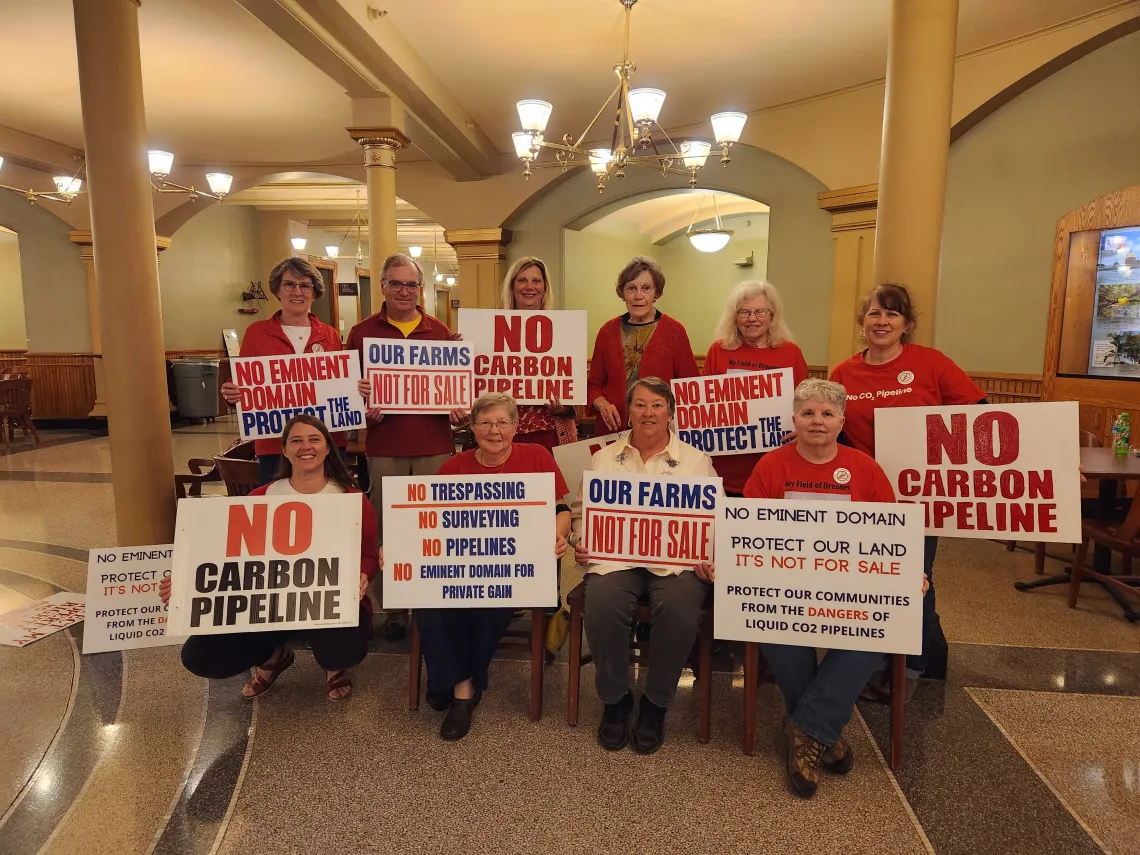
It’s time for the Iowa Legislature to pass a bill to protect Iowans from Summit’s proposed carbon pipeline! We need your help contacting our State Legislators to make sure they pass protective legislation this session. Several bills have already been introduced.
SF92 and HSB287 - Bans Eminent Domain on Agricultural Land for the construction of a hazardous liquid pipeline. The bill states that the construction of hazardous liquid pipelines for the transmission of liquified carbon dioxide is not a public use, public purpose, or public improvement for purposes of condemnation of agricultural land by a utility. The Sierra Club supports SF92.
- Ask the members of the Senate Commerce subcommittee to support SF92. Their email addresses are scott.webster@legis.iowa.gov , annette.sweeney@legis.iowa.gov , zach.wahls@legis.iowa.gov
- Ask your member of the Iowa Senate to support SF92. To look up your senate member, see www.legis.iowa.gov/legislators/senate or to Find your legislator
- Ask your member of the Iowa House to support HSB287. To look up your House member, see www.legis.iowa.gov/legislators/house or to Find your legislator
HF780 (formerly HF238) and SF225 - If the Utilities Commission grants a carbon dioxide pipeline permit, the permit is limited to 25 years and cannot be renewed. The Sierra Club supports HF780 and SF225.
- Ask the members of the Senate Commerce subcommittee to support SF225. Their email addresses are mike.bousselot@legis.iowa.gov , matt.blake@legis.iowa.gov , scott.webster@legis.iowa.gov
- Ask your member of the Iowa Senate to support SF225. To look up your senate member, see www.legis.iowa.gov/legislators/senate or to Find your legislator
- This is ready for floor debate in the House. Ask your member of the Iowa House to support HF780. To look up your House member, see www.legis.iowa.gov/legislators/house or to Find your legislator
HF639 (formerly HF240) and SF239 - Requires that an applicant for a permit for a hazardous liquid pipeline have insurance to cover losses and injury resulting from the construction of the pipeline and any discharge from the pipeline. The insurance must also cover any person's increased insurance costs or the person's inability to obtain insurance due to the presence of the pipeline. The Sierra Club supports HF639 and SF239.
- This is ready for floor debate. Ask your member of the Iowa House to support HF639. To look up your House member, see www.legis.iowa.gov/legislators/house or to Find your legislator
- Ask the members of the Senate Commerce subcommittee to support SF239. Their email addresses are mike.bousselot@legis.iowa.gov , matt.blake@legis.iowa.gov , kerry.gruenhagen@legis.iowa.gov
- Ask your member of the Iowa Senate to support SF239. To look up your senate member, see www.legis.iowa.gov/legislators/senate or to Find your legislator
SF74 - Repeals Iowa’s survey law. Under current law, after the Utilities Commission conducts informational meetings, the pipeline company is allowed to enter the private property of a landowner in the route of the pipeline without the owner's consent to perform surveys and examine the land, upon giving the landowner or person residing on the land 10-days written notice. This is before eminent domain is even granted. These surveys may include boring. They many include cutting down crops in order to get to a location. The surveys are not simply someone walking on the property with a tape measure. This legislation repeals the ability of the pipeline company to enter a person's private property. The Sierra Club supports SF74.
- Ask the members of the Senate Commerce subcommittee to support SF74. Their email addresses are scott.webster@legis.iowa.gov , matt.blake@legis.iowa.gov , annette.sweeney@legis.iowa.gov
- Ask your member of the Iowa Senate to support SF74. To look up your senate member, see www.legis.iowa.gov/legislators/senate or to Find your legislator
SF95 - Defines Common Carrier. The common carrier issue is important because if the pipeline company is considered a common carrier, the pipeline company gets to exercise eminent domain. This bill clarifies that a carrier that transports hazardous liquid only qualifies as a common carrier if the carrier transports for one or more shippers that are unaffiliated with the carrier and the shipper will not sell the hazardous liquid to the carrier. The net effect of this change is that for a company to be granted eminent domain by the Iowa Utilities Commission, the pipeline company must prove by clear and convincing evidence that the exercise of eminent domain meets the definition of a public use, public purpose, or public improvement. The Sierra Club supports SF95.
- Ask the members of the Senate Commerce subcommittee to support SF95. Their email addresses are scott.webster@legis.iowa.gov , izaah.knox@legis.iowa.gov , annette.sweeney@legis.iowa.gov
- Ask your member of the Iowa Senate to support SF95. To look up your senate member, see www.legis.iowa.gov/legislators/senate or to Find your legislator
SF136 - The bill addresses a number of issues related to hazardous liquid pipelines. Counties would be able to establish setbacks and safety regulations; the company must release all plume modeling studies; the pipeline must be buried at least 8 feet deep; investors in the project must be disclosed; in order to qualify for eminent domain, 90% of the parcels and 90% of the total distance must be acquired through voluntary easements; landowners are given an extended period of time to recover crop yield damages; landowners can sue for crop damages and do not have to rely on the county supervisors to sue; and other provisions. The Sierra Club supports SF136.
- Ask the members of the Senate Commerce subcommittee to support SF136. Their email addresses are mike.bousselot@legis.iowa.gov , matt.blake@legis.iowa.gov , scott.webster@legis.iowa.gov
- Ask your member of the Iowa Senate to support SF136. To look up your senate member, see www.legis.iowa.gov/legislators/senate or to Find your legislator
HF302 (formerly HSB67) - Forbids the Iowa Utilities Commission to consider climate change when deciding to grant a permit to build a hazardous liquid pipeline. If a hazardous liquid pipeline company tells the Utilities Commission that its proposed pipeline will help mitigate climate change, then the Commission can consider whether the facts support that allegation as part of its decision-making. If the pipeline company is using any federal programs that deal with climate change, including the 45Q tax credits, then the use of those programs should be something that the Utilities Board should be able to consider. The Sierra Club opposes HF302.
- This has already passed through a subcommittee and committee and is ready for floor debate. Ask your member of the Iowa House to oppose HF302. To look up your House member, see www.legis.iowa.gov/legislators/house or to Find your legislator
HF237 and SF228 - Forbids the Utilities Commission to threaten or impose sanctions on intervenors in contested cases before the Iowa Utilities Commission unless they were dishonest or in violation of criminal statute or unless injury is quantifiable and exceeds $500. The Sierra Club supports HF237 and SF228.
- Ask members of the House Judiciary committee to support HF237. Their email addresses are steven.holt@legis.iowa.gov , judd.lawler@legis.iowa.gov , lindsay.james@legis.iowa.gov , ken.croken@legis.iowa.gov , jon.dunwell@legis.iowa.gov , samantha.fett@legis.iowa.gov , bill.gustoff@legis.iowa.gov , brian.lohse@legis.iowa.gov , brian.meyer@legis.iowa.gov , carter.nordman@legis.iowa.gov , rick.olson@legis.iowa.gov , jeff.shipley@legis.iowa.gov , megan.srinivas@legis.iowa.gov , henry.stone@legis.iowa.gov , mark.thompson@legis.iowa.gov , charley.thomson@legis.iowa.gov , beth.wessel-kroeschell@legis.iowa.gov , skyler.wheeler@legis.iowa.gov , ross.wilburn@legis.iowa.gov , craig.williams@legis.iowa.gov , john.wills@legis.iowa.gov
- Ask your member of the Iowa House to support HF237. To look up your House member, see www.legis.iowa.gov/legislators/house or to Find your legislator .
- Ask the members of the Senate Commerce subcommittee to support SF228. Their email addresses are mike.bousselot@legis.iowa.gov , matt.blake@legis.iowa.gov , scott.webster@legis.iowa.gov
- Ask your member of the Iowa Senate to support SF228. To look up your senate member, see www.legis.iowa.gov/legislators/senate or to Find your legislator
HF790 (formerly HF241) and SF224 require that all of the members of the Iowa Utilities Commission be present during any live testimony before the commission. If all of the members are not present, the proceedings are to be paused. It also requires that at least one member of the Iowa Utilities Commission be present at each informational meeting. If a member is not present, the meeting will be paused. During the testimony of the phase 1 of the Summit carbon dioxide pipeline hearings, there were times that only 1 of the commission members was present and there were times that only two of the members were present. That is unacceptable, especially since sworn testimony from witnesses was being taken. During the phase 2 Summit carbon dioxide pipeline informational meetings, none of the commissioners were present. That is also unacceptable.
- This is ready for a floor vote. Ask your member of the Iowa House to support HF790. To look up your House member, see www.legis.iowa.gov/legislators/house or to Find your legislator .
- Ask the members of the Senate Commerce subcommittee to support SF224. Their email addresses are mike.bousselot@legis.iowa.gov , matt.blake@legis.iowa.gov , scott.webster@legis.iowa.gov
- Ask your member of the Iowa Senate to support SF224. To look up your senate member, see www.legis.iowa.gov/legislators/senate or to Find your legislator
HF578 (formerly HF239) and SF229 restructure the Office of Consumer Advocate (OCA). It changes the OCA from being a part of the attorney generals office and makes it an independent agency. The Consumer Advocate would be appointed by the governor, from a list of three candidates. The candidates for the Consumer Advocate would be selected by the secretary of agriculture, the state auditor, and the state treasurer. The Consumer Advocate would serve for 5 years.
- This is ready for the House to vote on. Ask your member of the Iowa House to support HF578. To look up your House member, see www.legis.iowa.gov/legislators/house or to Find your legislator .
- Ask the members of the Senate Commerce subcommittee to support SF229. Their email addresses are scott.webster@legis.iowa.gov , matt.blake@legis.iowa.gov , mike.klimesh@legis.iowa.gov
- Ask your member of the Iowa Senate to support SF229 To look up your senate member, see www.legis.iowa.gov/legislators/senate or to Find your legislator